Oklahoma Academic Standards Computer Science vs. CSTA: What the Crosswalk Shows
Oklahoma Academic Standards Computer Science vs. CSTA: What the Crosswalk Shows
We recently published a unit-by-unit comparison of Texas's Computer Science TEKS against the CSTA K-12 Computer Science Standards and found that half of Texas's content had no CSTA counterpart at all. Naturally, the next question was: what does the same comparison show for Oklahoma?
The answer is a very different story — and along the way, checking every single standard by hand caught something worth knowing about even if you already trust your curriculum's standards tags.
The Headline Number
Across all 218 Oklahoma Academic Standards for Computer Science (OAS-CS) units, from Grade 1 through the Level 2 (grades 11-12) course:
- 84% (184 units) are a strong match — the same skill, at the same CSTA grade band.
- 7% (15 units) are a partial match — related, but different scope or depth.
- 5% (11 units) are a match at a different CSTA band.
- Only 4% (8 units) have no CSTA equivalent at all.
That's the opposite pattern from Texas. Oklahoma didn't write independent computer science standards and happen to overlap with CSTA in places — OAS-CS was explicitly built as a state adoption of the CSTA framework, and the numbers confirm it. If you're comparing curricula or writing a program justification, that's a meaningfully different starting point than a state whose standards only partially map to the national framework.
The Part We Didn't Expect: 29 Wrong Codes
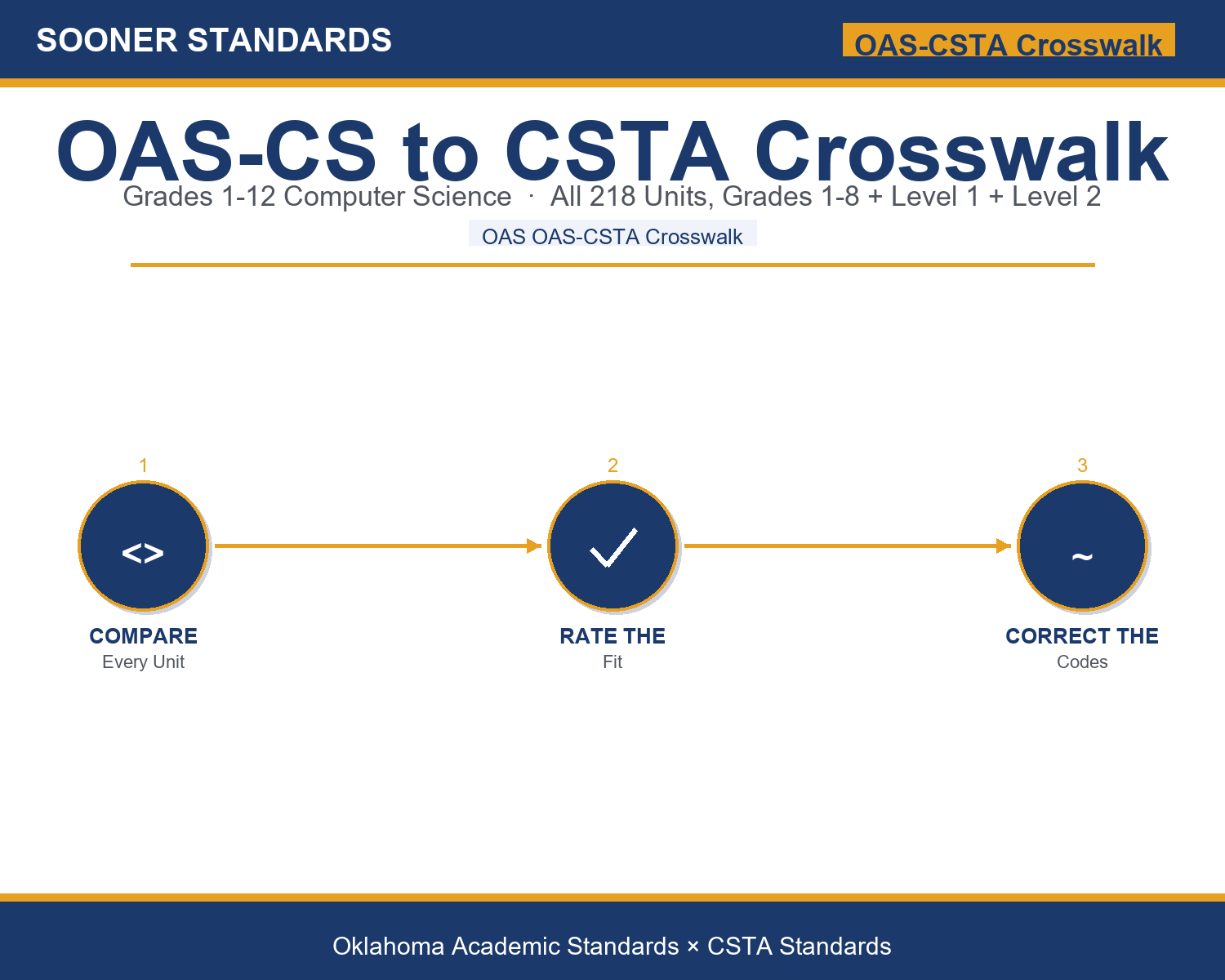
Because Oklahoma's standards already carry internal CSTA reference codes in the source curriculum materials, this crosswalk could have just extracted and reported those codes. Instead, every single one was independently re-verified against CSTA's actual standard text — and 29 of them turned out to be wrong.
The errors ranged from small to serious:
- Duplicated codes. Several standards in Grade 5 and the Level 1 (grades 9-10) course had the same CSTA code copied onto two or three different standards, when each one actually matched a different code.
- A non-existent code. One Level 1 standard was tagged "3A-AP-11" — a code that doesn't exist in the CSTA framework at all (Algorithms and Programming codes at that level start at 13).
- A category label used as a code. One standard's "code" was literally the text "Law & Ethics Strand" — a section heading, not a standard identifier.
- Wrong-band codes. Several standards were tagged with an 11th-12th-grade CSTA code when the actual best match was a 9th-10th-grade standard, or vice versa.
The grades 9-10 (Level 1) course accounted for the vast majority of this — 26 of its 31 codes needed correction. Worth noting: this wasn't a curriculum-quality problem. Once each standard's actual text was compared to CSTA independently, the content itself lined up well. The problem was entirely in how the standards had been tagged internally. The grades 11-12 (Level 2) course, by contrast, had zero errors — every one of its 20 codes was already correct.
We also found three units filed inside the Level 1 (grades 9-10) course that are, by content, Level 3B (grades 11-12) CSTA material — an artificial intelligence standard, a code-review standard, and a models-and-simulations standard. Either this is a course-folder filing issue, or the Level 1 course quietly reaches ahead into 11th/12th-grade territory in a few places.
Where Oklahoma and CSTA Diverge (A Short List)
Even with 84% strong alignment, a few real gaps showed up:
Storage location choice has no CSTA counterpart. Oklahoma teaches "choose the right storage location" (physical, cloud, shared) as its own standard in nearly every K-8 grade. CSTA has no standard, at any band, that addresses this.
CSTA drops digital etiquette and "communicate/publish data" after grade 5. This is the same structural gap we found comparing Texas's standards to CSTA — confirming it's a feature of the CSTA framework itself, not something specific to how any one state adapted it. Oklahoma, like Texas, keeps teaching both skills every year regardless.
How the Comparison Was Done
Every OAS-CS standard was read against the full text of the appropriate CSTA grade band (1A for grades K-2, 1B for grades 3-5, Level 2 for grades 6-8, Level 3A for grades 9-10, Level 3B for grades 11-12). A match was called "strong" only when both standards covered the same skill at the same depth — many turned out to be near-verbatim, which is exactly what you'd expect from a deliberate state adoption. Where an existing internal code didn't match its own standard's text, it was corrected and the reasoning shown, not silently kept.
Get the Full Crosswalk
The complete standard-by-standard table for all 218 units — OAS code, corrected CSTA code, fit rating, and a plain-English explanation for every row — is available as a printable reference guide.
Get the Complete Oklahoma OAS to CSTA Crosswalk on Teachers Pay Teachers →
This is an independently produced correlation guide. CSTA standard codes are cited as identifiers only; this article and the accompanying product do not reproduce CSTA's copyrighted standard text (CSTA K-12 CS Standards, Revised 2017, are licensed CC BY-NC-SA 4.0). Full CSTA standard text is available free at csteachers.org/k12standards. This guide is not endorsed by CSTA, the Association for Computing Machinery, or the Oklahoma State Department of Education.