Grade 5 Oklahoma Computer Science Standards vs. CSTA National Standards: The Full Comparison
Oklahoma doesn’t write its computer science standards from scratch — the Oklahoma Academic Standards for Computer Science (OAS-CS, February 2023) are built directly on top of the CSTA K-12 Computer Science Standards, the national framework maintained by the Computer Science Teachers Association. But “built on top of” doesn’t mean “copied word for word.” This post walks through exactly how Oklahoma’s 21 Grade 5 standards compare to their CSTA counterparts, standard by standard, with the full comparison available as a downloadable spreadsheet.
Download the Full Comparison Spreadsheet
Every Grade 5 OAS-CS standard, its matching CSTA code, the verbatim text of both, and a plain-language comparison note — all in one spreadsheet you can sort, filter, or print for a department meeting.
The Headline Numbers
- 21 of 21 Grade 5 OAS-CS standards trace back to the CSTA 3-5 grade band.
- 20 of 21 have a direct, one-to-one (or documented one-to-many) CSTA equivalent.
- 1 standard — 5.DA.S.01, on file storage trade-offs — has no direct CSTA match; it appears to be an Oklahoma-specific addition.
- 0 standards are copied verbatim. Oklahoma consistently rewrites the CSTA base text, most often to add grade-specific scaffolding, concrete examples, or classroom-facing language.
What “Close Match” Actually Looks Like
Take 5.AP.V.01 next to its CSTA source, 1B-AP-09:
Oklahoma (5.AP.V.01): “Create programs that use variables to store and modify grade level appropriate data.”
CSTA (1B-AP-09): “Create programs that use variables to store and modify data.”
One phrase — “grade level appropriate” — is the entire difference. That’s the pattern across most of the list: Oklahoma keeps CSTA’s cognitive demand intact but anchors it to what a fifth grader can actually do, rather than leaving the scope open-ended the way the national standard does.
A few standards go further than a light edit. 5.CS.D.01 and its source 1B-CS-01 actually shift emphasis: Oklahoma frames the skill as selecting the right computing system for a task, while CSTA’s underlying standard frames it as describing how a device’s internal and external parts form a system. Related territory, different center of gravity — Oklahoma leans toward application, CSTA toward mechanism.
The One With No National Match
5.DA.S.01 asks students to “evaluate trade-offs, including availability and quality, based on the type of file, storage requirements… and sharing requirements.” There’s no CSTA 3-5 band standard that addresses file storage trade-offs directly — the closest CSTA data-and-analysis standards focus on collecting, organizing, and visualizing data, not on storage decision-making. This looks like a genuine Oklahoma addition rather than an adaptation.
Full Standard-by-Standard Comparison
The table below is the same data as the spreadsheet, for quick reference in the browser.
| OAS-CS Code | CSTA Code | Oklahoma Standard | CSTA Standard |
|---|---|---|---|
| 5.AP.A.01 | 1B-AP-08 | Model, compare and refine multiple algorithms for the same task and determine which is the most efficient. | Compare and refine multiple algorithms for the same task and determine which is the most appropriate. |
| 5.AP.C.01 | 1B-AP-10 | Create programs using a programming language that utilize sequencing, repetition, conditionals, event handlers and variables using math operations to manipulate values to solve a problem or express ideas both independently and collaboratively. | Create programs that include sequences, events, loops, and conditionals. |
| 5.AP.M.01 | 1B-AP-11 | Decompose (break down) large problems into smaller, manageable subproblems and then into a precise sequence of instructions. | Decompose (break down) problems into smaller, manageable subproblems to facilitate the program development process. |
| 5.AP.M.02 | 1B-AP-12 | With grade appropriate complexity, modify, remix, or incorporate portions of an existing program into one’s own work, to develop something new or add more advanced features. | Modify, remix, or incorporate portions of an existing program into one’s own work, to develop something new or add more advanced features. |
| 5.AP.PD.01 | 1B-AP-13 | Use an iterative process to plan the development of a program that includes others’ perspectives and user preferences while solving simple problems. | Use an iterative process to plan the development of a computational artifact, introducing planning, testing, and refinement. |
| 5.AP.PD.02 | 1B-AP-14 | Observe intellectual property rights and give appropriate credit when creating programs using original code or code reuse. | Observe intellectual property rights and give appropriate attribution when creating or remixing programs. |
| 5.AP.PD.03 | 1B-AP-10/11/15 | Analyze, create, and debug a program that includes sequencing, repetition, conditionals, and variables in a programming language. | Create programs that use variables, conditionals, and loops, and debug them to make sure they run correctly. |
| 5.AP.PD.04 | 1B-AP-16 | Communicate and explain program development choices using comments, presentations, and demonstrations. | Describe choices made during program development using code comments, presentations, and demonstrations. |
| 5.AP.V.01 | 1B-AP-09 | Create programs that use variables to store and modify grade level appropriate data. | Create programs that use variables to store and modify data. |
| 5.CS.D.01 | 1B-CS-01 | Select and use the most efficient computing systems to perform a variety of tasks for an intended outcome while recognizing that users have different needs for the technology they use. | Describe how internal and external parts of computing devices function to form a system. |
| 5.CS.HS.01 | 1B-CS-02 | Model that information is translated into bits to transmit and process between hardware and software to accomplish tasks. | Model how computer hardware and software work together as a system to accomplish tasks. |
| 5.CS.T.01 | 1B-CS-03 | Identify, using accurate terminology, simple hardware and software problems that may occur during everyday use. Discuss problems with peers and adults, apply strategies for solving these problems, and explain why the strategy should work. | Describe basic hardware and software problems using accurate terminology. |
| 5.DA.CVT.01 | 1B-DA-06 | Organize and present collected data to highlight comparisons and support a claim. | Organize and present collected data visually to highlight relationships and support a claim. |
| 5.DA.IM.01 | 1B-DA-07 | Determine how the accuracy of conclusions is influenced by the amount of data collected. | Use data to highlight or propose cause-and-effect relationships, predict outcomes, or communicate an idea. |
| 5.DA.S.01 | No direct match | Evaluate trade-offs, including availability and quality, based on the type of file, storage requirements (e.g., file size, availability, available memory), and sharing requirements. | (No CSTA K-12 standard directly addresses file storage trade-offs at this grade band.) |
| 5.IC.CU.01 | 1B-IC-18 | Give examples and explain how computing technologies have changed the world, and express how computing technologies influence and are influenced by cultural practices within your community. | Discuss computing technologies that have changed the world, and express how they influence and are influenced by cultural practices. |
| 5.IC.CU.02 | 1B-IC-21 | Develop, test, and refine digital artifacts to improve accessibility and usability. | Develop, test, and refine digital artifacts to improve usability and accessibility. |
| 5.IC.SI.01 | 1B-IC-20 | Develop a code of conduct, explain, and practice grade-level appropriate behavior and responsibilities while participating in an online community. Identify and report inappropriate behavior. | Develop and practice a code of conduct and identify and report inappropriate behavior in online communities. |
| 5.IC.SI.02 | 1B-IC-19 | As a team, collaborate with outside resources (other grade levels, online spaces) to include different perspectives to improve computational artifacts. | Collaborate with others, including outside resources, to include diverse perspectives and improve a computational artifact. |
| 5.IC.SLE.01 | 1B-IC-21 | Observe intellectual property rights and give appropriate credit when using resources. | Observe intellectual property rights and give appropriate attribution when using resources to create artifacts. |
| 5.NI.CY.01 | 1B-NI-05 | Discuss real-world cybersecurity problems and identify strategies for how personal information can be protected. | Discuss real-world cybersecurity problems and how personal information can be protected. |
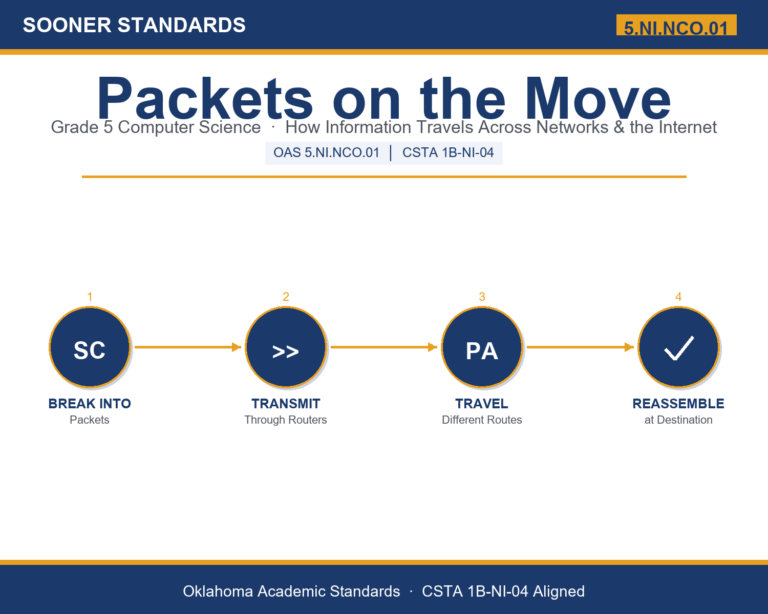
| 5.NI.NCO.01 | 1B-NI-04 | Model how information is broken down into packets (i.e., smaller pieces), transmitted through multiple devices over networks and the Internet, and reassembled at the destination. | Model how information is broken down into smaller pieces, transmitted as packets through multiple devices over networks and the Internet, and reassembled at the destination. |
Why This Matters for Oklahoma Teachers
If your district already has CSTA-aligned computer science resources, this comparison tells you exactly how much translation work is left: for 20 of 21 Grade 5 standards, a CSTA-aligned lesson is very close to Oklahoma-ready, usually needing only the grade-specific framing Oklahoma adds. For 5.DA.S.01, you’re building from scratch — there’s no national lesson bank to lean on for file storage trade-offs at this grade band.
Get the Complete Grade 5 Curriculum
See the whole year at a glance on the Grade 5 Computer Science Curriculum hub page — every standard, organized by strand.
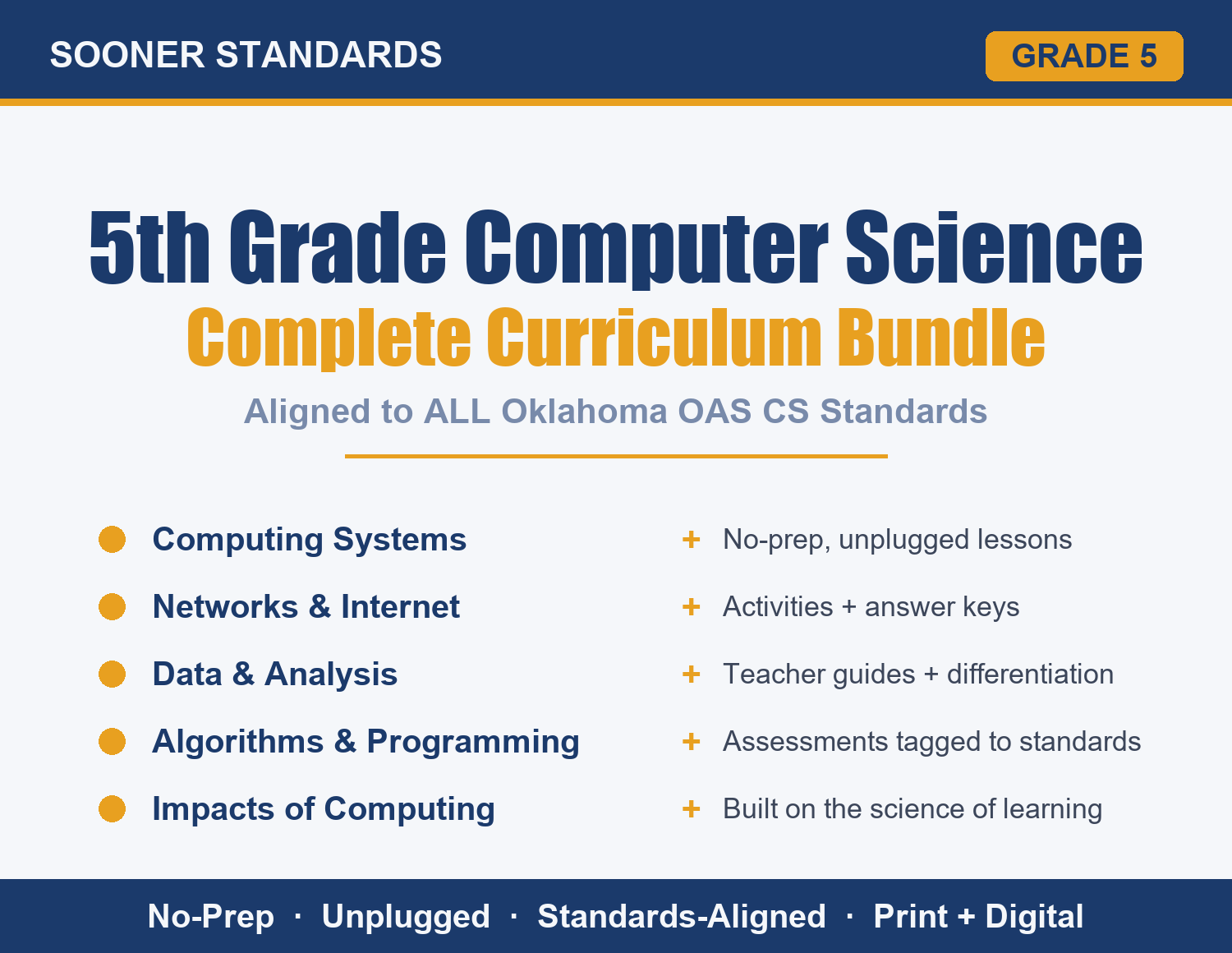
Every standard in the comparison above has a matching no-prep unit — teacher guide, activities, assessment, and answer key — built directly from the verified Oklahoma standard text. All 21 are available individually or as a complete bundle on Teachers Pay Teachers.
Every Sooner Standards resource is built directly from the official Oklahoma Academic Standards for Computer Science (February 2023) — standard text verified against the source document, never paraphrased from memory.