2nd Grade Computer Science Curriculum: Every Texas TEKS §126.3 Standard, No Prep
2nd Grade Computer Science Curriculum: Every Texas TEKS §126.3 Standard, No Prep
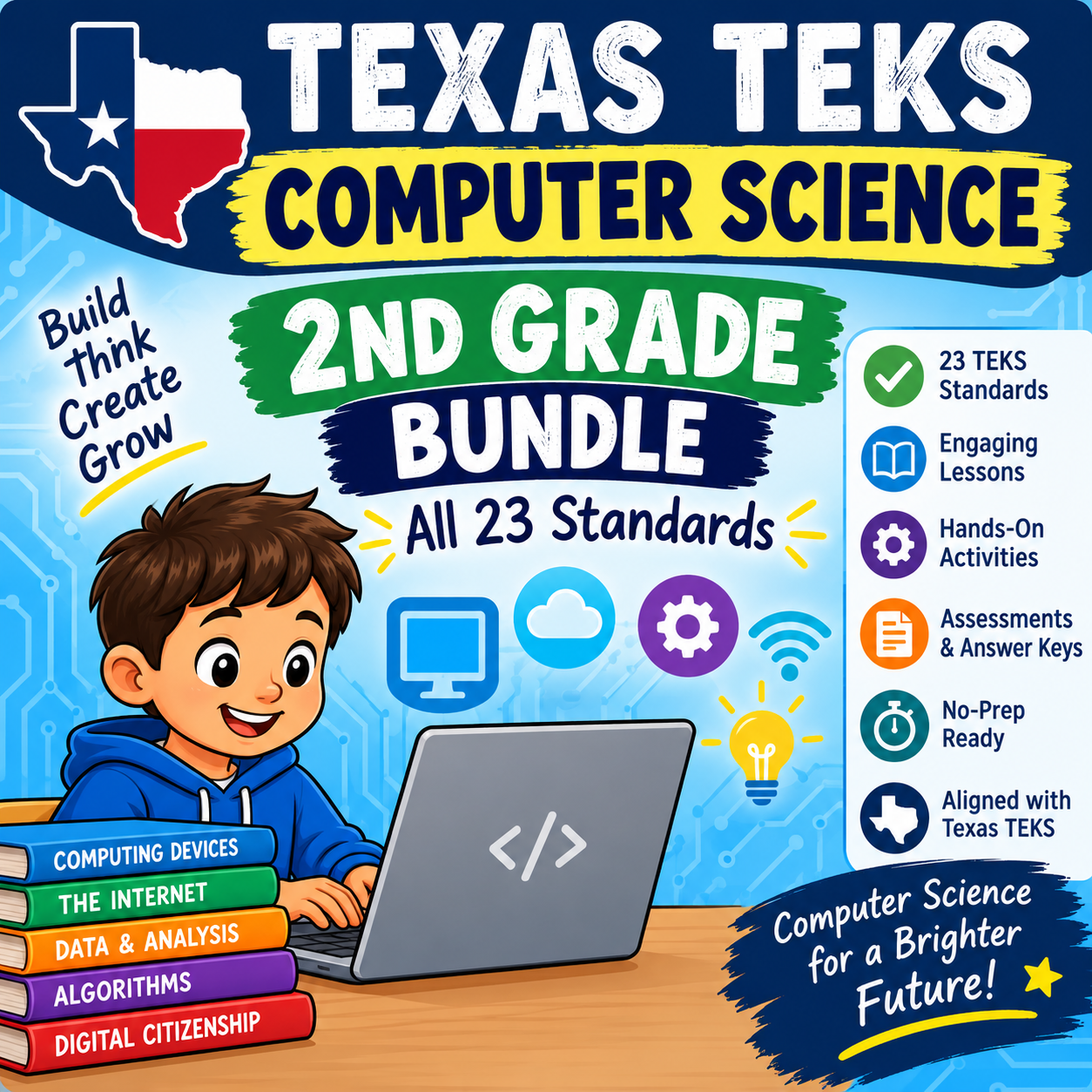
Teaching a full 2nd grade computer science curriculum in Texas is a tall order — the TEKS §126.3 Technology Applications standards span ten strands and 23 individual knowledge-and-skills statements, and few teachers have a single resource that covers all of them without stitching together products built for other states or another grade. This bundle solves that: it is a complete, no-prep 2nd grade computer science curriculum that covers every Texas TEKS §126.3 standard at grade 2, authored directly from Texas's own TEKS text — not relabeled from the Grade 3 bundle — in a format you can print and teach.
What Texas's 2nd Grade CS Standards Cover
Texas TEKS §126.3 spans ten strands:
- Computational Thinking — Foundations — turning a plan into step-by-step directions, spotting patterns and predicting what comes next, checking a plan with a helper, and building and fixing if-then plans (§126.3(c)(1)(A)–(D)).
- Computational Thinking — Applications — exploring what a variable is, and using loops to solve a simple problem (§126.3(c)(2)(A)–(B)).
- Creativity & Innovation — Innovative Design Process — the skills a builder needs, and testing, thinking about, and fixing an idea (§126.3(c)(3)(A)–(B)).
- Creativity & Innovation — Emerging Technologies — how technology helps communities (§126.3(c)(4)).
- Data Literacy — Collect Data — collecting non-numerical data, and searching with keywords (§126.3(c)(5)(A)–(B)).
- Data Literacy — Communicate & Publish — showing data with pictographs and bar graphs (§126.3(c)(6)).
- Digital Citizenship — Social Interactions — being kind and careful online (§126.3(c)(7)).
- Digital Citizenship — Ethics & Laws — following the rules for school devices, and understanding that digital content belongs to someone (§126.3(c)(8)(A)–(B)).
- Digital Citizenship — Privacy, Safety & Security — strong passwords and signing off, private versus public information, and noticing and telling a trusted adult about cyberbullying (§126.3(c)(9)(A)–(C)).
- Practical Technology Concepts — Skills & Tools — picking the right tool, input and output hardware, hands-on digital tools, comfortable keyboard positions, and finding keys and their secondary symbols (§126.3(c)(10)(A)–(E)).
Most "coding worksheet" packs only touch one or two strands. A real elementary curriculum covers the whole picture — and that is exactly what this bundle does, with all 23 standards built as their own complete unit, written fresh for second graders.
What's Inside the 2nd Grade Texas Computer Science Bundle
Every standard in the bundle comes as its own complete, TEKS-aligned unit:
- No-prep lessons — teach real CS concepts without requiring a coding background or a full lab.
- A full content lesson for each standard, written for young readers with embedded comprehension checkpoints.
- Activities — group and individual activities per unit, with all printable materials included.
- A 12-question assessment with answer key — six multiple choice, four true/false, plus two short-answer prompts, tagged to the exact standard.
- Teacher guides — pacing, common misconceptions and how to fix them, discussion questions, and a 4-level standard mastery rubric.
- A crossword and word search, a Family Connection Letter, and a Certificate of Achievement for every unit.
- Standards-verification pages showing exactly where each unit sits in the Texas TEKS progression.
- A bonus file with Standards at a Glance, a full-year pacing calendar, an answer-key compilation, and every unit's mastery rubric.
Every TEKS citation in this bundle has been verified verbatim against the official 19 TAC Chapter 126 source document — no guessed citations, no content carried over from another state or grade. The complete bundle totals 766 pages across 23 units.
Aligned to CSTA, Honestly
Of the 23 units, 17 show a correlation to the CSTA K-12 Computer Science Standards (11 strong matches, 6 partial). The other 6 have no CSTA equivalent and are labeled that way rather than force-matched.
Why It Works: Built on the Science of Learning
These are not busywork worksheets. Each unit is engineered with what cognitive science says actually makes learning stick: retrieval practice, spaced and interleaved review, and concrete-first instruction that turns abstract computer science ideas — algorithms, digital citizenship, data literacy — into something a second grader can reason about. Difficult early-elementary CS concepts become approachable, and they last.
Authored From Texas's Own Standards — Not Adapted From Another State or Grade
Every unit is built directly from the Texas Essential Knowledge and Skills for Technology Applications (TEKS §126.3, 19 TAC Chapter 126, Subchapter A), with the standard text verified rather than paraphrased from memory or relabeled from another state's or grade's content. The materials are print-ready and LMS-ready, work fully offline, and collect no student data — so they fit a one-device classroom, a full lab, or a homeschool table equally well.
See the Bundle in Action
Get the Complete 2nd Grade Texas CS Curriculum Bundle
Skip months of lesson-building and cover your entire year of Texas 2nd grade Technology Applications with one no-prep resource — all 23 standards, all ten strands, 766 pages.
Get the 2nd Grade Computer Science Curriculum Bundle on Teachers Pay Teachers →
Every Sooner Standards resource is built directly from the official state standards document — standard text verified, never paraphrased from memory. Aligned to the Texas Essential Knowledge and Skills for Technology Applications (TEKS §126.3); not a state-adopted or state-approved curriculum.