Fine-Tuning the Future: Training and Optimizing AI Systems for High School Computer Science
—
The rapid evolution of Artificial Intelligence (AI) is reshaping industries and daily life, making understanding how these systems learn and improve crucial for today’s students. Oklahoma Academic Standard L1.ET.AI.04 challenges high school computer science students to demonstrate how AI systems can be trained and optimized using different learning techniques. This isn’t just about using AI; it’s about understanding the ‘how’ and ‘why’ behind its intelligence, allowing students to move beyond passive consumers of technology to active creators and improvers. The ability to evaluate and optimize these systems is becoming increasingly vital in a world saturated with algorithmic decision-making, impacting everything from personalized recommendations to complex scientific modeling. This standard lays the groundwork for future innovators who can refine AI to solve real-world problems more effectively.
Want a free Oklahoma CS lesson?
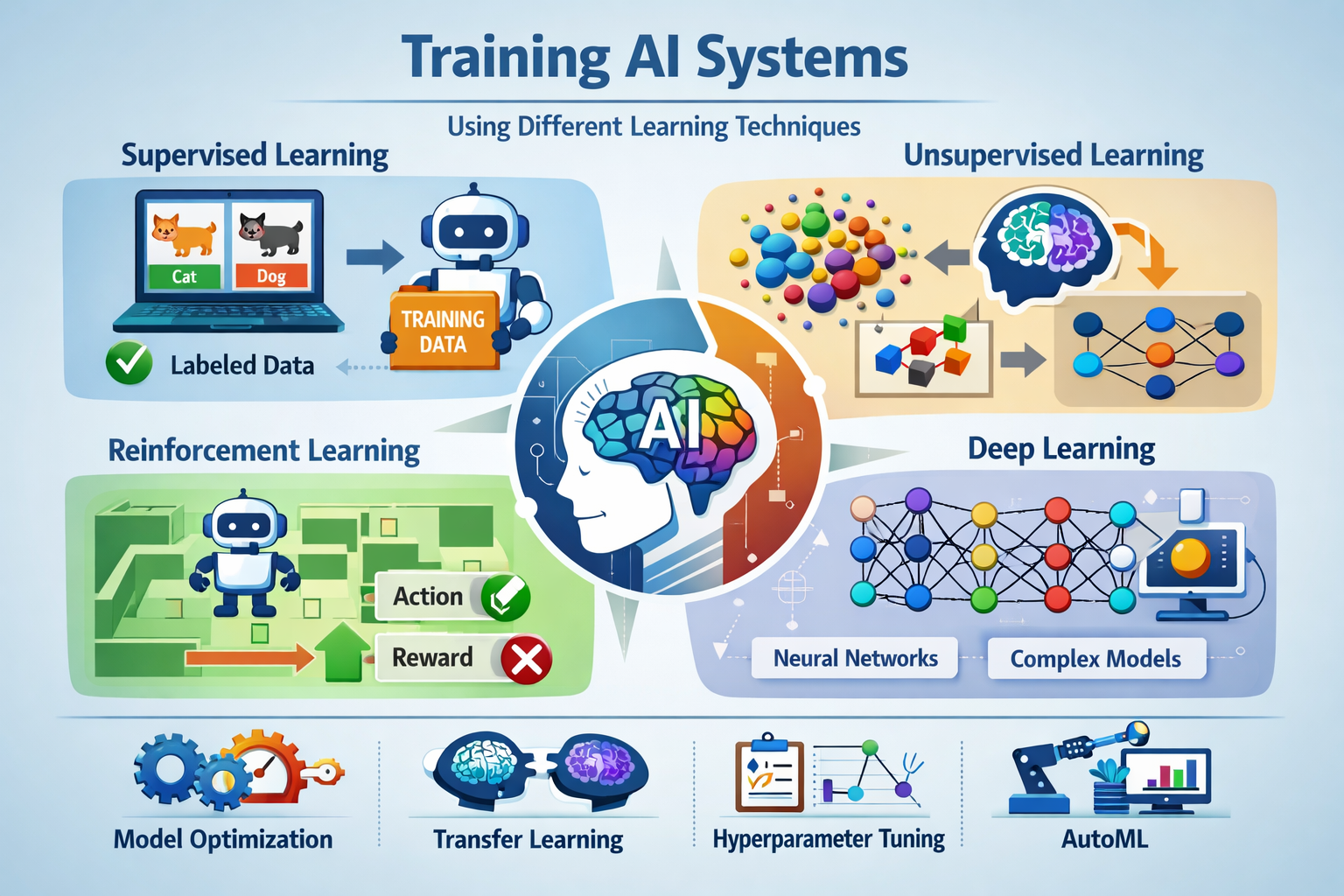
Understanding how AI learns begins with recognizing the core concept of training data – the fuel that powers these intelligent systems. AI doesn’t inherently know anything; it learns patterns from vast datasets, adjusting its internal parameters to better predict outcomes or classify information. Different learning techniques exist, each suited for different types of problems and data structures. Supervised learning, perhaps the most common approach, involves feeding the AI labeled examples – think images tagged with “cat” or “dog” – allowing it to learn the relationship between input and output. Unsupervised learning, on the other hand, allows the AI to find patterns in unlabeled data, like grouping customers based on purchasing behavior without pre-defined categories. Reinforcement learning mimics how humans learn through trial and error, rewarding the AI for desirable actions and penalizing it for mistakes, much like training a dog with treats. The choice of technique significantly impacts the efficiency and accuracy of the final AI system.
The Teachers Pay Teachers resource, High School Computer Science: Evaluating and Optimizing AI Systems – L2.ET.AI.04 (Resource), provides a comprehensive framework for exploring these learning techniques in the high school classroom. It moves beyond theoretical understanding and encourages students to actively experiment with different methods, applying them to practical problems. The resource likely includes activities that allow students to manipulate training data, adjust parameters within AI models, and observe the resulting changes in performance. This hands-on approach is crucial for solidifying their grasp of how optimization works, moving from abstract concepts to concrete application. The ability to analyze results and iterate on improvements is a key skill fostered by this resource, mirroring the iterative process used by data scientists and AI engineers.
Optimization isn’t simply about making an AI system more accurate; it’s about finding the sweet spot between accuracy, speed, and efficiency. A highly accurate AI that takes hours to produce a result might be useful in some contexts but impractical in others. Factors like the size of the training dataset, the complexity of the model, and the computational resources available all play a role in optimization. Techniques like hyperparameter tuning – adjusting settings within the learning algorithm itself – can significantly impact performance. Regularization methods help prevent overfitting, where the AI learns the training data too well and struggles to generalize to new, unseen data. Understanding these trade-offs is essential for building robust and practical AI systems that perform reliably in real-world scenarios.
Evaluating an AI system’s performance requires more than just looking at overall accuracy; it’s about understanding where the system excels and where it falters. Metrics like precision (how many of the predicted positives are actually correct) and recall (how many of the actual positives were correctly identified) provide a nuanced view of performance. Confusion matrices visually represent these metrics, helping students identify specific types of errors the AI is making. Different evaluation techniques are appropriate for different tasks; for example, evaluating an image recognition system requires different methods than evaluating a natural language processing model. The Teachers Pay Teachers resource likely incorporates activities that challenge students to select and apply appropriate evaluation metrics based on the specific AI problem they’re tackling, fostering critical thinking skills.
Furthermore, understanding bias in training data is paramount for creating fair and reliable AI systems. If the training data reflects existing societal biases – for example, if a facial recognition system is trained primarily on images of one ethnicity – the resulting AI may perpetuate those biases. Students need to learn how to identify potential sources of bias in their datasets and implement strategies to mitigate them, such as using more diverse training data or employing techniques like weighting samples based on their representation. This connects computer science to broader social issues, demonstrating that AI isn’t just a technical challenge but also a societal one. The ability to critically assess the impact of AI systems is becoming increasingly important in an era where algorithms are influencing everything from loan applications to criminal justice decisions.
In conclusion, Oklahoma Academic Standard L1.ET.AI.04 provides a solid foundation for high school students to understand the intricacies of training and optimizing AI systems. By exploring different learning techniques, mastering evaluation metrics, and recognizing the importance of data bias, students can move beyond simply using AI to actively shaping its future. Resources like the High School Computer Science: Evaluating and Optimizing AI Systems – L2.ET.AI.04 (Resource) provide valuable hands-on experiences that solidify these concepts, preparing students for success in a rapidly evolving technological landscape and equipping them to become the next generation of AI innovators. The ability to fine-tune these systems will be essential for unlocking their full potential and addressing some of the world’s most pressing challenges.
For a full resource on all Oklahoma Academic Standards involving AI: Resource [ Resource ]