Teaching Computing Careers in Grade 8: Oklahoma Standard 8.IC.CU.01
Teaching Computing Careers in Grade 8: Oklahoma Standard 8.IC.CU.01
Teaching computing careers in grade 8 does not have to be complicated. Picture a biomedical engineer designing a prosthetic limb by combining knowledge of biology and engineering. That kind of thinking is exactly what Oklahoma's grade 8 computer science standard 8.IC.CU.01 asks students to practice — and it is very teachable with the right materials. This post walks through what the standard means, the misconceptions students bring to it, and discussion starters you can use tomorrow, whether you teach in a classroom or at your kitchen table.
What Does Standard 8.IC.CU.01 Actually Ask?
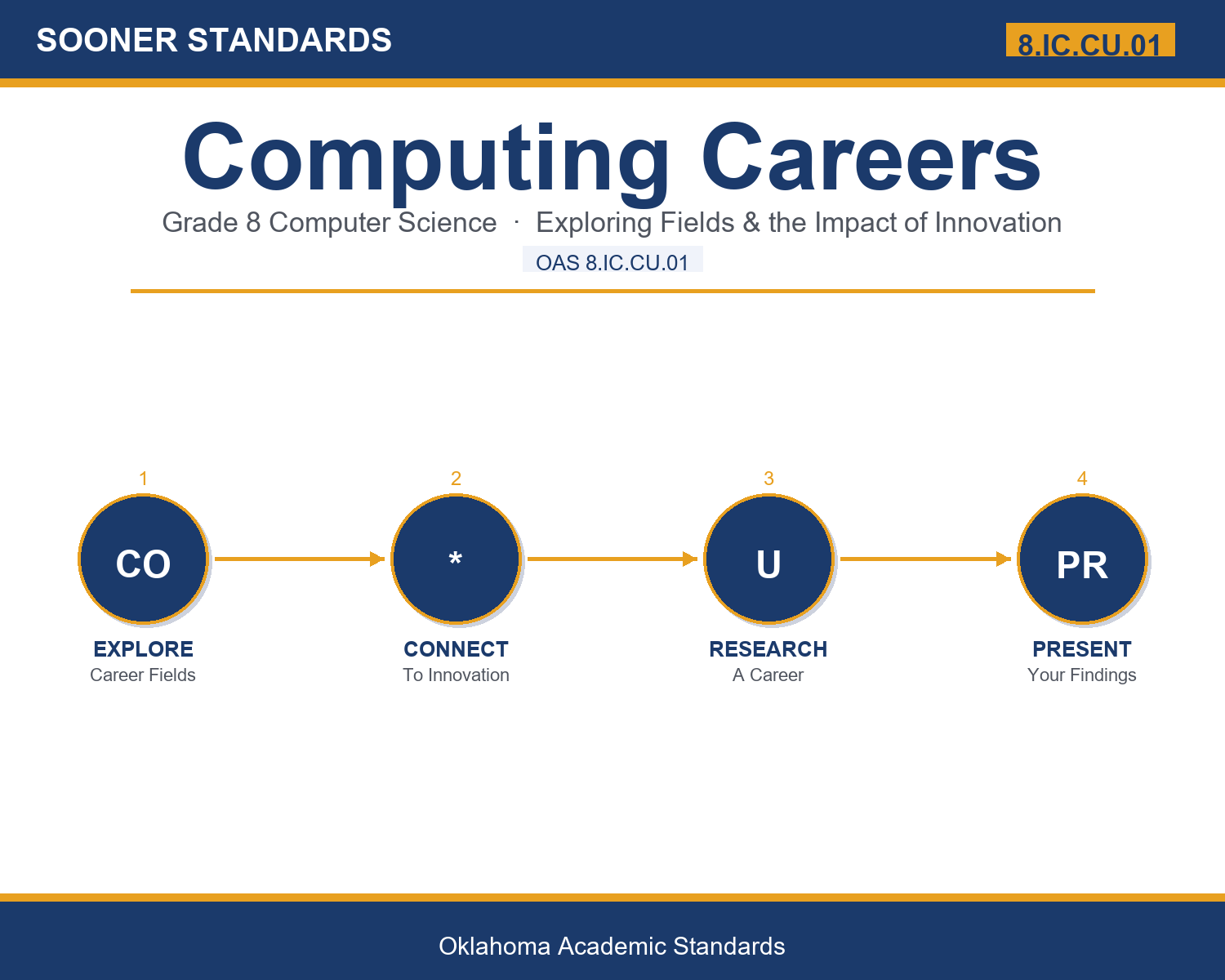
Explore careers related to the field of computer science, and explain how computing impacts innovation in various career fields. — Oklahoma Academic Standards for Computer Science (February 2023)
In plain language: Oklahoma's standard asks eighth graders to explore careers related to computer science and explain how computing impacts innovation in different career fields, from healthcare to agriculture to entertainment.
In student-friendly terms, the learning target is: "I can explore careers related to computer science and explain how computing impacts innovation in different career fields."
What Students Should Be Able to Do
- I can name at least four different computing careers and describe what each one does.
- I can explain how computing has created innovation inside a field that isn't purely 'tech,' like healthcare or agriculture.
- I can identify at least one soft skill computing professionals need beyond technical ability.
- I can connect a computing career to my own interests and identify a skill I would need to develop.
Along the way, students pick up the working vocabulary of the topic: career, innovation, automation, engineer, developer, analyst, cybersecurity, entrepreneur, programmer, technology, robotics, software, healthcare.
Computing Careers: Misconceptions to Watch For
These are the wrong turns students reliably take with this standard — knowing them ahead of time is half the lesson plan. Each correction strategy below comes straight from the unit's teacher guide (the paragraph and activity references point into the unit itself).
1. "Computing careers only exist in the tech industry."
Use paragraph 5 (healthcare) or paragraph 6 (robotics in agriculture) directly. Have students name a field they love and find a computing career connected to it.
2. "You have to be a 'coding genius' to have a career in computer science."
Point to paragraph 3 (cybersecurity), paragraph 4 (data analysis), and paragraph 9 — many computing careers value analytical thinking, communication, and problem-solving as much as deep coding skill.
3. "All computing jobs involve sitting alone at a computer all day."
Use paragraph 9 directly: most computing jobs involve working in teams, presenting ideas, and collaborating with non-technical people.
4. "Today's computing careers are all the careers that will ever exist in this field."
Use paragraph 8 — computing is still reshaping industries like transportation and education. Ask students to predict a computing career that might exist in 10 years but doesn't yet.
Discussion Starters You Can Use Tomorrow
- If you had to pick a computing career today, which one from the reading would you choose, and why?
- Why might a hospital need software developers, data scientists, AND biomedical engineers, all doing very different jobs?
- What's one 'soft skill' (non-technical skill) you already have that could help you in a computing career?
Bringing It Home
This topic is a natural one for families. One ten-minute activity to try: Together, think of three jobs in our family or community and discuss whether computing plays a role in any of them, even a small one. There are no wrong answers — the goal is noticing how widespread computing careers really are.
Where This Leads
Students who can explore careers related to computer science and explain how computing impacts innovation in different career fields are building skills used every day in software development, cybersecurity, data analysis, healthcare technology, robotics, and entrepreneurship.
See the Unit in Action
Get the Complete 8.IC.CU.01 Unit
I built a complete, no-prep unit for this standard — Computing Careers: Exploring Fields and the Impact of Technology on Innovation — covering 3-4 days of instruction across 31 pages:
- Teacher guide — day-by-day pacing, misconceptions to watch for, discussion questions, differentiation for support / ELL / extension, and a 4-point rubric
- Student learning target page — a kid-friendly "I can" statement with success criteria
- Full content lesson with 3 embedded "Check Your Understanding" checkpoints
- 12-question assessment (6 multiple choice, 4 true/false, 2 short answer) with a complete answer key, explanations, and exemplar responses
- Group activity — "Career Panel Research and Presentation" (25-35 minutes)
- Individual activity — "My Computing Career Profile" (20-25 minutes)
- Crossword and word search built from all 13 vocabulary terms (with answer keys)
- Family connection letter — a plain-language page for parents, with dinner-table questions and a 10-minute home activity
- Certificate of achievement — ready to sign and send home
- Computing Careers Quick Reference (separate printable, 1 page)
- My Computing Career Profile Worksheet (separate printable, 2 pages)
Get Computing Careers on Teachers Pay Teachers →
Every Sooner Standards resource is built directly from the official Oklahoma Academic Standards for Computer Science (February 2023) — standard text verified, never paraphrased from memory.