
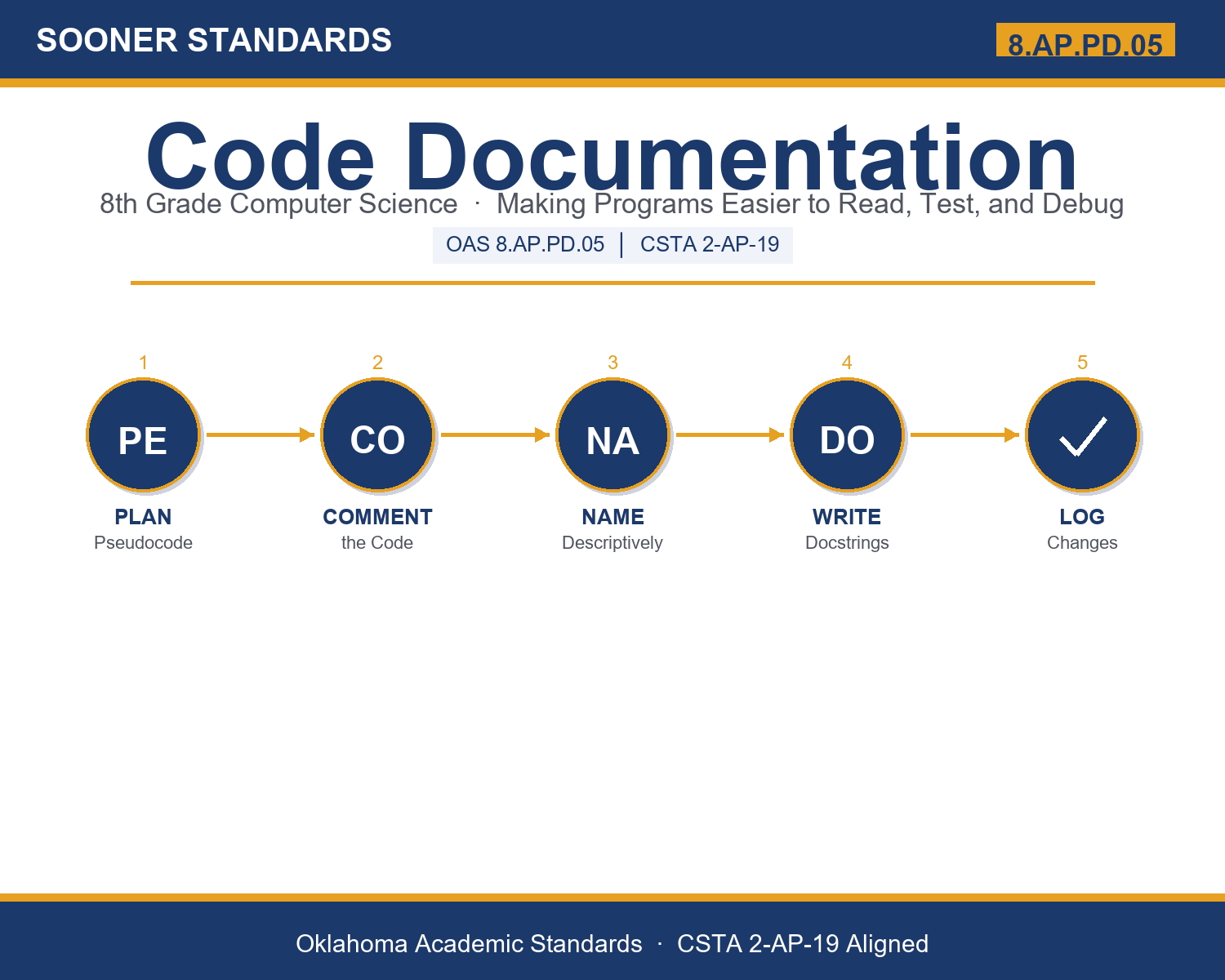
Code Documentation: Making Programs Easier to Read, Test, and Debug
Teaching Code Documentation in Grade 8: Oklahoma Standard 8.AP.PD.05
A program might take a week to write but will be read, reviewed, and modified hundreds of times over its lifetime. Oklahoma's standard 8.AP.PD.05 asks eighth graders to plan for that reality: documenting text-based programs of increasing complexity so they're easier to follow, test, and debug — for other people, and for their future selves. This post walks through what the standard means, the vocabulary students need, and a few discussion starters you can use tomorrow.
What Does Standard 8.AP.PD.05 Actually Ask?
Document text-based programs of increasing complexity in order to make them easier to follow, test, and debug. — Oklahoma Academic Standards for Computer Science (February 2023)
In plain language: students need to write explanations alongside their code — what it does, how it works, and why they made specific decisions — so that anyone reading the program later, including themselves, can actually understand it.
Key Vocabulary Students Will Learn
Documentation, Comment, Readability, Inline, Header, Pseudocode, Annotation, Maintainable, Clarity, Convention, Changelog, Docstring, Debugging
This vocabulary spans both the practical mechanics of documentation (comments, headers, docstrings) and the payoff it's meant to deliver (readability, clarity, maintainability).
What's Inside the Lesson
The content reading opens with a claim that surprises a lot of students: code is read far more often than it is written. Every professional programmer knows this — a program might take a week to build but will be read, reviewed, and modified hundreds of times over its lifetime. Without clear documentation, the reading explains, even the original author will struggle to remember why a particular approach was chosen months later.
That framing — documentation as a gift to your future self, not just to other people — is the throughline of the whole unit.
Discussion Starters You Can Use Tomorrow
- Have you ever come back to something you wrote a while ago and couldn't remember why you did it that way? How could a comment have helped?
- What's the difference between a comment that just restates what a line of code does and one that explains why it's there?
- If you were handing your program to a teammate who'd never seen it, what would you want them to know before they started reading the code?
Where This Leads
Students who can document their programs clearly are building a habit that every professional developer relies on — because in the real world, code is a team effort across time, not just a single sitting at the keyboard.
See the Unit in Action
Get the Complete 8.AP.PD.05 Unit
I built a complete, no-prep unit for this standard — Code Documentation: Making Programs Easier to Read, Test, and Debug — across 22 ready-to-print pages:
- Vocabulary reference — all 13 terms with definitions and real-world examples
- Full content reading with embedded comprehension checkpoints
- 10-question assessment (6 multiple choice, 4 true/false) with a complete answer key and explanations
- Group activity — "Documentation Audit and Repair"
- Individual activity — "Document Your Own Code"
- Crossword and word search built from all 13 vocabulary terms (with answer keys)
- Standards alignment verification page
- Documentation Reference Sheet (separate printable)
- Documentation Worksheet (separate printable)
Get Code Documentation on Teachers Pay Teachers →
Every Sooner Standards resource is built directly from the official Oklahoma Academic Standards for Computer Science (February 2023) — standard text verified, never paraphrased from memory.