Teaching The Four Building Blocks of Code in Grade 5: Oklahoma Standard 5.AP.PD.03
Teaching The Four Building Blocks of Code in Grade 5: Oklahoma Standard 5.AP.PD.03
Teaching coding concepts in grade 5 does not have to be complicated. Picture a weather app using variables for temperature and conditionals to choose a sun or rain icon. That kind of thinking is exactly what Oklahoma's grade 5 computer science standard 5.AP.PD.03 asks students to practice — and it is very teachable with the right materials. This post walks through what the standard means, the misconceptions students bring to it, and discussion starters you can use tomorrow, whether you teach in a classroom or at your kitchen table.
What Does Standard 5.AP.PD.03 Actually Ask?
Analyze, create, and debug a program that includes sequencing, repetition, conditionals, and variables in a programming language. — Oklahoma Academic Standards for Computer Science (February 2023)
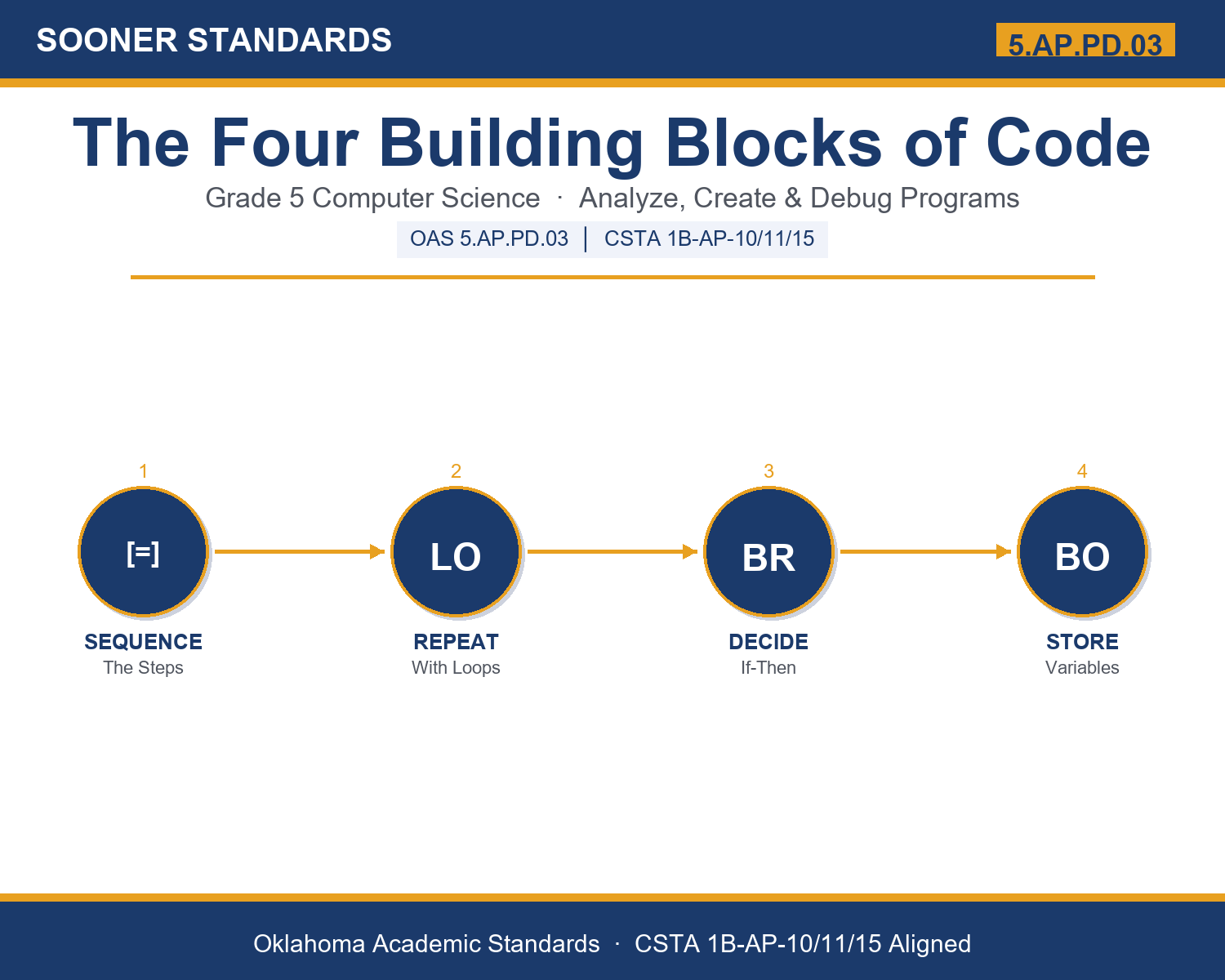
In plain language: Oklahoma's standard asks fifth graders to study (analyze), build (create), and fix (debug) programs that use four building blocks: putting steps in order, repeating steps with loops, making if-then decisions, and storing changing information in variables.
In student-friendly terms, the learning target is: "I can analyze, create, and debug a program that uses sequencing, repetition, conditionals, and variables."
What Students Should Be Able to Do
- I can identify sequencing, loops, conditionals, and variables in a program.
- I can trace a program step by step to predict what it will do.
- I can plan and create a program that uses all four building blocks.
- I can find and fix a bug by tracing and changing one thing at a time.
Along the way, students pick up the working vocabulary of the topic: algorithm, command, variable, sequence, program, trace, boolean, repeat, conditional, analyze, value, debug.
Coding Concepts: Misconceptions to Watch For
These are the wrong turns students reliably take with this standard — knowing them ahead of time is half the lesson plan. Each correction strategy below comes straight from the unit's teacher guide (the paragraph and activity references point into the unit itself).
1. "The computer understands what you mean and will fix the order of your commands."
Return to paragraph 2: computers do exactly what they are told, in order, with no guessing. Use the peanut butter example to show right commands in the wrong sequence still fail.
2. "Finding a bug means you failed or are bad at programming."
Paragraph 7 reframes debugging as a normal, expected part of coding that professionals do daily. Celebrate found bugs as progress, not failure.
3. "A variable's value is fixed and cannot change once the program starts."
Paragraph 5: the whole point of a variable is that its value can change while the program runs, like a score going up. Demo a score changing live if possible.
4. "You debug by changing lots of blocks at once until it works."
Paragraph 7: change one thing at a time and trace to test each idea, so you know exactly what fixed the bug. Random changes hide the real cause.
Discussion Starters You Can Use Tomorrow
- Think of a game you play. Where do you think it uses a loop, and where does it use a conditional?
- Why is it so important that a computer follows commands in exact order instead of guessing what you mean?
- What is something in real life (not a computer) that works like a variable, holding a value that changes?
Bringing It Home
This topic is a natural one for families. One ten-minute activity to try: Pick an everyday routine, like getting ready for school, and write it together as a program. Put the steps in order (sequence), find a step that repeats (loop), add an if-then choice (if it is cold, then wear a coat), and track something that changes like minutes left (a variable). Then 'debug' it by spotting any step in the wrong order.
Where This Leads
Students who can analyze, create, and debug a program that uses sequencing, repetition, conditionals, and variables are building skills used every day in software development, game design, robotics, data science, and engineering.
Part of the Complete Grade 5 Computer Science Curriculum
This lesson covers just one standard. It is part of a complete grade 5 computer science curriculum aligned to every Oklahoma OAS CS standard. See the full listing — every standard, organized by strand — here: Grade 5 Computer Science Curriculum: Every Oklahoma OAS CS Standard.
See the Unit in Action
Get the Complete 5.AP.PD.03 Unit
I built a complete, no-prep unit for this standard — The Four Building Blocks of Code: Analyze, Create, and Debug — covering 3-4 days of instruction across 41 pages:
- Teacher guide — day-by-day pacing, misconceptions to watch for, discussion questions, differentiation for support / ELL / extension, and a 4-point rubric
- Student learning target page — a kid-friendly "I can" statement with success criteria
- Full content lesson with 3 embedded "Check Your Understanding" checkpoints
- 12-question assessment (6 multiple choice, 4 true/false, 2 short answer) with a complete answer key, explanations, and exemplar responses
- Group activity — "Block Detectives: Analyze, Build, and Debug" (25-30 minutes)
- Individual activity — "Design Your Own Program" (15-20 minutes)
- Crossword and word search built from all 12 vocabulary terms (with answer keys)
- Family connection letter — a plain-language page for parents, with dinner-table questions and a 10-minute home activity
- Certificate of achievement — ready to sign and send home
- Program Analysis Cards (separate printable, 2 pages)
- The Four Building Blocks Reference Sheet (separate printable, 2 pages)
- Design Your Own Program (separate printable, 1 page)
Get The Four Building Blocks of Code on Teachers Pay Teachers →
Also aligned to CSTA 1B-AP-10/11/15: Create programs that use variables, conditionals, and loops, and debug them to make sure they run correctly.
Every Sooner Standards resource is built directly from the official Oklahoma Academic Standards for Computer Science (February 2023) — standard text verified, never paraphrased from memory.