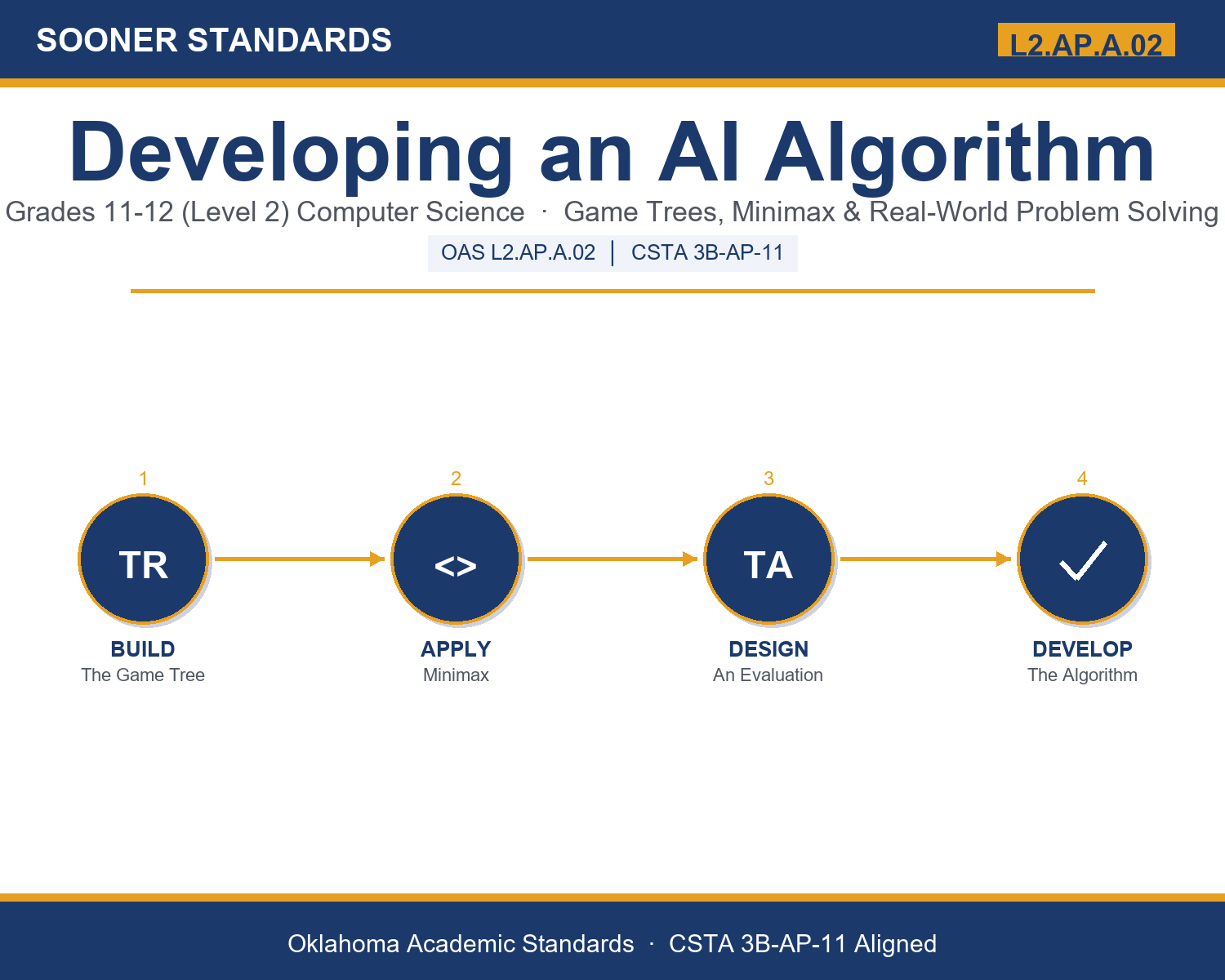
Teaching Developing an AI Algorithm in Grades 11-12 (Level 2): Oklahoma Standard L2.AP.A.02
Teaching Developing an AI Algorithm in Grades 11-12 (Level 2): Oklahoma Standard L2.AP.A.02
Teaching ai game algorithm in grades 11-12 (level 2) does not have to be complicated. Picture a game studio AI programmer tuning an evaluation function so a non-player character feels challenging but fair. That kind of thinking is exactly what Oklahoma's grades 11-12 (level 2) computer science standard L2.AP.A.02 asks students to practice — and it is very teachable with the right materials. This post walks through what the standard means, the misconceptions students bring to it, and discussion starters you can use tomorrow, whether you teach in a classroom or at your kitchen table.
What Does Standard L2.AP.A.02 Actually Ask?
Develop an artificial intelligence algorithm to play a game against a human opponent or solve a real-world problem. — Oklahoma Academic Standards for Computer Science (February 2023)
In plain language: This standard asks students to develop their own artificial intelligence algorithm: a program that can look ahead in a game against a human opponent, or search through options for a real-world problem, and choose a good action on its own.
In student-friendly terms, the learning target is: "I can develop an artificial intelligence algorithm — using states, minimax, an evaluation function, and pruning — to play a game against a human opponent or solve a real-world problem."
What Students Should Be Able to Do
- I can represent a game or problem as a set of states, actions, and a goal.
- I can build a game tree and apply minimax to identify the optimal move.
- I can design an evaluation function that estimates how good a position is without a full search.
- I can explain how alpha-beta pruning skips branches without changing the algorithm's final decision.
Along the way, students pick up the working vocabulary of the topic: algorithm, agent, state, heuristic, minimax, pruning, terminal, evaluation, search, opponent, branch, optimal, greedy.
Ai Game Algorithm: Misconceptions to Watch For
These are the wrong turns students reliably take with this standard — knowing them ahead of time is half the lesson plan. Each correction strategy below comes straight from the unit's teacher guide (the paragraph and activity references point into the unit itself).
1. "Minimax works by predicting that the opponent will make a mistake."
Return to paragraph 3. Point out that minimax deliberately assumes the opponent plays optimally at every step — that is exactly why it produces strong moves even against a skilled human opponent, not only a careless one.
2. "A game-playing algorithm should always search the entire game tree if the computer is fast enough."
Use the branching-factor explosion from paragraph 2. Have students estimate how many states exist after just 4-5 moves in chess to see why depth-limited search with an evaluation function is necessary even on fast computers.
3. "Alpha-beta pruning changes which move the algorithm ultimately chooses."
Emphasize the phrase 'without changing the outcome' from paragraph 5. Pruning only skips branches already proven irrelevant to the final decision; it produces the identical move minimax would have found, just faster.
4. "AI algorithms for real-world problems are completely different from game-playing algorithms."
Revisit paragraph 6's delivery-route example. Have students identify the states, actions, and goal in a real-world problem and compare them side by side to a game tree's states, moves, and terminal states.
Discussion Starters You Can Use Tomorrow
- Why does minimax assume the opponent will always play their best possible move, even if a real human opponent sometimes makes mistakes?
- What makes a good evaluation function 'good'? What could go wrong if it rewards the wrong factors?
- Describe a real-world problem, not a game, where you think a search-and-evaluate algorithm could help make a decision faster or better than a person alone.
Bringing It Home
This topic is a natural one for families. One ten-minute activity to try: Play a simple strategy game together (tic-tac-toe, checkers, or a phone game with a computer opponent) and, before each of your moves, have your student say out loud what a 'thinking-ahead' computer might consider before choosing its next move. There are no wrong answers — the goal is hearing their reasoning about looking ahead and estimating which option is best.
Where This Leads
Students who can develop an artificial intelligence algorithm — using states, minimax, an evaluation function, and pruning — to play a game against a human opponent or solve a real-world problem are building skills used every day in game development, robotics / autonomous systems, operations research, machine learning / AI engineering, and software engineering.
See the Unit in Action
Get the Complete L2.AP.A.02 Unit
I built a complete, no-prep unit for this standard — Developing an AI Algorithm: Game-Playing and Problem-Solving Agents — covering 3-4 days of instruction across 44 pages:
- Teacher guide — day-by-day pacing, misconceptions to watch for, discussion questions, differentiation for support / ELL / extension, and a 4-point rubric
- Student learning target page — a kid-friendly "I can" statement with success criteria
- Full content lesson with 3 embedded "Check Your Understanding" checkpoints
- 12-question assessment (6 multiple choice, 4 true/false, 2 short answer) with a complete answer key, explanations, and exemplar responses
- Group activity — "Build the Tree: Minimax, Evaluation, and Pruning" (25-30 minutes)
- Individual activity — "My AI Algorithm Design Portfolio" (20-25 minutes)
- Crossword and word search built from all 13 vocabulary terms (with answer keys)
- Family connection letter — a plain-language page for parents, with dinner-table questions and a 10-minute home activity
- Certificate of achievement — ready to sign and send home
- Game Scenario Card Set: Build the Tree (separate printable, 2 pages)
- Reference Notes: Developing an AI Algorithm (separate printable, 2 pages)
- My AI Algorithm Design Portfolio (separate printable, 2 pages)
Get Developing an AI Algorithm on Teachers Pay Teachers →
Also aligned to CSTA 3B-AP-11: Illustrate the flow of execution of a recursive algorithm.
Every Sooner Standards resource is built directly from the official Oklahoma Academic Standards for Computer Science (February 2023) — standard text verified, never paraphrased from memory.