Teaching Reusing Libraries, APIs & Repositories in Grades 11-12 (Level 2): Oklahoma Standard L2.AP.M.03
Teaching Reusing Libraries, APIs & Repositories in Grades 11-12 (Level 2): Oklahoma Standard L2.AP.M.03
Teaching code reuse libraries apis in grades 11-12 (level 2) does not have to be complicated. Picture a developer comparing two libraries by update history, documentation, and license before adding one to a project. That kind of thinking is exactly what Oklahoma's grades 11-12 (level 2) computer science standard L2.AP.M.03 asks students to practice — and it is very teachable with the right materials. This post walks through what the standard means, the misconceptions students bring to it, and discussion starters you can use tomorrow, whether you teach in a classroom or at your kitchen table.
What Does Standard L2.AP.M.03 Actually Ask?
Create programming solutions by reusing existing code (e.g., libraries, Application Programming Interface (APIs), code repositories). — Oklahoma Academic Standards for Computer Science (February 2023)
In plain language: This standard asks students to build programs by reusing existing code from sources such as libraries, online services, and public code collections, instead of writing every part themselves.
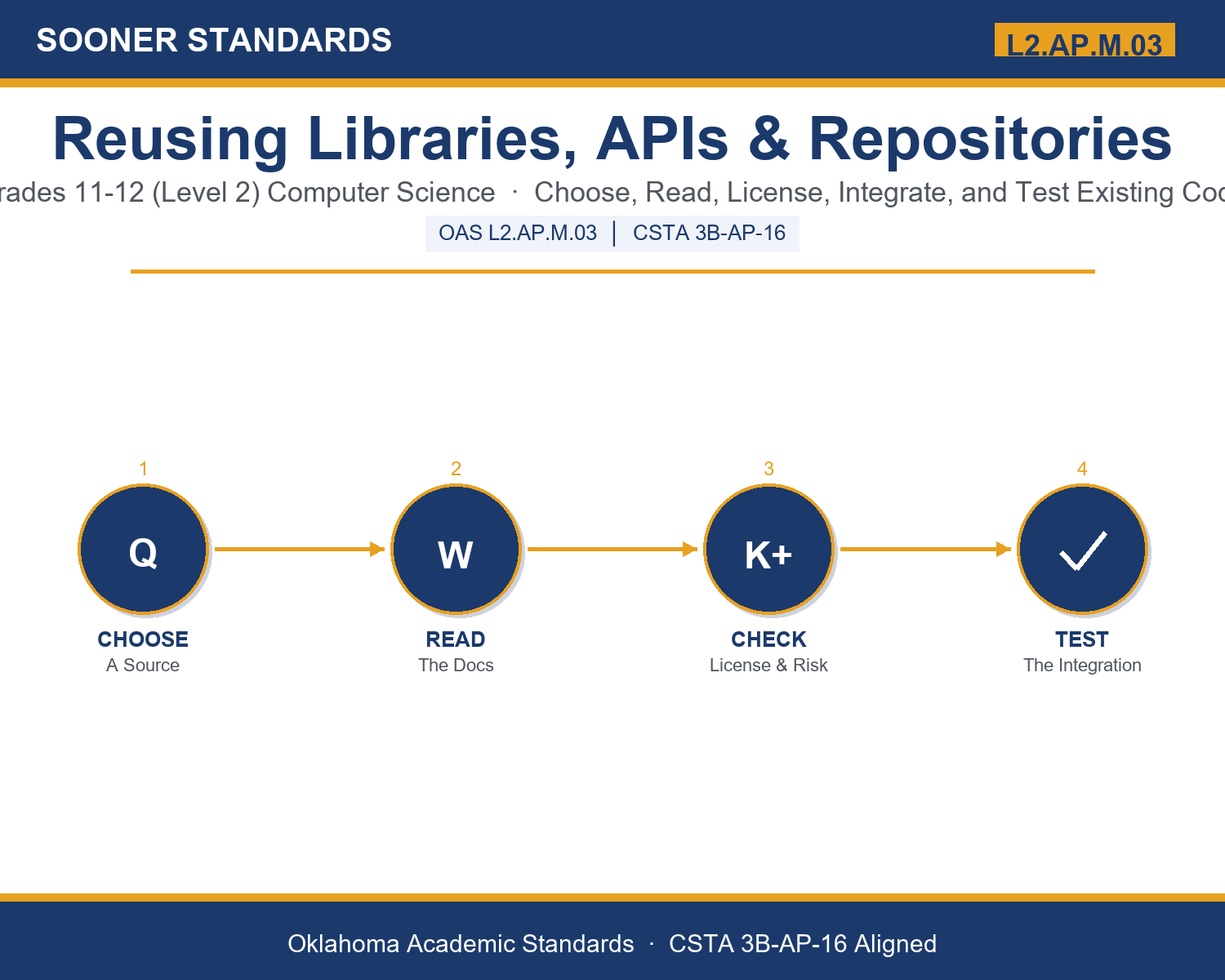
In student-friendly terms, the learning target is: "I can create a programming solution by reusing existing code, choosing and evaluating a library, API, or repository, following its documentation and license, and testing it inside my program."
What Students Should Be Able to Do
- I can compare libraries, APIs, and repositories and justify a choice using evidence.
- I can read documentation to identify the inputs, outputs, and errors of reused code.
- I can explain what a license permits and requires, and give correct attribution.
- I can identify dependency and security risks and describe a way to reduce each.
- I can integrate reused code behind a clear boundary and write tests for normal, edge, and failure cases.
Along the way, students pick up the working vocabulary of the topic: library, repository, endpoint, interface, documentation, license, attribution, dependency, version, vulnerability, integration, package, reuse.
Code Reuse Libraries Apis: Misconceptions to Watch For
These are the wrong turns students reliably take with this standard — knowing them ahead of time is half the lesson plan. Each correction strategy below comes straight from the unit's teacher guide (the paragraph and activity references point into the unit itself).
1. "If code is posted publicly, anyone may use it however they like."
Return to paragraph 5. Public visibility is not permission; no license means the author keeps all rights. Have students find the license statement in a sample listing and state what it permits and requires.
2. "A popular library is automatically safe and correct, so testing it is unnecessary."
Use paragraphs 7 and 9. Popularity says nothing about whether a library fits your inputs or is free of flaws. Walk through the Log4Shell example and ask which test or update practice would have helped.
3. "Reusing code means copying it into your project and changing a few names."
Contrast copying with depending on a maintained, versioned, licensed component. Ask students what they would lose track of if the copied code later received a security fix.
4. "Once an API call works in testing, the integration is finished."
Revisit paragraph 8. Services can time out, change formats, or enforce limits. Have students list three failures a production program should handle and where in a wrapper each would be addressed.
Discussion Starters You Can Use Tomorrow
- When is writing a few lines of your own code a better choice than adding a new dependency?
- What evidence would make you trust a library written by strangers, and what evidence would make you hesitate?
- Why might a company forbid certain licenses in its products, and how does that affect which libraries its developers can choose?
Bringing It Home
This topic is a natural one for families. One ten-minute activity to try: Together, choose a household task that people usually do with a ready-made tool, such as using a recipe app, a map, or a bank's website. Ask your student to explain what the tool does for you, what you have to trust about whoever made it, and what you would do if it stopped working tomorrow. There are no wrong answers; the goal is hearing their reasoning.
Where This Leads
Students who can create a programming solution by reusing existing code, choosing and evaluating a library, API, or repository, following its documentation and license, and testing it inside my program are building skills used every day in software engineering, application security, API and integration development, open source maintenance, and computer science education.
See the Unit in Action
Get the Complete L2.AP.M.03 Unit
I built a complete, no-prep unit for this standard — Building on Others' Work: Reusing Libraries, APIs, and Code Repositories — covering 3-4 days of instruction across 44 pages:
- Teacher guide — day-by-day pacing, misconceptions to watch for, discussion questions, differentiation for support / ELL / extension, and a 4-point rubric
- Student learning target page — a kid-friendly "I can" statement with success criteria
- Full content lesson with 4 embedded "Check Your Understanding" checkpoints
- 12-question assessment (6 multiple choice, 4 true/false, 2 short answer) with a complete answer key, explanations, and exemplar responses
- Group activity — "The Reuse Review Board" (25-30 minutes)
- Individual activity — "My Reuse Plan" (20-25 minutes)
- Crossword and word search built from all 13 vocabulary terms (with answer keys)
- Family connection letter — a plain-language page for parents, with dinner-table questions and a 10-minute home activity
- Certificate of achievement — ready to sign and send home
- Candidate Evaluation Cards: Choosing Reusable Code (separate printable, 2 pages)
- Reference Notes: Reusing Existing Code (separate printable, 2 pages)
- My Reuse Plan (separate printable, 2 pages)
Get Reusing Libraries, APIs & Repositories on Teachers Pay Teachers →
Also compared with CSTA 2026 HS-PRO-PD-13 (strong match) and CSTA 2017 3B-AP-16
Every Sooner Standards resource is built directly from the official Oklahoma Academic Standards for Computer Science (February 2023) — standard text verified, never paraphrased from memory.