Evaluating Computing Devices: A User-Centered Design Approach
Teaching Evaluating Computing Devices in Grade 8: Oklahoma Standard 8.CS.D.01
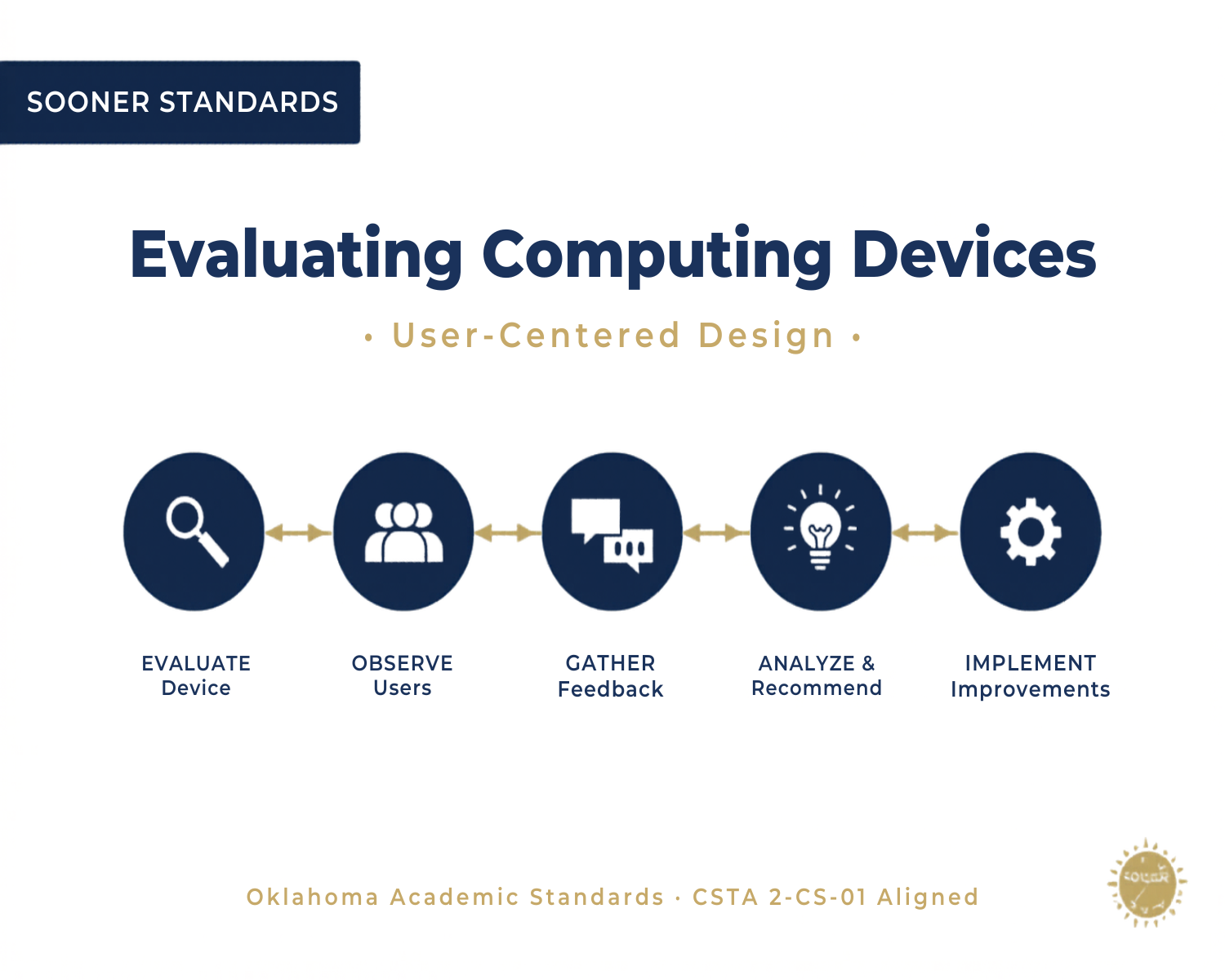
Not every device is designed equally well for every person who uses it — some interfaces are confusing, some text is too small, some tasks take far more steps than they should. Oklahoma's standard 8.CS.D.01 asks eighth graders to notice that gap systematically: developing and implementing a process to evaluate existing computing devices and recommend improvements based on how other users actually interact with them. This post walks through what the standard means, the vocabulary students need, and a few discussion starters you can use tomorrow.
What Does Standard 8.CS.D.01 Actually Ask?
Develop and implement a process to evaluate existing computing devices and recommend improvements to the design based on how other users interact with the device. — Oklahoma Academic Standards for Computer Science (February 2023)
In plain language: students need to move beyond "does this device work for me?" and build an actual process for observing how other people use a device — then use those observations to recommend real, specific improvements.
Key Vocabulary Students Will Learn
Usability, Interface, Accessibility, Evaluation, Prototype, Feedback, Ergonomics, Navigation, Iteration, Benchmark, Workflow, Criteria, Heuristic, Observation, Recommendation
This is the vocabulary of professional user-experience (UX) evaluation — the same words used by teams that test real products before they ship.
What's Inside the Lesson
The content reading opens by naming how central computing devices have become to daily life — smartphones, tablets, desktops, smartwatches — and then pivots to the honest observation that not every device is perfectly designed for every user. Some people struggle to navigate certain interfaces, find text too small to read, or can't complete common tasks efficiently. Evaluating how well a device serves its users is framed as a real, teachable process, not just a matter of personal opinion.
Discussion Starters You Can Use Tomorrow
- Think of an app or device you find easy to use. What specifically makes it easy — and would it be just as easy for someone seeing it for the first time?
- If you were watching someone else use a device and they got stuck, how would you decide whether the problem was the device's design or the user's unfamiliarity?
- What's one small design change that could make a device you use every day easier for more people to use?
Where This Leads
Students who can evaluate devices from a user's perspective are building the exact skill that UX designers, accessibility engineers, and product teams use to make technology genuinely usable — the discipline of designing for other people, not just for yourself.
See the Unit in Action
Get the Complete 8.CS.D.01 Unit
I built a complete, no-prep unit for this standard — Evaluating Computing Devices: A User-Centered Design Approach — across 28 ready-to-print pages:
- Vocabulary reference — all 15 terms with definitions and real-world examples
- Full content reading with embedded comprehension checkpoints
- 10-question assessment (6 multiple choice, 4 true/false) with a complete answer key and explanations
- Group activity — "Device Audit Challenge"
- Individual activity — "Design Improvement Proposal"
- Crossword and word search built from all 15 vocabulary terms (with answer keys)
- Standards alignment verification page
- Evaluation Rubric (separate printable)
- Observation Notes (separate printable)
Get Evaluating Computing Devices on Teachers Pay Teachers →
Every Sooner Standards resource is built directly from the official Oklahoma Academic Standards for Computer Science (February 2023) — standard text verified, never paraphrased from memory.