Teaching Comparing and Refining Algorithms in Grade 5: Oklahoma Standard 5.AP.A.01
Teaching Comparing and Refining Algorithms in Grade 5: Oklahoma Standard 5.AP.A.01
Teaching comparing algorithms in grade 5 does not have to be complicated. Picture a delivery company comparing routes to pick the most efficient one. That kind of thinking is exactly what Oklahoma's grade 5 computer science standard 5.AP.A.01 asks students to practice — and it is very teachable with the right materials. This post walks through what the standard means, the misconceptions students bring to it, and discussion starters you can use tomorrow, whether you teach in a classroom or at your kitchen table.
What Does Standard 5.AP.A.01 Actually Ask?
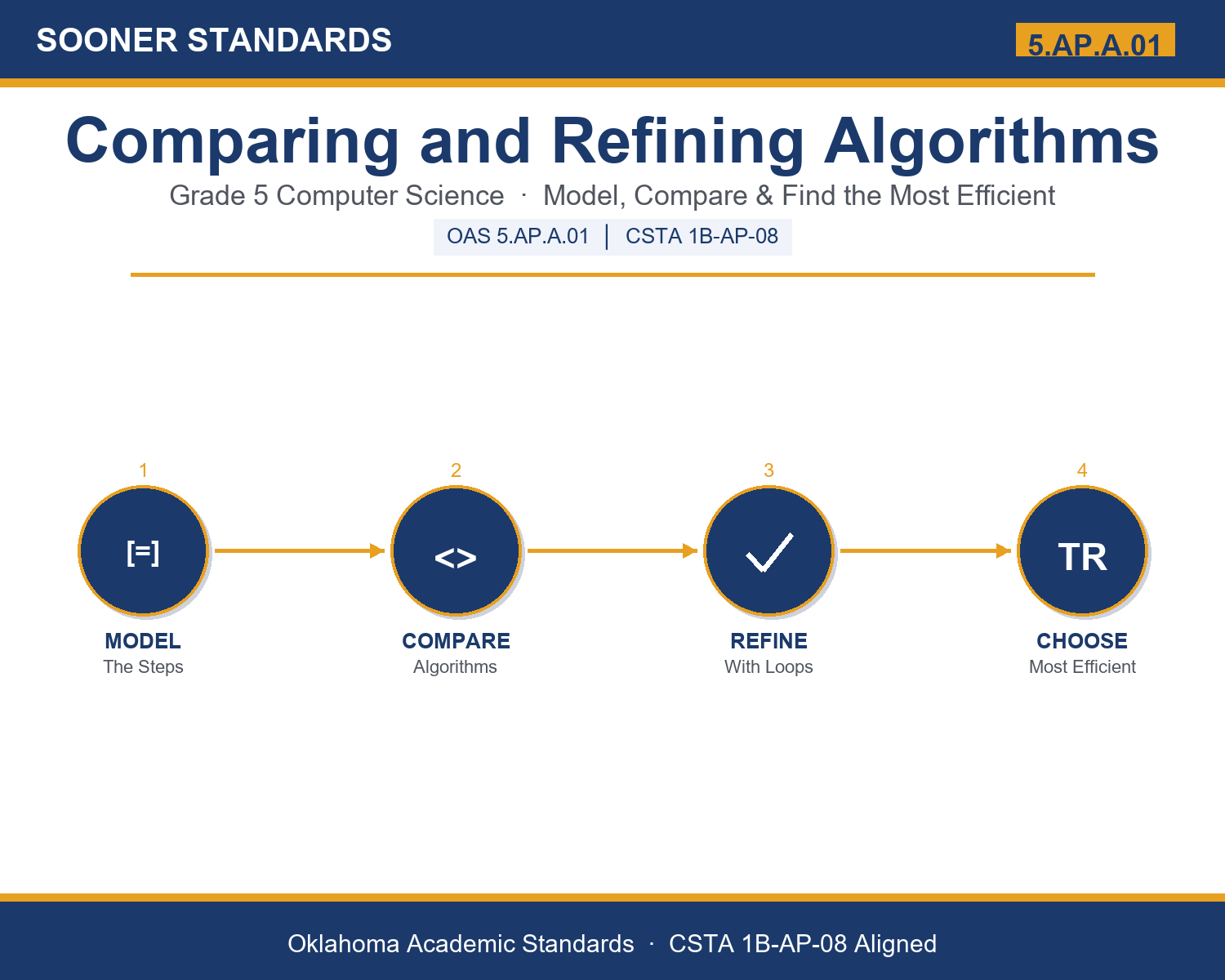
Model, compare and refine multiple algorithms for the same task and determine which is the most efficient. — Oklahoma Academic Standards for Computer Science (February 2023)
In plain language: Oklahoma's standard asks fifth graders to write more than one set of step-by-step instructions for the same task, compare them, improve them, and decide which one finishes the job with the least wasted effort.
In student-friendly terms, the learning target is: "I can model, compare, and refine more than one algorithm for the same task and determine which one is the most efficient."
What Students Should Be Able to Do
- I can model an algorithm clearly as a numbered list or a flowchart.
- I can write more than one algorithm that completes the same task.
- I can compare algorithms by counting steps and decide which is more efficient.
- I can refine an algorithm by removing extra steps or adding a loop.
Along the way, students pick up the working vocabulary of the topic: algorithm, step, task, order, model, compare, refine, debug, loop, repeat, pattern, path, efficient.
Comparing Algorithms: Misconceptions to Watch For
These are the wrong turns students reliably take with this standard — knowing them ahead of time is half the lesson plan. Each correction strategy below comes straight from the unit's teacher guide (the paragraph and activity references point into the unit itself).
1. "There is only one right algorithm for a task."
Use paragraph 4 and the book-finding example. Have students share different ways to do the same classroom task. Almost every task has more than one algorithm, which is why we compare.
2. "A longer algorithm with more steps is more powerful or better."
Use paragraph 5. More steps usually means more wasted effort. Efficiency is about fewer steps for the same correct result, not more steps.
3. "Efficient just means fast, nothing else."
Use paragraph 5. Efficiency can mean fewer steps, less time, or less memory and energy. Have students count steps as a concrete, fair measure.
4. "Once an algorithm works, it cannot be improved."
Use paragraph 7. Refining is normal; working algorithms can almost always be shortened by removing extra steps or adding a loop. First-draft thinking versus revision.
Discussion Starters You Can Use Tomorrow
- What is an everyday task you do, and can you think of two different algorithms for doing it?
- Why do you think computer programmers care so much about saving even a few steps?
- How could a loop make a long set of repeated instructions shorter?
Bringing It Home
This topic is a natural one for families. One ten-minute activity to try: Together, pick a simple task like making a sandwich or setting the table, and write down the exact steps as an algorithm. Then see if you can find a second way to do the same task and count the steps in each. Talk about which algorithm is more efficient and why, and whether any steps could be removed.
Where This Leads
Students who can model, compare, and refine more than one algorithm for the same task and determine which one is the most efficient are building skills used every day in software programming, video game design, logistics and route planning, robotics engineering, and data science.
Part of the Complete Grade 5 Computer Science Curriculum
This lesson covers just one standard. It is part of a complete grade 5 computer science curriculum aligned to every Oklahoma OAS CS standard. See the full listing — every standard, organized by strand — here: Grade 5 Computer Science Curriculum: Every Oklahoma OAS CS Standard.
See the Unit in Action
Get the Complete 5.AP.A.01 Unit
I built a complete, no-prep unit for this standard — Comparing and Refining Algorithms to Find the Most Efficient — covering 3-4 days of instruction across 37 pages:
- Teacher guide — day-by-day pacing, misconceptions to watch for, discussion questions, differentiation for support / ELL / extension, and a 4-point rubric
- Student learning target page — a kid-friendly "I can" statement with success criteria
- Full content lesson with 3 embedded "Check Your Understanding" checkpoints
- 12-question assessment (6 multiple choice, 4 true/false, 2 short answer) with a complete answer key, explanations, and exemplar responses
- Group activity — "Two Ways to Sort: Compare the Algorithms" (25-30 minutes)
- Individual activity — "Refine the Algorithm" (15-20 minutes)
- Crossword and word search built from all 13 vocabulary terms (with answer keys)
- Family connection letter — a plain-language page for parents, with dinner-table questions and a 10-minute home activity
- Certificate of achievement — ready to sign and send home
- Compare Two Algorithms Recording Sheet (separate printable, 1 page)
- Algorithms & Efficiency Reference Notes (separate printable, 1 page)
- Refine the Algorithm (separate printable, 1 page)
Get Comparing and Refining Algorithms on Teachers Pay Teachers →
Also aligned to CSTA 1B-AP-08: Compare and refine multiple algorithms for the same task and determine which is the most appropriate.
Every Sooner Standards resource is built directly from the official Oklahoma Academic Standards for Computer Science (February 2023) — standard text verified, never paraphrased from memory.