Representing Data: Analyzing Methods for Storing and Displaying Information
Teaching Representing Data in Grade 8: Oklahoma Standard 8.DA.S.01
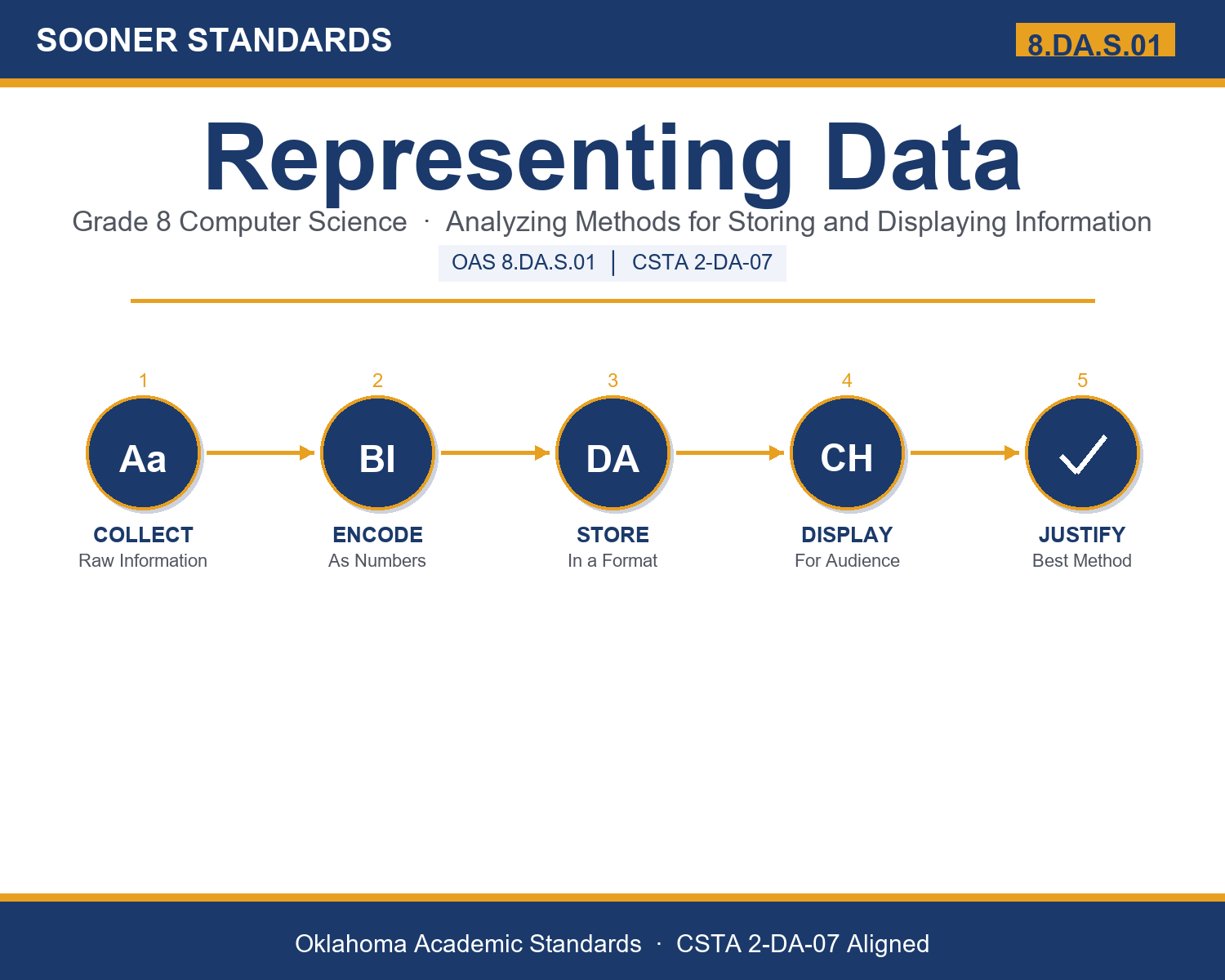
A text message, a photograph, a song, and a video are all, underneath everything else, numbers — because that's the only language a computer's circuits actually understand. Oklahoma's standard 8.DA.S.01 asks eighth graders to dig into that idea directly: analyzing multiple methods of representing the same data and justifying which method is most appropriate for a given purpose. This post walks through what the standard means, the vocabulary students need, and a few discussion starters you can use tomorrow.
What Does Standard 8.DA.S.01 Actually Ask?
Analyze multiple methods of representing the same data and justify the most appropriate method for representing data. — Oklahoma Academic Standards for Computer Science (February 2023)
In plain language: students need to know that the same piece of information — a picture, a sound, a piece of text — can be stored in more than one way, and be able to explain why one representation might be better than another for a specific use.
Key Vocabulary Students Will Learn
Data Representation, Binary, Hexadecimal, ASCII, Unicode, Pixel, Bitmap, Vector Graphic, Compression, Lossless Compression, Lossy Compression, File Format, Metadata, Sampling Rate, Bit Depth
This is a dense, technical vocabulary set — the actual terms used when comparing image formats, audio quality, or file sizes in the real world.
What's Inside the Lesson
The content reading opens with the foundational idea of the whole unit: every piece of information a computer stores or processes — a text message, a photograph, a song, a spreadsheet, a video — must be represented as numbers before a computer can work with it. This isn't framed as a limitation but as a fundamental design choice: computers are built around circuits that distinguish between two states (on and off), which makes binary the natural language of digital systems.
Discussion Starters You Can Use Tomorrow
- Why might a photo saved as a lossy-compressed file look almost identical to the original but take up far less storage space?
- If you were choosing between two file formats for the same picture, what would make one format more "appropriate" than another?
- Why do you think a higher sampling rate generally means a larger audio file?
Where This Leads
Students who understand how data can be represented in multiple ways — and can justify which representation fits a given purpose — are building literacy that underlies everything from streaming media to digital photography to how the internet moves information at all.
See the Unit in Action
Get the Complete 8.DA.S.01 Unit
I built a complete, no-prep unit for this standard — Representing Data: Analyzing Methods for Storing and Displaying Information — across 27 ready-to-print pages:
- Vocabulary reference — all 15 terms with definitions and real-world examples
- Full content reading with embedded comprehension checkpoints
- 10-question assessment (6 multiple choice, 4 true/false) with a complete answer key and explanations
- Group activity — "Same Data, Different Representations"
- Individual activity — "Data Representation Justification Report"
- Crossword and word search built from all 15 vocabulary terms (with answer keys)
- Standards alignment verification page
- Data Representation Analysis (separate printable)
- Representing Data Reference (separate printable)
Get Representing Data on Teachers Pay Teachers →
Every Sooner Standards resource is built directly from the official Oklahoma Academic Standards for Computer Science (February 2023) — standard text verified, never paraphrased from memory.