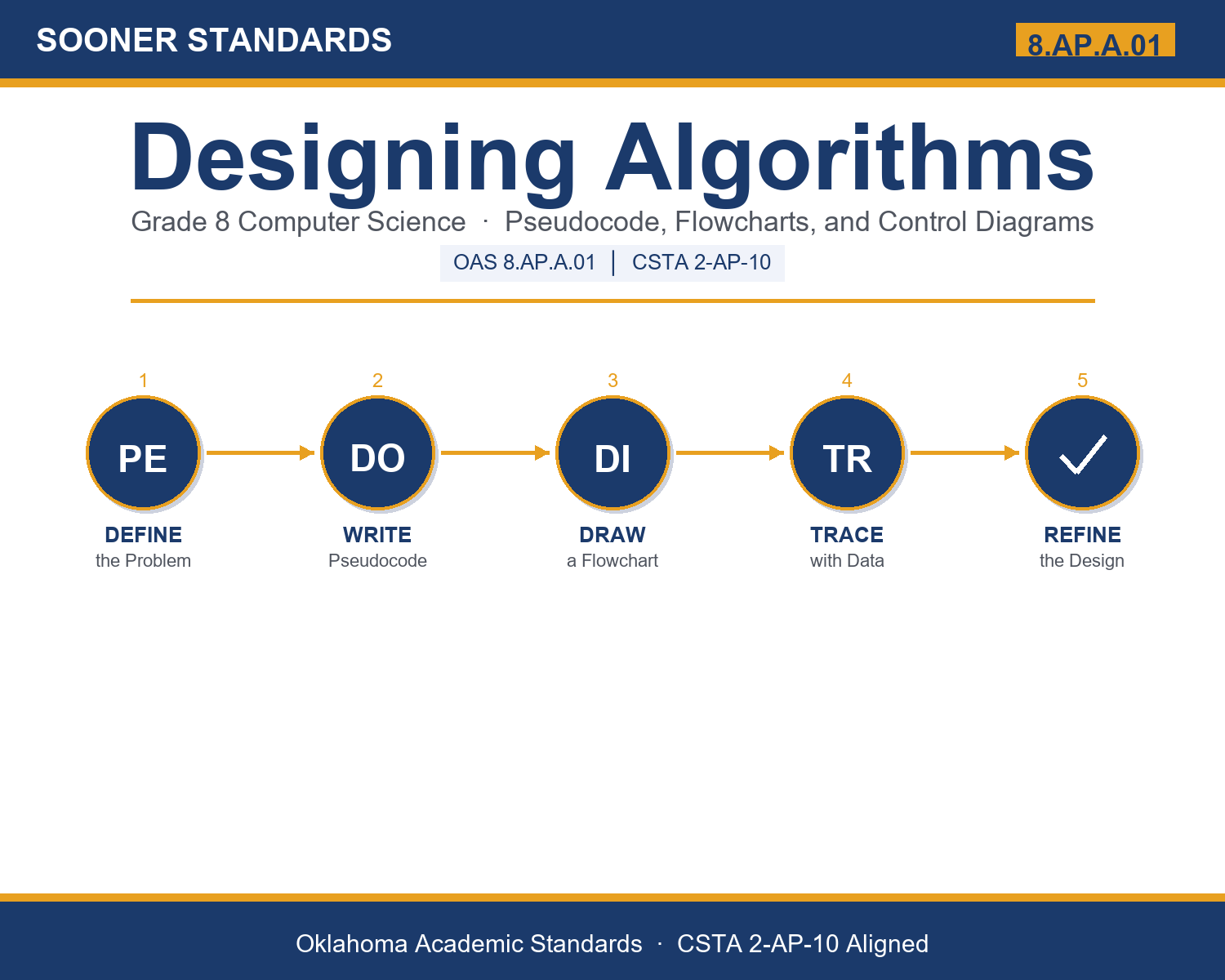
Designing Algorithms: Pseudocode, Flowcharts, and Control Structures
Teaching Designing Algorithms in Grade 8: Oklahoma Standard 8.AP.A.01
Every recipe, assembly instruction, and set of directions is a form of algorithm — students just don't usually think of it that way. Oklahoma's grade 8 computer science standard 8.AP.A.01 asks students to take that everyday idea and formalize it: designing algorithms in natural language, flowcharts, and pseudocode to solve problems that are too complex to just wing. This post walks through what the standard means, the vocabulary students need, and a few discussion starters you can use tomorrow, whether you teach in a classroom or at your kitchen table.
What Does Standard 8.AP.A.01 Actually Ask?
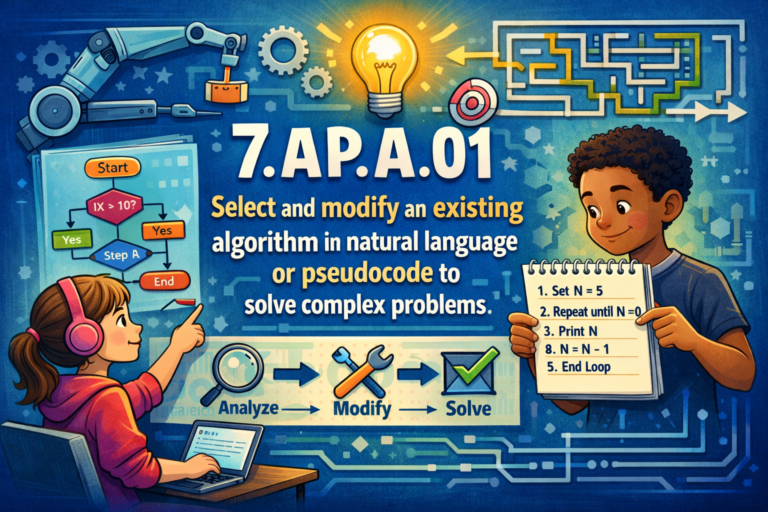
Design algorithms in natural language, flow and control diagrams, comments within code, and/or pseudocode to solve complex problems. — Oklahoma Academic Standards for Computer Science (February 2023)
In plain language: eighth graders need to be able to plan out a solution to a complex problem before they touch a keyboard — using whichever planning tool fits the job, whether that's a numbered list in plain English, a flowchart with decision diamonds, or pseudocode that reads like a hybrid of English and code.
Key Vocabulary Students Will Learn
This standard comes with real vocabulary load — thirteen terms, each with a definition and a concrete example in the unit:
Algorithm, Pseudocode, Flowchart, Sequence, Conditional, Iteration, Variable, Input, Output, Decision, Decomposition, Comment, Syntax
These aren't just vocabulary-quiz words. They're the actual toolkit students reach for the moment they open a blank document and need to plan a program — the difference between a student who can describe a solution and one who can only guess at code.
What's Inside the Lesson
The content reading opens with the idea that a good algorithm has to be clear, complete, and finite — every step unambiguous, nothing missing, and an actual stopping point. From there it walks through why professional programmers plan before they code: catching logic errors on paper is far cheaper than catching them after the fact, and pseudocode lets a student focus on what a program should do without getting tangled in the exact syntax of a specific language yet.
That planning-first mindset is the throughline of the whole standard — flowcharts and pseudocode aren't busywork, they're what separates a program that happens to work from one that was actually designed.
Discussion Starters You Can Use Tomorrow
- When would you reach for a flowchart instead of writing pseudocode — and when would pseudocode be faster?
- Why might a program work perfectly on paper as an algorithm but still need debugging once it's actual code?
- Can you think of a daily routine with a decision point in it (an "if this, then that")? How would you draw that as a flowchart?
Where This Leads
Students who can design algorithms in natural language, diagrams, and pseudocode are building the exact planning skill that professional software developers, game designers, and engineers use before writing a single line of production code — the habit of thinking through a solution completely before building it.
See the Unit in Action
Get the Complete 8.AP.A.01 Unit
I built a complete, no-prep unit for this standard — Designing Algorithms: Pseudocode, Flowcharts, and Control Structures — across 22 ready-to-print pages:
- Vocabulary reference — all 13 terms with definitions and real-world examples
- Full content reading with embedded comprehension checkpoints
- 10-question assessment (6 multiple choice, 4 true/false) with a complete answer key and explanations
- Group activity — "Algorithm Design Challenge"
- Individual activity — "Algorithm Trace and Fix"
- Crossword and word search built from all 13 vocabulary terms (with answer keys)
- Standards alignment verification page
- Algorithm Design Worksheet (separate printable)
- Pseudocode Reference Sheet (separate printable)
Get Designing Algorithms on Teachers Pay Teachers →
Every Sooner Standards resource is built directly from the official Oklahoma Academic Standards for Computer Science (February 2023) — standard text verified, never paraphrased from memory.