Teaching Algorithms Across Disciplines in Grades 9-10 (Level 1): Oklahoma Standard L1.IC.CU.03
Teaching Algorithms Across Disciplines in Grades 9-10 (Level 1): Oklahoma Standard L1.IC.CU.03
Teaching algorithms across disciplines in grades 9-10 (level 1) does not have to be complicated. Picture a bioinformatics technician adapting a search algorithm from text search to genetic sequence matching. That kind of thinking is exactly what Oklahoma's grades 9-10 (level 1) computer science standard L1.IC.CU.03 asks students to practice — and it is very teachable with the right materials. This post walks through what the standard means, the misconceptions students bring to it, and discussion starters you can use tomorrow, whether you teach in a classroom or at your kitchen table.
What Does Standard L1.IC.CU.03 Actually Ask?
Demonstrate ways a given algorithm can help solve computational problems across disciplines. — Oklahoma Academic Standards for Computer Science (February 2023)
In plain language: This standard asks Level 1 students (grades 9-10) to demonstrate ways a given algorithm can help solve computational problems across different disciplines — showing that the same underlying tool, like a pattern-matching or optimization algorithm, can be adapted to work in fields as different as healthcare, environmental science, business, and the arts.
In student-friendly terms, the learning target is: "I can demonstrate ways a given algorithm can help solve computational problems across different disciplines, and explain why the same algorithm transfers from one field to another."
What Students Should Be Able to Do
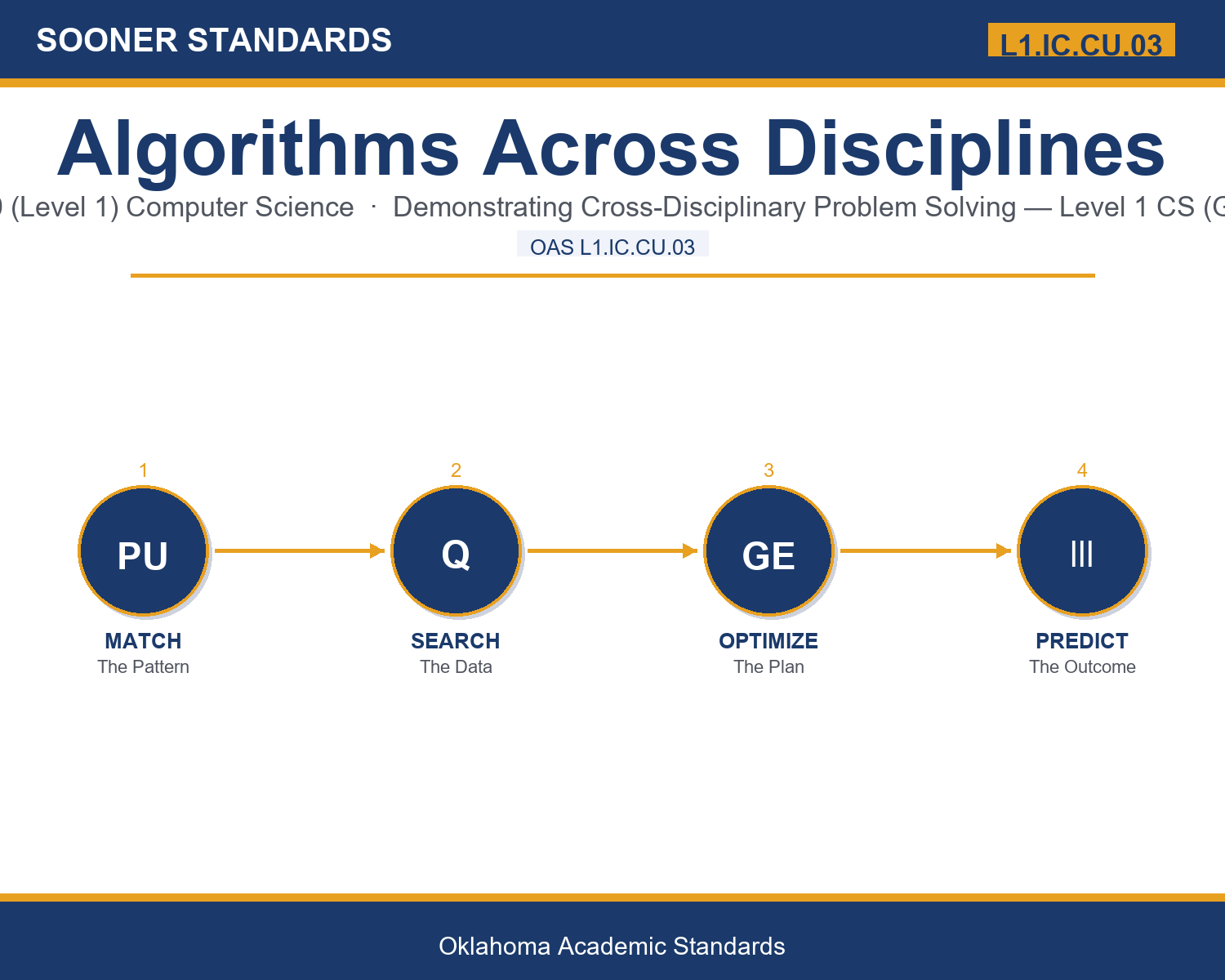
- I can name the four algorithm families covered in this unit (pattern matching, search, optimization, simulation) and describe what problem each one solves.
- I can demonstrate how a given algorithm family applies to real problems in at least two unrelated disciplines.
- I can explain why an algorithm transfers across disciplines by identifying the underlying problem shape it solves.
- I can distinguish between a discipline and a domain when describing where an algorithm is applied.
Along the way, students pick up the working vocabulary of the topic: algorithm, discipline, domain, model, simulation, pattern, dataset, iteration, optimization, heuristic, prediction, application, adaptation.
Algorithms Across Disciplines: Misconceptions to Watch For
These are the wrong turns students reliably take with this standard — knowing them ahead of time is half the lesson plan. Each correction strategy below comes straight from the unit's teacher guide (the paragraph and activity references point into the unit itself).
1. "An algorithm built for one field (like healthcare) can only ever be used in that field."
Return to paragraph 2's pattern-matching example. The exact same underlying algorithm was adapted from handwriting recognition to medical imaging with only a change in training data, not a change in the algorithm's core logic.
2. "Every new discipline requires an entirely new kind of computer science thinking."
Point back to paragraph 7's central idea: what matters is the underlying problem shape (searching, sorting, optimizing, predicting), not the surface-level subject matter. The same four algorithm families reappear across every discipline in this unit.
3. "A discipline and a domain are the same thing."
Use the definitions in the vocabulary list directly: a discipline is a broad field (biology), while a domain is the specific problem space within that field (genetic sequence matching). Have students generate their own discipline/domain pair as a quick check.
4. "Only STEM fields like medicine and environmental science use algorithms; the arts do not."
Revisit paragraph 5 on generative art and music composition algorithms. Creative fields adapt pattern-based and procedural algorithms just as directly as scientific fields do.
Discussion Starters You Can Use Tomorrow
- Pick one algorithm family from this unit. Which discipline in the reading do you think uses it in the most surprising or unexpected way?
- Why might it be faster and cheaper for a company or research team to adapt an existing algorithm from another discipline rather than build a brand-new one from scratch?
- Describe a career you are interested in that was NOT named in this unit. What computational problem might exist in that career, and which algorithm family might help solve it?
Bringing It Home
This topic is a natural one for families. One ten-minute activity to try: Together, pick a job or activity someone in your family does regularly (planning meals, managing a budget, organizing a garage). Ask your student to describe the underlying problem (searching, sorting, optimizing, or predicting) and brainstorm what a computer algorithm built for that exact same underlying problem could look like, even if it comes from a completely different field. There are no wrong answers — the goal is hearing their reasoning.
Where This Leads
Students who can demonstrate ways a given algorithm can help solve computational problems across different disciplines, and explain why the same algorithm transfers from one field to another are building skills used every day in bioinformatics, environmental data analysis, healthcare data analysis, digital art and generative design, and business analytics.
See the Unit in Action
Get the Complete L1.IC.CU.03 Unit
I built a complete, no-prep unit for this standard — One Algorithm, Many Fields: Cross-Disciplinary Problem Solving — covering 3-4 days of instruction across 44 pages:
- Teacher guide — day-by-day pacing, misconceptions to watch for, discussion questions, differentiation for support / ELL / extension, and a 4-point rubric
- Student learning target page — a kid-friendly "I can" statement with success criteria
- Full content lesson with 3 embedded "Check Your Understanding" checkpoints
- 12-question assessment (6 multiple choice, 4 true/false, 2 short answer) with a complete answer key, explanations, and exemplar responses
- Group activity — "Algorithm Detectives: Trace It Across Disciplines" (25-30 minutes)
- Individual activity — "My Cross-Disciplinary Algorithm Case Study" (20 minutes)
- Crossword and word search built from all 13 vocabulary terms (with answer keys)
- Family connection letter — a plain-language page for parents, with dinner-table questions and a 10-minute home activity
- Certificate of achievement — ready to sign and send home
- Discipline Scenario Card Set: Algorithm Detectives (separate printable, 2 pages)
- Reference Sheet: Four Algorithm Families (separate printable, 2 pages)
- My Cross-Disciplinary Algorithm Case Study (separate printable, 2 pages)
Get Algorithms Across Disciplines on Teachers Pay Teachers →
Every Sooner Standards resource is built directly from the official Oklahoma Academic Standards for Computer Science (February 2023) — standard text verified, never paraphrased from memory.