Teaching Choosing the Right Computing System in Grade 5: Arkansas Standard 4.1.1
Teaching Choosing the Right Computing System in Grade 5: Arkansas Standard 4.1.1
Teaching computing systems in grade 5 does not have to be complicated. Picture a photographer shooting on a smartphone but editing on a desktop with a color-accurate monitor. That kind of thinking is exactly what Arkansas's grade 5 computer science standard 4.1.1 asks students to practice — and it is very teachable with the right materials. This post walks through what the standard means, the misconceptions students bring to it, and discussion starters you can use tomorrow, whether you teach in a classroom or at your kitchen table.
What Does Standard 4.1.1 Actually Ask?
Computer Components – Focusing on the basic functions of each part of the computer. — Arkansas Computer Science 5-8 Embedded Standards, 2025
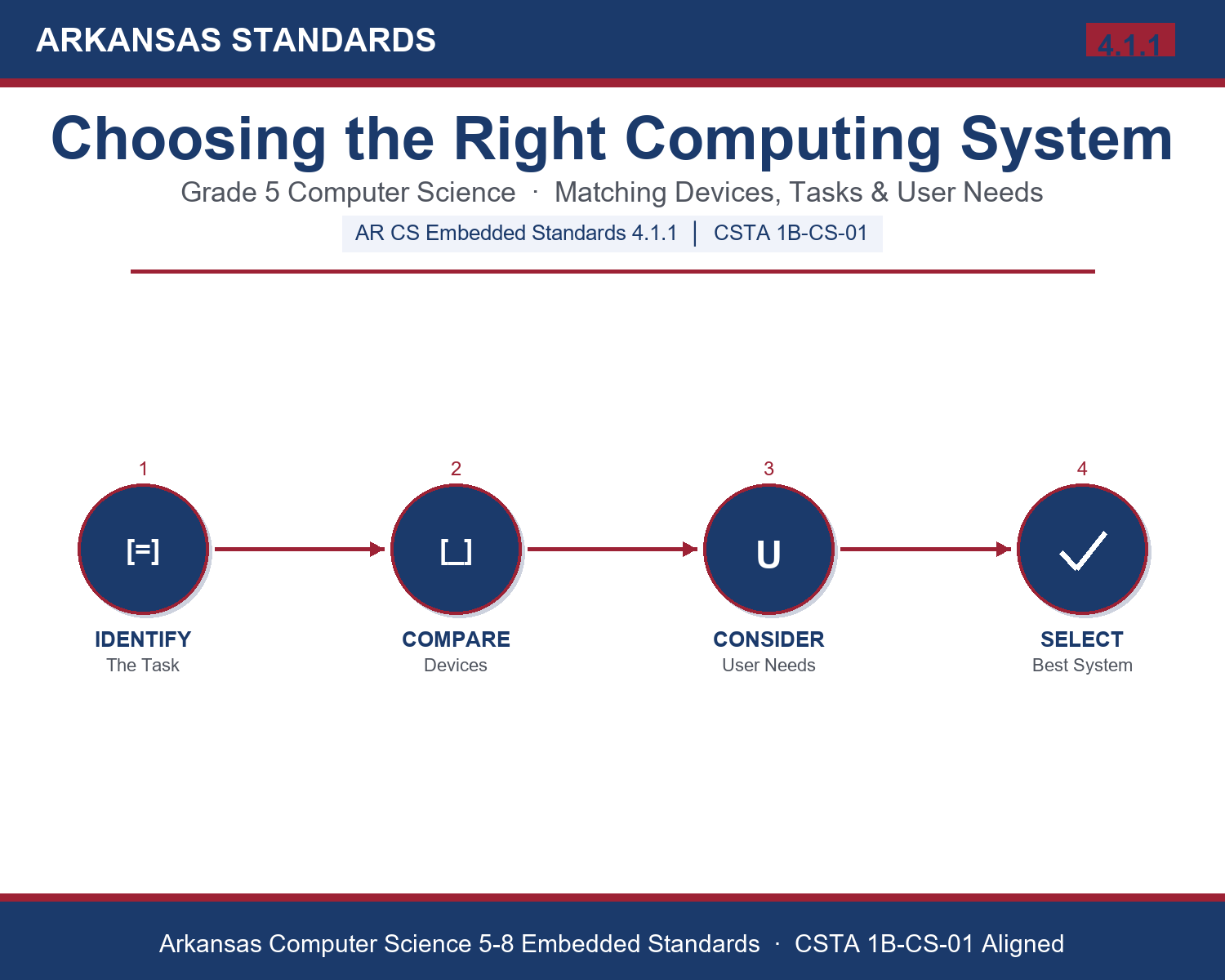
In plain language: Arkansas's computer science standards ask fifth graders to understand the parts of a computing system and what affects how well it performs — including picking the most efficient device for a task and explaining their thinking, and understanding that different people need different technology, like voice typing for someone who struggles with a keyboard.
In student-friendly terms, the learning target is: "I can choose the most efficient computing system for a task and explain my choice, remembering that different users have different technology needs."
What Students Should Be Able to Do
- I can name the strengths and weaknesses of desktops, laptops, tablets, and smartphones.
- I can match a task to the device that completes it most efficiently and explain why.
- I can describe at least two accessibility features and explain who they help.
- I can explain how a peripheral can change which tasks a device handles well.
Along the way, students pick up the working vocabulary of the topic: device, hardware, software, efficient, task, laptop, tablet, desktop, accessibility, peripheral, storage, processor.
Computing Systems: Misconceptions to Watch For
These are the wrong turns students reliably take with this standard — knowing them ahead of time is half the lesson plan. Each correction strategy below comes straight from the unit's teacher guide (the paragraph and activity references point into the unit itself).
1. "The newest or most expensive device is always the best choice."
Return to the task-first questions in paragraph 6. Have students name a task where a cheap, old desktop beats a brand-new phone (long typing, big-screen editing). Efficiency depends on the task, never the device alone.
2. "Hardware and software are the same thing, or the words are interchangeable."
Use the touch test: if you can physically touch it, it is hardware. Reinforce with the keyboard-without-a-writing-program example from paragraph 1 — neither part does useful work alone.
3. "Accessibility features are 'extras' only for a few people."
Point out features everyone already uses: captions in a noisy room, voice assistants while cooking. Good design helps every user; the standard's own language says users have different needs.
4. "A tablet can never be used for writing tasks."
Paragraph 4 covers this — adding a peripheral keyboard changes what the device handles efficiently. The device's abilities are not fixed; peripherals stretch them.
Discussion Starters You Can Use Tomorrow
- What device do you reach for first at home, and is it actually the most efficient choice for what you usually do on it?
- Why do schools buy desktops for computer labs but give teachers laptops?
- Describe a task where the 'weakest' device in the reading (the smartphone) is clearly the BEST tool.
Bringing It Home
This topic is a natural one for families. One ten-minute activity to try: Together, pick three tasks your family did on a device this week (sending a photo, paying a bill, watching a movie). For each one, ask your child whether the device used was the most efficient choice and what they would pick instead. There are no wrong answers — the goal is hearing their reasoning.
Where This Leads
Students who can choose the most efficient computing system for a task and explain my choice, remembering that different users have different technology needs are building skills used every day in IT support, healthcare technology, photography and media, logistics, and game design.
Part of the Complete Grade 5 Computer Science Curriculum
This lesson covers just one standard. It is part of a complete grade 5 computer science curriculum aligned to every Oklahoma OAS CS standard. See the full listing — every standard, organized by strand — here: Grade 5 Computer Science Curriculum: Every Oklahoma OAS CS Standard.
See the Unit in Action
Get the Complete 4.1.1 Unit
I built a complete, no-prep unit for this standard — Choosing the Right Computing System for the Job — covering 3-4 days of instruction across 40 pages:
- Teacher guide — day-by-day pacing, misconceptions to watch for, discussion questions, differentiation for support / ELL / extension, and a 4-point rubric
- Student learning target page — a kid-friendly "I can" statement with success criteria
- Full content lesson with 3 embedded "Check Your Understanding" checkpoints
- 12-question assessment (6 multiple choice, 4 true/false, 2 short answer) with a complete answer key, explanations, and exemplar responses
- Group activity — "Match the Task to the Tech" (20-30 minutes)
- Individual activity — "My Tech Toolkit Reflection" (15-20 minutes)
- Crossword and word search built from all 12 vocabulary terms (with answer keys)
- Family connection letter — a plain-language page for parents, with dinner-table questions and a 10-minute home activity
- Certificate of achievement — ready to sign and send home
- Task Card Set: Match the Task to the Tech (separate printable, 2 pages)
- Reference Notes: Computing Systems & Devices (separate printable, 2 pages)
- My Tech Toolkit Reflection (separate printable, 2 pages)
Get Choosing the Right Computing System on Teachers Pay Teachers →
Also aligned to CSTA 1B-CS-01: Describe how internal and external parts of computing devices function to form a system.
Every Arkansas Standards resource is built directly from the official Arkansas Computer Science 5-8 Embedded Standards, 2025 — standard text verified, never paraphrased from memory.