Refining Computational Models: Inference and Improvement
Teaching Refining Computational Models in Grade 8: Oklahoma Standard 8.DA.IM.01
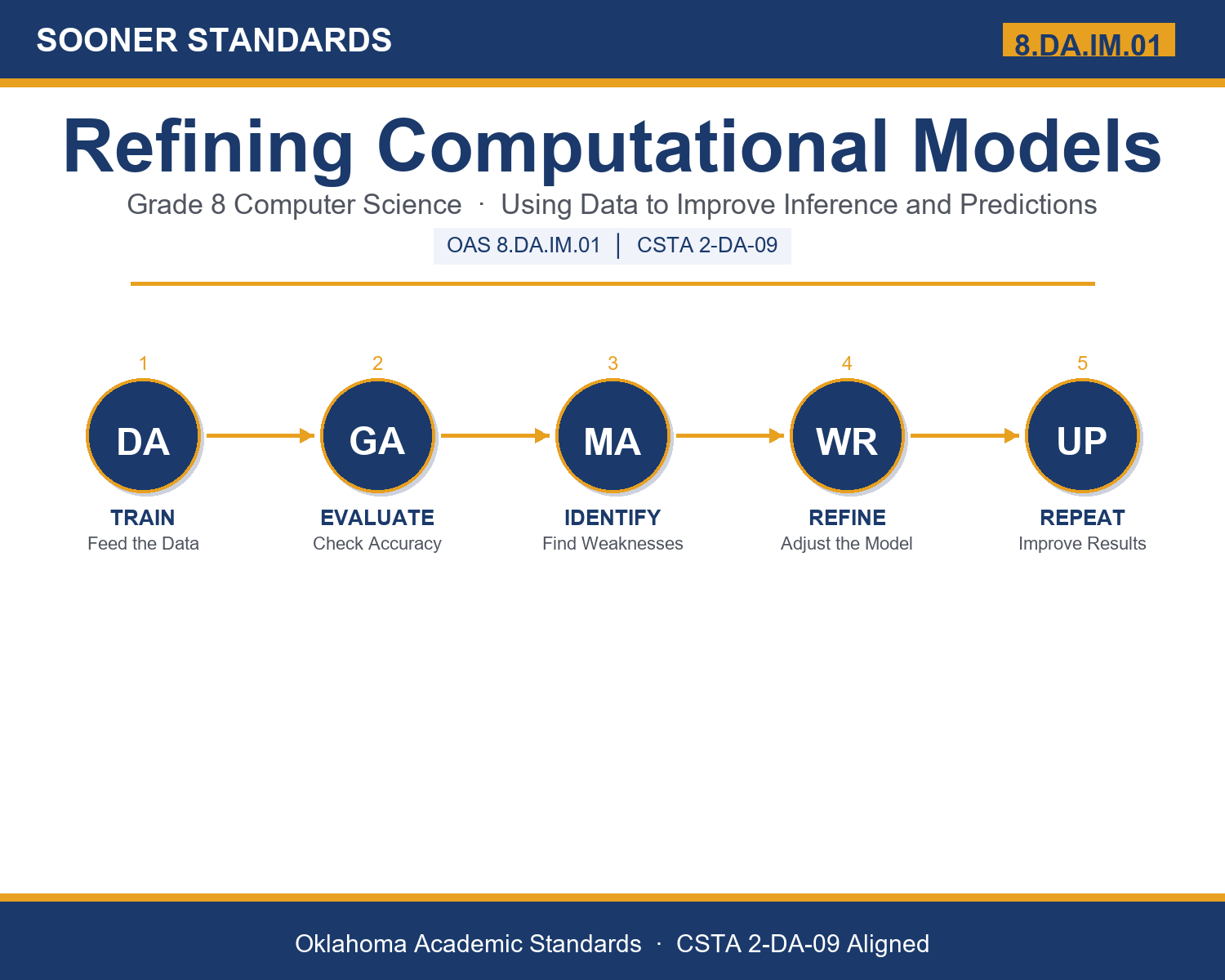
A computational model that predicts drive time across town and a model that predicts the spread of a virus share the same fundamental limitation: neither is a perfect copy of reality. Oklahoma's standard 8.DA.IM.01 asks eighth graders to work with that limitation directly — refining computational models based on the data the models themselves generate. This post walks through what the standard means, the vocabulary students need, and a few discussion starters you can use tomorrow.
What Does Standard 8.DA.IM.01 Actually Ask?
Refine computational models based on the data generated by the models. — Oklahoma Academic Standards for Computer Science (February 2023)
In plain language: students need to understand that a model's predictions can be checked against real outcomes — and when a model gets things wrong, that mismatch is exactly the information needed to make it better.
Key Vocabulary Students Will Learn
Model, Inference, Iteration, Accuracy, Training, Validation, Bias, Overfitting, Prediction, Dataset, Feedback, Parameter, Refinement
Several of these terms — Training, Bias, Overfitting — are foundational vocabulary for understanding how modern predictive and AI systems actually work.
What's Inside the Lesson
The content reading defines computational models as tools that use data and mathematical rules to represent real-world processes and make predictions about future events or outcomes — anything from a simple formula estimating drive time to a complex system predicting the spread of a virus through a population. The key idea the reading builds toward: no matter how sophisticated, every model is an approximation, not a perfect copy of reality, which means every model has room to improve.
Discussion Starters You Can Use Tomorrow
- Can you think of a prediction (a weather forecast, a sports score prediction) that turned out to be wrong? What might have caused the gap between the prediction and reality?
- Why might a model that fits its training data perfectly still make bad predictions on new, real-world situations?
- If a model consistently makes the same kind of mistake, how would you use that pattern to improve it?
Where This Leads
Students who understand how to refine computational models are building foundational literacy for a world increasingly run on predictive systems and AI — the ability to question a model's output instead of just trusting it.
See the Unit in Action
Get the Complete 8.DA.IM.01 Unit
I built a complete, no-prep unit for this standard — Refining Computational Models: Inference and Improvement — across 23 ready-to-print pages:
- Vocabulary reference — all 13 terms with definitions and real-world examples
- Full content reading with embedded comprehension checkpoints
- 10-question assessment (6 multiple choice, 4 true/false) with a complete answer key and explanations
- Group activity — "Model Refinement Simulation"
- Individual activity — "Bias Detective: Analyzing a Flawed Model"
- Crossword and word search built from all 13 vocabulary terms (with answer keys)
- Standards alignment verification page
- Bias Detective Worksheet (separate printable)
- Model Iteration Tracker (separate printable)
- Model Refinement Reference (separate printable)
Get Refining Computational Models on Teachers Pay Teachers →
Every Sooner Standards resource is built directly from the official Oklahoma Academic Standards for Computer Science (February 2023) — standard text verified, never paraphrased from memory.