Teaching Packets on the Move in Grade 5: Oklahoma Standard 5.NI.NCO.01
Teaching Packets on the Move in Grade 5: Oklahoma Standard 5.NI.NCO.01
Teaching how the internet works in grade 5 does not have to be complicated. Picture a network technician tracing why packets slow down when a whole school streams video at once. That kind of thinking is exactly what Oklahoma's grade 5 computer science standard 5.NI.NCO.01 asks students to practice — and it is very teachable with the right materials. This post walks through what the standard means, the misconceptions students bring to it, and discussion starters you can use tomorrow, whether you teach in a classroom or at your kitchen table.
What Does Standard 5.NI.NCO.01 Actually Ask?
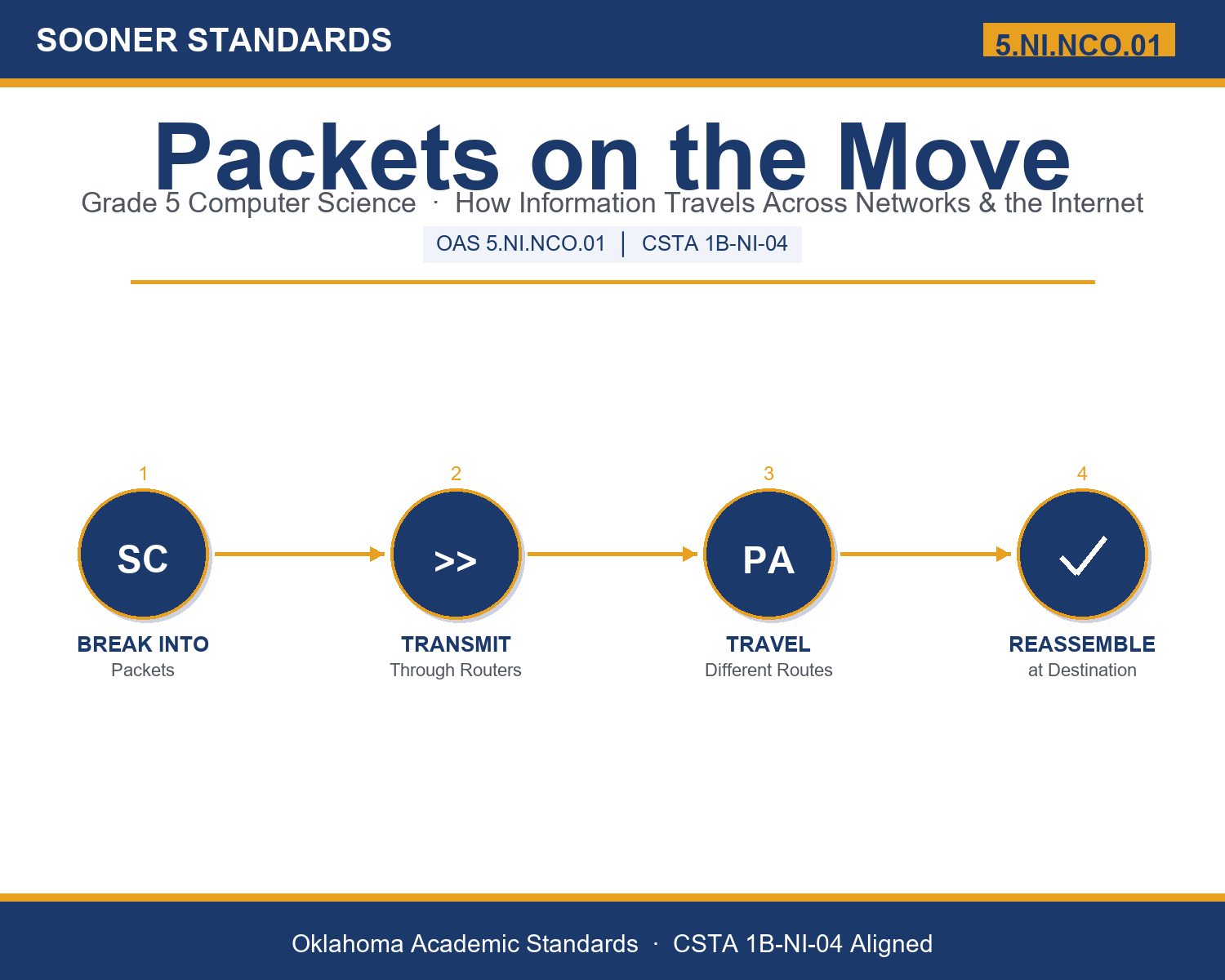
Model how information is broken down into packets (i.e., smaller pieces), transmitted through multiple devices over networks and the Internet, and reassembled at the destination. — Oklahoma Academic Standards for Computer Science (February 2023)
In plain language: Oklahoma's standard asks fifth graders to model the whole journey: how a message is broken into small pieces, how those pieces travel through many devices like the Wi-Fi router in your home, and how they are put back together in the right order when they arrive.
In student-friendly terms, the learning target is: "I can model how information is broken into packets, transmitted through many devices across networks and the Internet, and reassembled in the correct order at its destination."
What Students Should Be Able to Do
- I can explain the three things every packet carries: a piece of the data, the destination address, and a sequence number.
- I can describe how routers move packets and why packets from the same message can take different routes.
- I can explain how the destination device puts packets back in order and recovers a lost packet.
- I can use packets to explain everyday network problems, like a frozen video call or slow Wi-Fi.
Along the way, students pick up the working vocabulary of the topic: packet, network, internet, router, server, transmit, destination, reassemble, address, wireless, connection, route.
How The Internet Works: Misconceptions to Watch For
These are the wrong turns students reliably take with this standard — knowing them ahead of time is half the lesson plan. Each correction strategy below comes straight from the unit's teacher guide (the paragraph and activity references point into the unit itself).
1. "All the packets from one message travel together along the same path, like train cars."
Re-run the relay activity moment where packets split between Routers, or revisit paragraph 4's traffic analogy. Routers send each packet along whatever path is best at that instant — piece 52 can legally arrive before piece 47 because sequence numbers fix the order at the end.
2. "If a packet is lost, the whole message must start over from the beginning."
Point to the puzzle-envelope analogy in paragraph 1: if one envelope is lost in the mail, you ask for that envelope, not the whole puzzle. The destination requests only the missing sequence number.
3. "The Internet is one single thing — a cloud or a company that someone owns."
Unpack the word itself: INTERconnected NETworks. No one owns it all; it works because thousands of separate networks agree to the same packet rules. Your school network and a network in another country are separate networks that cooperate.
4. "Slow Wi-Fi means the computer or the app is broken."
Use paragraph 7's troubleshooting frame: most slowdowns are packets competing for space or being lost and resent over a weak signal. Ask students what else in the house was using the network when things got slow.
Discussion Starters You Can Use Tomorrow
- Why do you think the inventors of the Internet chose small packets instead of sending each message whole? What would tonight's video streaming look like the other way?
- Our relay used 5-6 packets per message. A real photo can be thousands of packets. What parts of our model would stay the same at that scale, and what parts would break down?
- When your video call freezes, what is happening to the packets? What could you change in the room to help them?
Bringing It Home
This topic is a natural one for families. One ten-minute activity to try: Write a short sentence on a strip of paper, cut it into 5 pieces, and number the pieces on the back. Shuffle them and hand them to your child one at a time, holding one piece back. Ask them to rebuild the sentence, notice which numbered piece is missing, and 'request' it from you — that is exactly how the Internet delivers everything you send.
Where This Leads
Students who can model how information is broken into packets, transmitted through many devices across networks and the Internet, and reassembled in the correct order at its destination are building skills used every day in network engineering, IT support, cybersecurity, game development, and video streaming technology.
Part of the Complete Grade 5 Computer Science Curriculum
This lesson covers just one standard. It is part of a complete grade 5 computer science curriculum aligned to every Oklahoma OAS CS standard. See the full listing — every standard, organized by strand — here: Grade 5 Computer Science Curriculum: Every Oklahoma OAS CS Standard.
See the Unit in Action
Get the Complete 5.NI.NCO.01 Unit
I built a complete, no-prep unit for this standard — Packets on the Move: How Information Travels Across Networks and the Internet — covering 3-4 days of instruction across 41 pages:
- Teacher guide — day-by-day pacing, misconceptions to watch for, discussion questions, differentiation for support / ELL / extension, and a 4-point rubric
- Student learning target page — a kid-friendly "I can" statement with success criteria
- Full content lesson with 3 embedded "Check Your Understanding" checkpoints
- 12-question assessment (6 multiple choice, 4 true/false, 2 short answer) with a complete answer key, explanations, and exemplar responses
- Group activity — "The Classroom Packet Relay" (25-30 minutes)
- Individual activity — "Design a Packet Journey Map" (15-20 minutes)
- Crossword and word search built from all 12 vocabulary terms (with answer keys)
- Family connection letter — a plain-language page for parents, with dinner-table questions and a 10-minute home activity
- Certificate of achievement — ready to sign and send home
- Packet Relay Message Strips (separate printable, 1 page)
- Network Vocabulary Reference Sheet (separate printable, 2 pages)
- Design a Packet Journey Map (separate printable, 2 pages)
Get Packets on the Move on Teachers Pay Teachers →
Also aligned to CSTA 1B-NI-04: Model how information is broken down into smaller pieces, transmitted as packets through multiple devices over networks and the Internet, and reassembled at the destination.
Every Sooner Standards resource is built directly from the official Oklahoma Academic Standards for Computer Science (February 2023) — standard text verified, never paraphrased from memory.