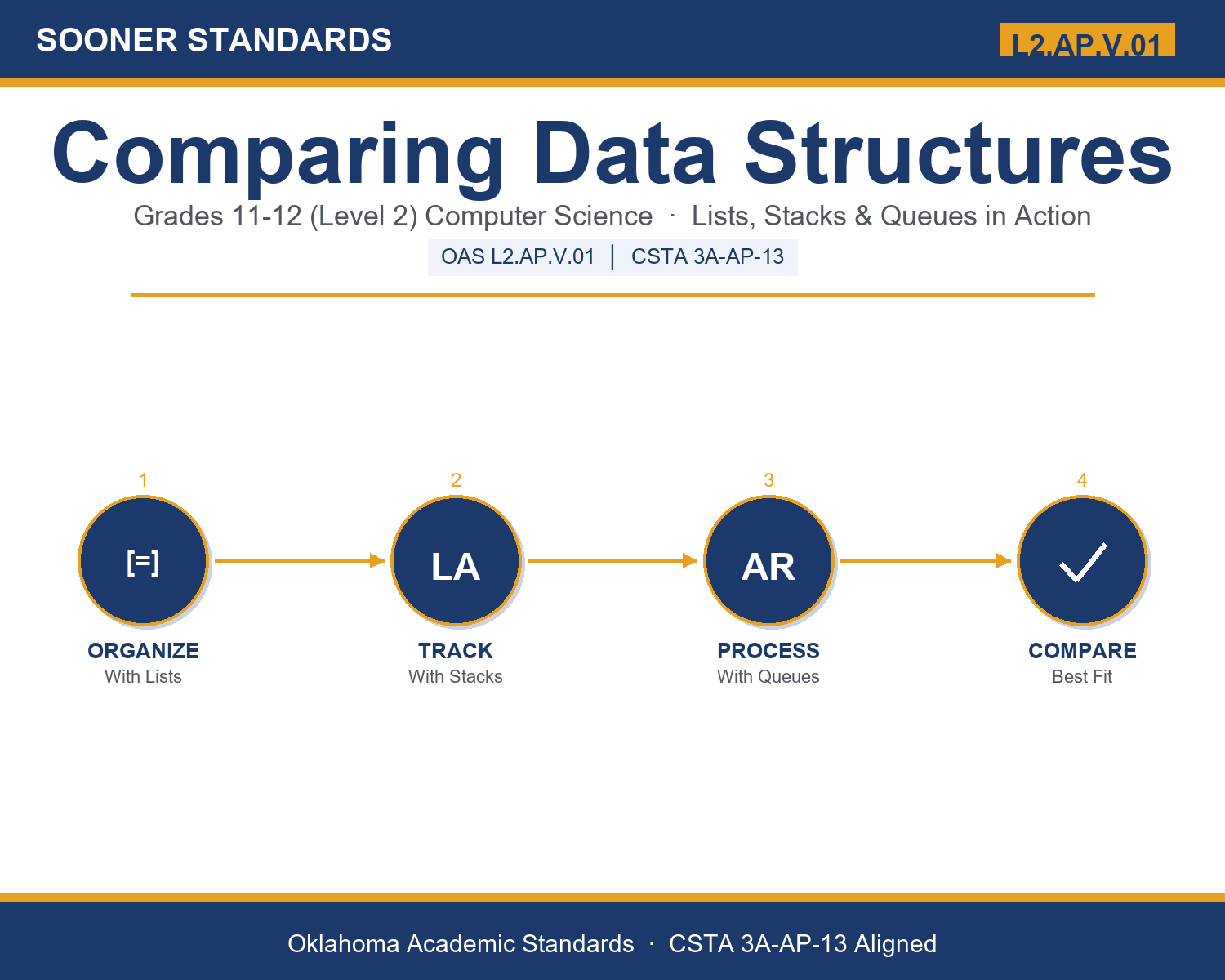
Teaching Comparing Data Structures in Grades 11-12 (Level 2): Oklahoma Standard L2.AP.V.01
Teaching Comparing Data Structures in Grades 11-12 (Level 2): Oklahoma Standard L2.AP.V.01
Teaching stacks and queues in grades 11-12 (level 2) does not have to be complicated. Picture a backend engineer choosing a queue to fairly process thousands of incoming server requests without dropping any. That kind of thinking is exactly what Oklahoma's grades 11-12 (level 2) computer science standard L2.AP.V.01 asks students to practice — and it is very teachable with the right materials. This post walks through what the standard means, the misconceptions students bring to it, and discussion starters you can use tomorrow, whether you teach in a classroom or at your kitchen table.
What Does Standard L2.AP.V.01 Actually Ask?
Compare and contrast data structures and their uses (e.g., lists, stacks, queues). — Oklahoma Academic Standards for Computer Science (February 2023)
In plain language: This standard asks students to compare different ways a program can store a group of items, and to explain which way fits best for a given situation — whether the program needs to grab any item directly, grab the newest item first, or grab the oldest waiting item first.
In student-friendly terms, the learning target is: "I can compare and contrast lists, stacks, and queues by describing how each one controls access to its data, and I can choose and justify the best-fit structure for a given real-world scenario."
What Students Should Be Able to Do
- I can describe how a list, a stack, and a queue each control access to their elements, using index, LIFO, and FIFO correctly.
- I can trace push/pop operations on a stack and enqueue/dequeue operations on a queue, showing the contents change accurately at each step.
- I can identify which structure best fits a described scenario and explain why, referencing its access order.
- I can explain what overflow and underflow errors are and why professional code checks for them.
Along the way, students pick up the working vocabulary of the topic: list, array, stack, queue, index, element, push, enqueue, dequeue, traversal, capacity, overflow, underflow.
Stacks And Queues: Misconceptions to Watch For
These are the wrong turns students reliably take with this standard — knowing them ahead of time is half the lesson plan. Each correction strategy below comes straight from the unit's teacher guide (the paragraph and activity references point into the unit itself).
1. "A stack and a queue are basically the same thing, just with different names."
Return to paragraph 6's side-by-side comparison. Have students trace the same sequence of adds and removes on both a stack and a queue and compare the resulting order to see the LIFO/FIFO difference directly.
2. "A list is always the best choice because it lets you access anything."
Use the undo-feature example from paragraph 4. Ask students what would happen if undo used a list instead of a stack — the program would have to search for the most recent action instead of simply popping it, which is slower and more complex.
3. "Overflow only happens with stacks, and underflow only happens with queues."
Point back to paragraph 8, which defines both errors for any structure with a boundary. Have students identify an overflow and an underflow scenario for a list, a stack, and a queue to see the errors apply to all three.
4. "Index 1 refers to the first element in a list."
Model a small example together, such as a 3-item list, and have students state what element sits at index 0. Reinforce that most programming languages start counting positions at 0, so index 1 is actually the second element.
Discussion Starters You Can Use Tomorrow
- Why might a programmer choose a stack over a list even though a list allows access to more positions?
- Describe a real-world process (not a computer program) that behaves like a queue, and one that behaves like a stack. What makes each one fit its label?
- If overflow means a structure is too full and underflow means it is too empty, why do professional programmers check for both before performing an operation?
Bringing It Home
This topic is a natural one for families. One ten-minute activity to try: Together, look around your home for an example of each: something organized like a stack (a pile of folded towels, mail on a desk) and something organized like a queue (a waiting list, a line for the bathroom). Have your student explain out loud which item would come off first in each case and why. There are no wrong answers — the goal is hearing their reasoning about access order.
Where This Leads
Students who can compare and contrast lists, stacks, and queues by describing how each one controls access to its data, and choose and justify the best-fit structure for a given real-world scenario are building skills used every day in software engineering, backend / systems engineering, data engineering, compiler / language engineering, and computer science education.
See the Unit in Action
Get the Complete L2.AP.V.01 Unit
I built a complete, no-prep unit for this standard — Comparing Data Structures: Lists, Stacks, and Queues — covering 3-4 days of instruction across 41 pages:
- Teacher guide — day-by-day pacing, misconceptions to watch for, discussion questions, differentiation for support / ELL / extension, and a 4-point rubric
- Student learning target page — a kid-friendly "I can" statement with success criteria
- Full content lesson with 3 embedded "Check Your Understanding" checkpoints
- 12-question assessment (6 multiple choice, 4 true/false, 2 short answer) with a complete answer key, explanations, and exemplar responses
- Group activity — "Pick the Structure: Lists, Stacks, and Queues in Action" (25-30 minutes)
- Individual activity — "My Data Structure Comparison Log" (20-25 minutes)
- Crossword and word search built from all 13 vocabulary terms (with answer keys)
- Family connection letter — a plain-language page for parents, with dinner-table questions and a 10-minute home activity
- Certificate of achievement — ready to sign and send home
- Scenario Card Set: Which Structure Fits? (separate printable, 2 pages)
- Reference Notes: Comparing Lists, Stacks, and Queues (separate printable, 2 pages)
- My Data Structure Comparison Log (separate printable, 2 pages)
Get Comparing Data Structures on Teachers Pay Teachers →
Also aligned to CSTA 3A-AP-13: Create prototypes that use algorithms to solve computational problems by leveraging prior student knowledge and personal interests.
Every Sooner Standards resource is built directly from the official Oklahoma Academic Standards for Computer Science (February 2023) — standard text verified, never paraphrased from memory.