Teaching Evaluating Algorithms: Efficiency & Clarity in Grades 11-12 (Level 2): Oklahoma Standard L2.AP.A.04
Teaching Evaluating Algorithms: Efficiency & Clarity in Grades 11-12 (Level 2): Oklahoma Standard L2.AP.A.04
Teaching algorithm efficiency and clarity in grades 11-12 (level 2) does not have to be complicated. Picture a software engineer choosing between a fast, complex algorithm and a simple, slower one to keep a codebase maintainable. That kind of thinking is exactly what Oklahoma's grades 11-12 (level 2) computer science standard L2.AP.A.04 asks students to practice — and it is very teachable with the right materials. This post walks through what the standard means, the misconceptions students bring to it, and discussion starters you can use tomorrow, whether you teach in a classroom or at your kitchen table.
What Does Standard L2.AP.A.04 Actually Ask?
Evaluate algorithms (e.g., sorting, searching) in terms of their efficiency and clarity. — Oklahoma Academic Standards for Computer Science (February 2023)
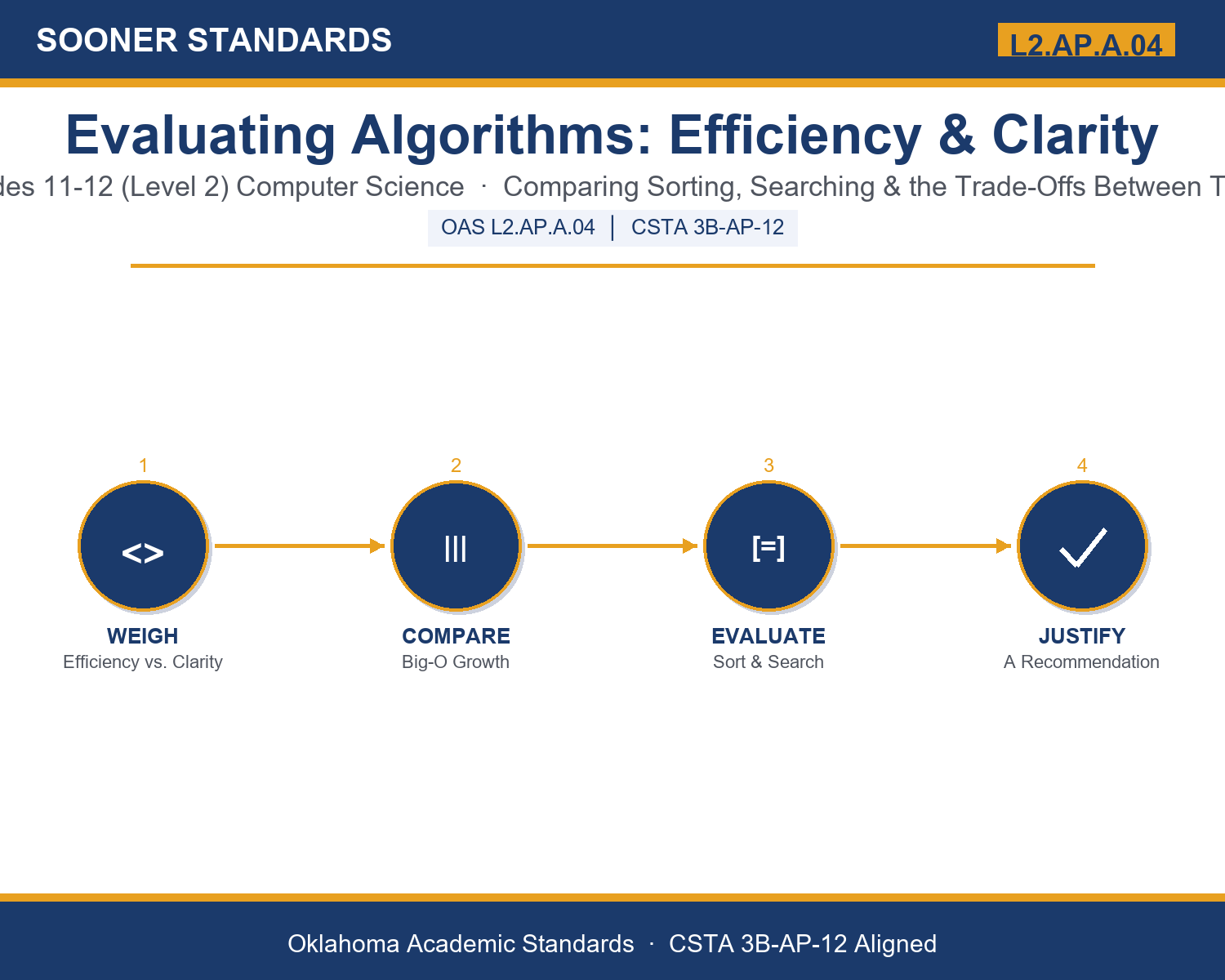
In plain language: This standard asks students to compare algorithms, such as ways of sorting or searching a list, and judge which one is the better choice based on how fast it runs and how easy it is to understand.
In student-friendly terms, the learning target is: "I can evaluate sorting and searching algorithms in terms of their efficiency and clarity, and I can justify which algorithm best fits a specific real-world scenario."
What Students Should Be Able to Do
- I can describe an algorithm's efficiency using Big-O growth-rate reasoning across best, average, and worst cases.
- I can judge an algorithm's clarity by naming specific reasons related to its structure and readability.
- I can weigh efficiency against clarity and justify a recommendation for a given scenario.
- I can explain why the 'fastest' algorithm is not always the 'best' algorithm for every situation.
Along the way, students pick up the working vocabulary of the topic: algorithm, efficiency, complexity, clarity, benchmark, tradeoff, scalability, readability, optimization, heuristic, growth, throughput, maintainable.
Algorithm Efficiency And Clarity: Misconceptions to Watch For
These are the wrong turns students reliably take with this standard — knowing them ahead of time is half the lesson plan. Each correction strategy below comes straight from the unit's teacher guide (the paragraph and activity references point into the unit itself).
1. "The algorithm with the best Big-O complexity is always the correct choice."
Return to paragraph 8's real-world scenarios. Have students compare a small-list scenario, where a simpler O(n squared) algorithm is the better real choice, against a large-scale scenario, where efficiency clearly wins, to show that 'best' depends on context.
2. "A clearer algorithm is always slower, and a faster algorithm is always less clear."
Point out that clarity and efficiency are two separate axes, not opposite ends of a single scale — some algorithms score low on both, and improving one does not automatically hurt the other. Have students name a change (better variable names, added comments) that improves clarity without changing an algorithm's Big-O complexity at all.
3. "Quicksort's average-case and worst-case performance are the same thing."
Return to paragraph 5's best/average/worst case discussion. Have students explain, in their own words, why quicksort's typical O(n log n) performance and its rare O(n squared) worst case are different claims about different situations.
4. "Binary search is always better than linear search because its Big-O complexity is lower."
Return to paragraph 7. Remind students that binary search's advantage depends entirely on the data already being sorted — for a short, frequently-changing, unsorted list, linear search can be the more practical choice once the cost of sorting is considered.
Discussion Starters You Can Use Tomorrow
- When might a team deliberately choose a less efficient algorithm on purpose? Give a specific reason.
- Why might a technical interviewer care more about how you justify your algorithm choice than which algorithm you pick?
- Describe a real-world process (not a computer program) where choosing the 'fastest' way to do something turned out to be the wrong choice.
Bringing It Home
This topic is a natural one for families. One ten-minute activity to try: Together, pick a household task that can be done more than one way (loading the dishwasher, packing a suitcase, organizing a closet) and have your student evaluate two approaches the way a computer scientist would: which is faster, which is easier to explain to someone else, and which they would actually recommend. There are no wrong answers — the goal is hearing their reasoning about the trade-off.
Where This Leads
Students who can evaluate sorting and searching algorithms in terms of their efficiency and clarity, and justify which algorithm best fits a specific real-world scenario are building skills used every day in software engineering, data engineering, systems / performance engineering, technical interviewing / hiring, and computer science education.
See the Unit in Action
Get the Complete L2.AP.A.04 Unit
I built a complete, no-prep unit for this standard — Evaluating Algorithms: Efficiency, Clarity, and the Trade-Offs Between Them — covering 3-4 days of instruction across 43 pages:
- Teacher guide — day-by-day pacing, misconceptions to watch for, discussion questions, differentiation for support / ELL / extension, and a 4-point rubric
- Student learning target page — a kid-friendly "I can" statement with success criteria
- Full content lesson with 3 embedded "Check Your Understanding" checkpoints
- 12-question assessment (6 multiple choice, 4 true/false, 2 short answer) with a complete answer key, explanations, and exemplar responses
- Group activity — "The Algorithm Evaluation Panel" (25-30 minutes)
- Individual activity — "My Algorithm Evaluation Worksheet" (20-25 minutes)
- Crossword and word search built from all 13 vocabulary terms (with answer keys)
- Family connection letter — a plain-language page for parents, with dinner-table questions and a 10-minute home activity
- Certificate of achievement — ready to sign and send home
- Scenario Card Set: Evaluating Algorithms (separate printable, 2 pages)
- Reference Notes: Evaluating Algorithm Efficiency and Clarity (separate printable, 2 pages)
- My Algorithm Evaluation Worksheet (separate printable, 2 pages)
Get Evaluating Algorithms: Efficiency & Clarity on Teachers Pay Teachers →
Also aligned to CSTA 3B-AP-12: Evaluate algorithms in terms of their efficiency, correctness, and clarity.
Every Sooner Standards resource is built directly from the official Oklahoma Academic Standards for Computer Science (February 2023) — standard text verified, never paraphrased from memory.