

Level 1 (Grades 9-10) Oklahoma Computer Science Standards vs. CSTA National Standards: The Full Comparison
Level 1 covers Oklahoma’s grades 9-10 computer science standards, which draw from CSTA’s Level 3A national band. This is the cleanest alignment we’ve found in this series: all 28 Level 1 standards trace directly back to a CSTA 3A standard — no Oklahoma-only additions, no gaps. Here’s the full standard-by-standard breakdown, with a downloadable spreadsheet.
Sourcing note — read this one before the data: while auditing this product line’s Level 1 build files, we found CSTA reference codes that directly contradicted each other — in a few cases the exact same CSTA code was attached to three different Oklahoma standards, and even live product-listing URLs disagreed with the build files and with each other. Rather than guess between conflicting sources, every CSTA code and text below was independently re-verified word-for-word against the official CSTA K-12 Computer Science Standards (Revised 2017), Level 3A band. This is the most rigorously sourced comparison in this series.
Download the Full Comparison Spreadsheet
Every Level 1 OAS-CS standard, its verified CSTA code, the verbatim text of both, and a comparison note — sortable and printable.
The Headline Numbers
- 28 of 28 Level 1 OAS-CS standards were checked against the CSTA Level 3A (grades 9-10) band.
- 28 standards have a direct CSTA match — 100%, the highest alignment rate of any grade band in this series.
- 0 standards are Oklahoma-only additions with no CSTA equivalent.
- Three standards are word-for-word identical to their CSTA source: L1.AP.C.01/3A-AP-15, L1.IC.CU.01/3A-IC-24, and L1.IC.SLE.01/3A-IC-28.
The Pattern Breaks: High School Drops the Oklahoma-Only Standards
Every middle-school grade in this series (6, 7, and 8) included at least one Oklahoma-specific standard with no CSTA match — almost always a netiquette or digital-citizenship standard. Level 1 breaks that pattern entirely. All 28 standards map cleanly onto CSTA’s 3A band, meaning Oklahoma’s high-school CS standards track the national framework far more tightly than its middle-school standards do. That’s a meaningful signal for anyone evaluating how “national” Oklahoma’s CS pathway really is by grade span.
Where the Text Diverges: AI, Licensing, and Documentation
Even where the match is “direct,” Oklahoma’s phrasing sometimes narrows or reframes the CSTA original. L1.AP.PD.02 asks students to evaluate software licensing schemes and their advantages/disadvantages — CSTA’s 3A-AP-20 frames the same idea more narrowly around evaluating licenses “when using resources such as libraries.” L1.DA.IM.01‘s language about illustrating relationships between data elements maps almost word-for-word onto 3A-DA-12‘s “computational models that represent the relationships among different elements of data.” These aren’t gaps — they’re the kind of light rewording you’d expect from a state adapting a national framework to its own standard-writing style.
Full Standard-by-Standard Comparison
| OAS-CS Code | CSTA Code | Oklahoma Standard | CSTA Standard |
|---|---|---|---|
| L1.AP.A.01 | 3A-AP-13 | Create a prototype that uses algorithms (e.g., searching, sorting, or finding shortest distance) to solve a real-world problem. | Create prototypes that use algorithms to solve computational problems by leveraging prior student knowledge and personal interests. |
| L1.AP.C.01 | 3A-AP-15 | Justify the selection of specific control structures when tradeoffs involve implementation, readability, and program performance, and explain the benefits and drawbacks of choices made. | Justify the selection of specific control structures when tradeoffs involve implementation, readability, and program performance, and explain the benefits and drawbacks of choices made. |
| L1.AP.M.01 | 3A-AP-17 | Decompose problems into procedures using systematic analysis and design. | Decompose problems into smaller components through systematic analysis, using constructs such as procedures, modules, and/or objects. |
| L1.AP.M.02 | 3A-AP-18 | Create computational artifacts by systematically organizing, manipulating and/or processing data. | Create artifacts by using procedures within a program, combinations of data and procedures, or independent but interrelated programs. |
| L1.AP.PD.01 | 3A-AP-19 | Create software that will provide solutions to a variety of users using a software development process. | Systematically design and develop programs for broad audiences by incorporating feedback from users. |
| L1.AP.PD.02 | 3A-AP-20 | Evaluate a variety of software licensing schemes and describe advantages and disadvantages of each. | Evaluate licenses that limit or restrict use of computational artifacts when using resources such as libraries. |
| L1.AP.PD.03 | 3A-AP-16 | Working in a team, develop, test, and refine event-based programs. | Design and iteratively develop computational artifacts for practical intent, personal expression, or to address a societal issue by using events to initiate instructions. |
| L1.AP.PD.04 | 3A-AP-23 | Create visual aids and/or documentation to illustrate the design elements and data flow (e.g., flowcharts, pseudocode) of the development of a complex program. | Document design decisions using text, graphics, presentations, and/or demonstrations in the development of complex programs. |
| L1.AP.PD.05 | 3A-AP-21 | Evaluate and refine computational artifacts to make them more user-friendly, efficient, and accessible. | Evaluate and refine computational artifacts to make them more usable and accessible. |
| L1.AP.V.01 | 3A-AP-14 | Use lists (arrays) to simplify solutions, generalizing computational problems. | Use lists to simplify solutions, generalizing computational problems instead of repeatedly using simple variables. |
| L1.CS.D.01 | 3A-CS-01 | Model how abstractions hide the underlying implementation details of computing systems embedded in everyday objects. | Explain how abstractions hide the underlying implementation details of computing systems embedded in everyday objects. |
| L1.CS.HS.01 | 3A-CS-02 | Analyze levels of abstraction and interactions between application software, system software, and hardware. | Compare levels of abstraction and interactions between application software, system software, and hardware layers. |
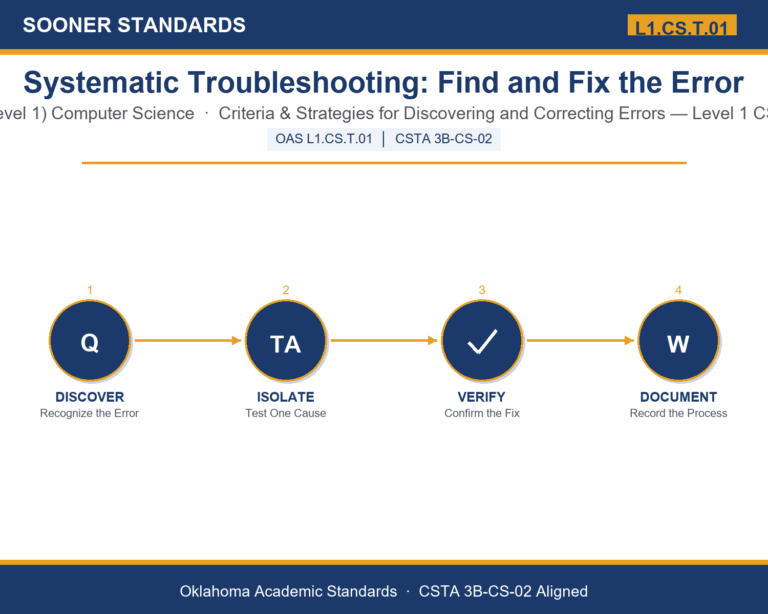
| L1.CS.T.01 | 3A-CS-03 | Develop and apply criteria for systematic discovery and correction of errors in computing systems. | Develop guidelines that convey systematic troubleshooting strategies that others can use to identify and fix errors. |
| L1.DA.CVT.01 | 3A-DA-11 | Use tools and techniques to locate, collect, and create visualizations of small- and large-scale data sets. | Create interactive data visualizations using software tools to help others better understand real-world phenomena. |
| L1.DA.IM.01 | 3A-DA-12 | Illustrate and explain relationships between collected data elements using computational models. | Create computational models that represent the relationships among different elements of data collected from a phenomenon or process. |
| L1.DA.S.01 | 3A-DA-09 | Convert and compare different bit representations of data types (e.g., characters, numbers, images). | Translate between different bit representations of real-world phenomena, such as characters, numbers, and images. |
| L1.DA.S.02 | 3A-DA-10 | Evaluate trade-offs in how data is organized and stored digitally. | Evaluate the tradeoffs in how data elements are organized and where data is stored. |
| L1.IC.CU.01 | 3A-IC-24 | Evaluate ways computing impacts personal, ethical, social, economic, and cultural practices. | Evaluate the ways computing impacts personal, ethical, social, economic, and cultural practices. |
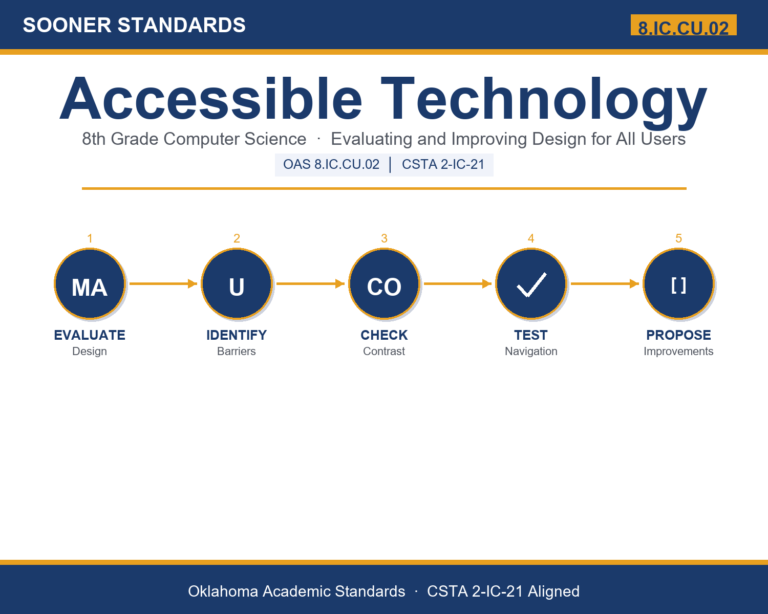
| L1.IC.CU.02 | 3A-IC-25 | Test and refine computational artifacts to ensure access to a variety of user audiences. | Test and refine computational artifacts to reduce bias and equity deficits. |
| L1.IC.CU.03 | 3A-IC-26 | Demonstrate ways a given algorithm can help solve computational problems across disciplines. | Demonstrate ways a given algorithm applies to problems across disciplines. |
| L1.IC.SI.01 | 3A-IC-27 | Demonstrate and/or debate how computing increases or decreases connectivity and communication among people of various cultures. | Use tools and methods for collaboration on a project to increase connectivity of people in different cultures and career fields. |
| L1.IC.SLE.01 | 3A-IC-28 | Explain the beneficial and harmful effects that intellectual property laws can have on innovation. | Explain the beneficial and harmful effects that intellectual property laws can have on innovation. |
| L1.IC.SLE.02 | 3A-IC-29 | Explain privacy concerns related to the large-scale collection and analysis of information about individuals that may not be evident to users. | Explain the privacy concerns related to the collection and generation of data through automated processes that may not be evident to users. |
| L1.IC.SLE.03 | 3A-IC-30 | Evaluate the social and economic consequences of how law and ethics interact with digital privacy, data, property, information, and identity. | Evaluate the social and economic implications of privacy in the context of safety, law, or ethics. |
| L1.NI.CY.01 | 3A-NI-07 | Compare physical and cybersecurity trade-offs including usability versus security and the risks of attack. | Compare various security measures, considering tradeoffs between the usability and security of a computing system. |
| L1.NI.CY.02 | 3A-NI-06 | Recommend security measures to address various scenarios based on information security principles. | Recommend security measures to address various scenarios based on factors such as efficiency, feasibility, and ethical impacts. |
| L1.NI.CY.03 | 3A-NI-08 | Explain trade-offs when selecting and implementing cybersecurity recommendations from multiple perspectives (user, enterprise, government). | Explain tradeoffs when selecting and implementing cybersecurity recommendations. |
| L1.NI.NCO.01 | 3A-NI-04 | Evaluate the scalability and reliability of networks by describing the relationship between routers, switches, servers, topology, and addressing. | Evaluate the scalability and reliability of networks, by describing the relationship between routers, switches, servers, topology, and addressing. |
Get the Complete Level 1 Curriculum
Every standard in the comparison above has a matching no-prep unit — teacher guide, activities, assessment, and answer key — built directly from the verified Oklahoma standard text. Browse the full Level 1 (grades 9-10) collection on Teachers Pay Teachers.
Every Sooner Standards resource is built directly from the official Oklahoma Academic Standards for Computer Science (February 2023) — standard text verified against the source document, never paraphrased from memory.


One Comment
Comments are closed.