
Level 2 (Grades 11-12) Oklahoma Computer Science Standards vs. CSTA National Standards: The Full Comparison
Level 2 covers Oklahoma’s grades 11-12 computer science standards — the CS-specialty capstone year, drawing from CSTA’s Level 3B national band. Like Level 1, this is a clean match: all 22 Level 2 standards trace directly to a CSTA 3B standard, several of them word for word. Here’s the full standard-by-standard breakdown, with a downloadable spreadsheet.
Sourcing note: as with the Level 1 comparison, every CSTA code and text below was independently verified word-for-word against the official CSTA K-12 Computer Science Standards (Revised 2017), Level 3B band — not pulled from internal build files, which proved unreliable earlier in this series.
Download the Full Comparison Spreadsheet
Every Level 2 OAS-CS standard, its verified CSTA code, the verbatim text of both, and a comparison note — sortable and printable.
The Headline Numbers
- 22 of 22 Level 2 OAS-CS standards were checked against the CSTA Level 3B (grades 11-12) band.
- 22 standards have a direct CSTA match — 100%, matching Level 1’s perfect alignment.
- 0 standards are Oklahoma-only additions with no CSTA equivalent.
- Four standards are word-for-word identical to their CSTA source: L2.AP.PD.05/3B-AP-21, L2.AP.PD.06/3B-AP-18, L2.AP.PD.07/3B-AP-22, and L2.IC.SLE.01/3B-IC-28.
High School Stays Tightly Aligned Through Graduation
Combined with Level 1, this means both high-school CS courses — 50 standards total across grades 9-12 — map completely onto CSTA’s national framework with zero Oklahoma-only additions. That’s a sharp contrast to the 6-8 band, where every single grade included at least one standard (almost always netiquette-related) with no CSTA equivalent. Oklahoma’s CS standards diverge from the national model in middle school and converge tightly with it by high school.
Where Level 2 Gets Technical: AI, Data Structures, and Code Review
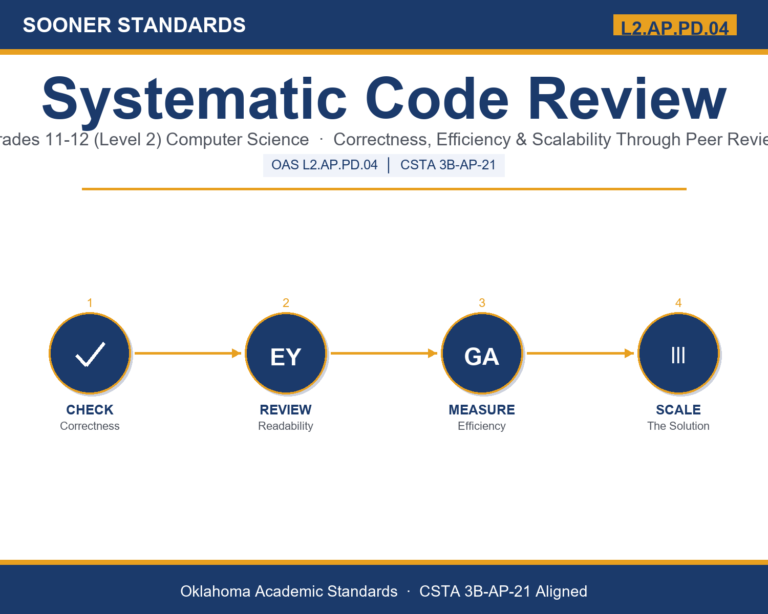
Level 2 is where Oklahoma’s CS pathway gets noticeably more advanced. L2.AP.A.02 has students implement an actual AI algorithm to play a game or solve a problem — CSTA’s 3B-AP-09 reads almost identically. L2.AP.PD.04‘s code-review standard (“correctness, usability, readability, efficiency, portability, and scalability”) lifts CSTA 3B-AP-23‘s quality-review criteria nearly verbatim. This is the first grade band in the series where “compare data structures” (L2.AP.V.01, matching 3B-AP-12) and recursion (L2.AP.C.01, matching 3B-AP-13) show up as standalone standards — concepts that don’t appear anywhere in the K-8 comparisons.
Full Standard-by-Standard Comparison
| OAS-CS Code | CSTA Code | Oklahoma Standard | CSTA Standard |
|---|---|---|---|
| L2.AP.A.01 | 3B-AP-08 | Model and use appropriate terminology to describe how artificial intelligence algorithms drive many software and physical systems (e.g., autonomous robots, pattern recognition, text analysis). | Describe how artificial intelligence drives many software and physical systems. |
| L2.AP.A.02 | 3B-AP-09 | Develop an artificial intelligence algorithm to play a game against a human opponent or solve a real-world problem. | Implement an artificial intelligence algorithm to play a game against a human opponent or solve a real-world problem. |
| L2.AP.A.03 | 3B-AP-10 | Critically examine and trace classic algorithms (e.g., selection sort, insertion sort, binary search, linear search). | Use and adapt classic algorithms to solve computational problems. |
| L2.AP.A.04 | 3B-AP-11 | Evaluate algorithms (e.g., sorting, searching) in terms of their efficiency and clarity. | Evaluate algorithms in terms of their efficiency, correctness, and clarity. |
| L2.AP.C.01 | 3B-AP-13 | Model the execution of repetition (e.g., loops, recursion) of an algorithm, illustrating output and changes in values of named variables. | Illustrate the flow of execution of a recursive algorithm. |
| L2.AP.M.01 | 3B-AP-14 | Construct solutions to problems using student-created components (e.g., procedures, modules, objects). | Construct solutions to problems using student-created procedures, modules, and/or objects. |
| L2.AP.M.02 | 3B-AP-15 | Design or redesign a solution to a large-scale computational problem by identifying generalizable patterns. | Analyze a large-scale computational problem and identify generalizable patterns that can be applied to a solution. |
| L2.AP.PD.01 | 3B-AP-17 | Create software that will provide solutions to a variety of users using multiple software development processes. | Plan and develop programs for diverse audiences using a software life cycle process (e.g., Agile, spiral, or waterfall). |
| L2.AP.PD.02 | 3B-AP-20 | Design software in a project team environment using integrated development environments (IDEs), versioning systems, and collaboration systems. | Use version control systems, integrated development environments (IDEs), and collaborative tools and practices (code review) in a group software project. |
| L2.AP.PD.04 | 3B-AP-23 | Systematically examine code for correctness, usability, readability, efficiency, portability, and scalability through peer review. | Evaluate key qualities of a program through a process such as a code review (e.g., correctness, usability, readability, efficiency, portability, and scalability). |
| L2.AP.PD.05 | 3B-AP-21 | Develop and use a series of test cases to verify that a program performs according to its design specifications. | Develop and use a series of test cases to verify that a program performs according to its design specifications. |
| L2.AP.PD.06 | 3B-AP-18 | Explain security issues that might lead to compromised computer programs. | Explain security issues that might lead to compromised computer programs. |
| L2.AP.PD.07 | 3B-AP-22 | Modify an existing program to add additional functionality and discuss intended and unintended implications (e.g., breaking other functionality). | Modify an existing program to add additional functionality and discuss intended and unintended implications (e.g., breaking other functionality). |
| L2.AP.V.01 | 3B-AP-12 | Compare and contrast data structures and their uses (e.g., lists, stacks, queues). | Compare and contrast fundamental data structures and their uses (e.g., strings, lists, arrays, stacks, queues). |
| L2.CS.HS.01 | 3B-CS-01 | Identify and categorize the roles of a variety of operating system software. | Categorize the roles of operating system software. |
| L2.CS.T.01 | 3B-CS-02 | Illustrate how understanding the ways hardware components facilitate logic, input, output, and storage in computing systems will support troubleshooting. | Illustrate how computing systems implement logic through hardware components, such as logic gates and their interaction with electrical signals and voltage to represent information, including binary encodings. |
| L2.DA.CVT.01 | 3B-DA-05 | Use data analysis tools and techniques to identify patterns from complex real-world data. | Use data analysis tools and techniques to identify patterns in data representing complex systems. |
| L2.DA.CVT.02 | 3B-DA-06 | Generate data sets that use a variety of data collection tools and analysis techniques to support a claim and/or communicate information. | Select data collection tools and techniques to generate data sets that support a claim or communicate information. |
| L2.DA.IM.01 | 3B-DA-07 | Use models and simulations to help plan, conduct, and refine investigations. | Evaluate the ability of models and simulations to test and support the refinement of hypotheses. |
| L2.IC.SLE.01 | 3B-IC-28 | Debate laws and regulations that impact the development and use of software. | Debate laws and regulations impacting the development and use of software. |
| L2.NI.CY.01 | 3B-NI-04 | Compare and refine ways in which software developers protect devices and information from unauthorized access. | Compare ways software developers protect devices and information from unauthorized access. |
| L2.NI.NCO.01 | 3B-NI-03 | Describe the issues that impact network functionality (e.g., bandwidth, load, latency, topology). | Describe issues that impact network functionality (e.g., bandwidth, load, delay, topology). |
Get the Complete Level 2 Curriculum
Every standard in the comparison above has a matching no-prep unit — teacher guide, activities, assessment, and answer key — built directly from the verified Oklahoma standard text. Browse the full Level 2 (grades 11-12) collection on Teachers Pay Teachers.
Every Sooner Standards resource is built directly from the official Oklahoma Academic Standards for Computer Science (February 2023) — standard text verified against the source document, never paraphrased from memory.

One Comment
Comments are closed.