Teaching Creating Iterations in Grade 6: Arkansas Standard 2.1.1
Teaching Creating Iterations in Grade 6: Arkansas Standard 2.1.1
Teaching loops and iteration in grade 6 does not have to be complicated. Picture an animator looping one walk cycle instead of drawing every step a character takes. That kind of thinking is exactly what Arkansas's grade 6 computer science standard 2.1.1 asks students to practice — and it is very teachable with the right materials. This post walks through what the standard means, the misconceptions students bring to it, and discussion starters you can use tomorrow, whether you teach in a classroom or at your kitchen table.
What Does Standard 2.1.1 Actually Ask?
Computational Thinking – Breaking down big, complex problems into smaller, manageable parts. — Arkansas Computer Science 5-8 Embedded Standards, 2025
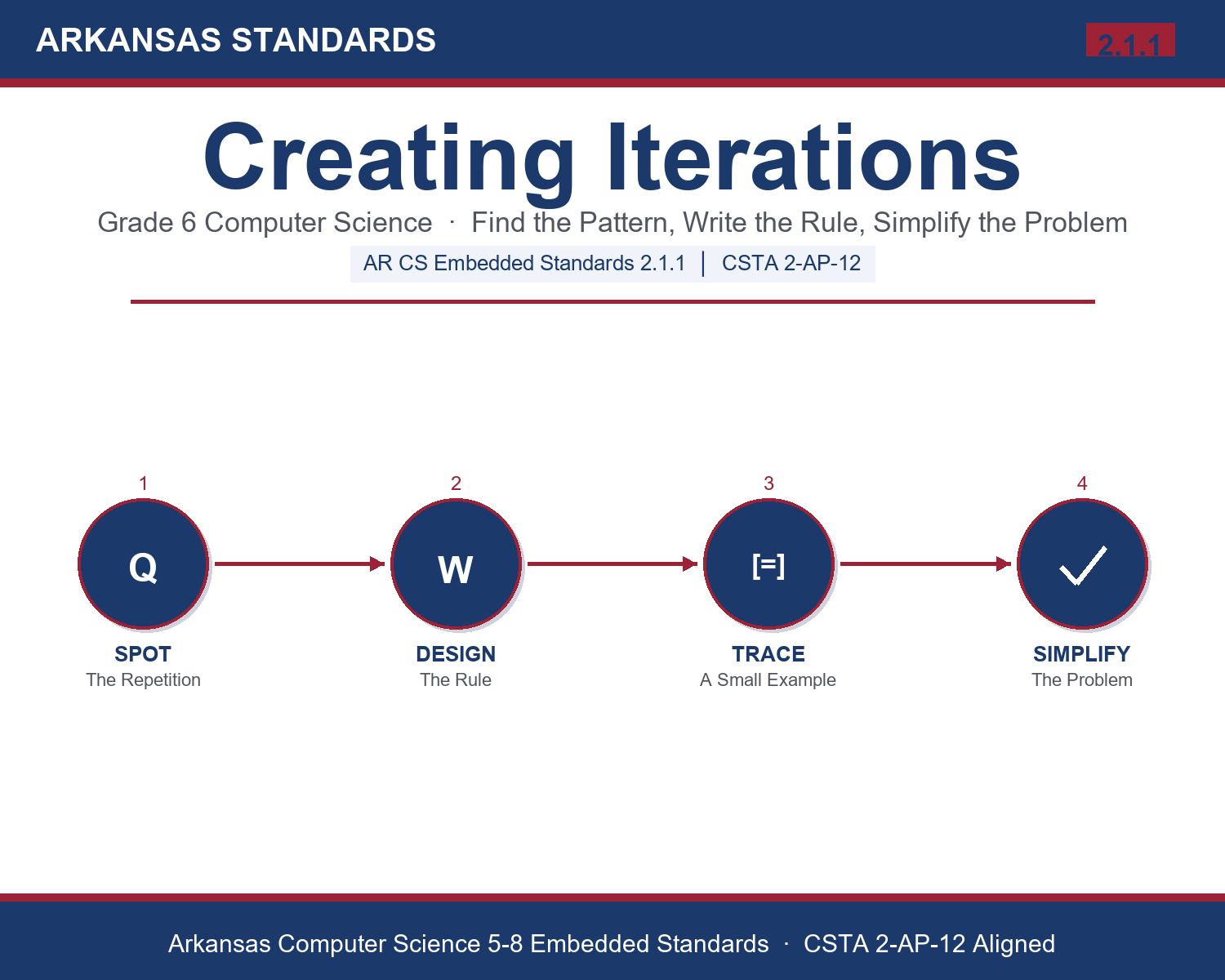
In plain language: This grade's standard asks students to create their own repeating rule (an iteration) that makes a problem simpler, and to explain how the rule works: where it starts, what repeats, and when it stops.
In student-friendly terms, the learning target is: "I can create an original iteration to simplify a problem and explain its rule."
What Students Should Be Able to Do
- I can find the repeated step hiding inside a bigger problem.
- I can design an iteration with a clear starting point, repeated step, and stopping condition.
- I can explain my rule so plainly that someone else could follow it without asking questions.
- I can trace my rule with a small example to prove it works before trusting it with a big job.
Along the way, students pick up the working vocabulary of the topic: iteration, pattern, rule, loop, repetition, simplify, algorithm, sequence, trace, generalize, input, efficient.
Loops And Iteration: Misconceptions to Watch For
These are the wrong turns students reliably take with this standard — knowing them ahead of time is half the lesson plan. Each correction strategy below comes straight from the unit's teacher guide (the paragraph and activity references point into the unit itself).
1. "An iteration is just 'doing something a lot' — no rule needed."
Repetition without a rule is only labor. Return to the three-part structure: an iteration is the repeated step PLUS the starting point and the stopping condition. Ask students to say all three aloud whenever they present a design.
2. "There is exactly one correct iteration for each problem."
Have two groups share different working rules for the same problem card (paragraph 5's folder example allows several). Trace both to show both succeed — comparing designs by clarity and efficiency is the real skill.
3. "A rule that lists every case ('Maria, then Jayden, then Aliyah') is just as good as a generalized one."
Add a new student to the roster mid-example and watch the listed rule break. Generalized rules point at the input ('the next name on the list') and survive change — paragraph 4's contrast makes this concrete.
4. "If the rule sounds right, it works — testing is a waste of time."
Give students the broken 'stop when the table has three folders' rule from paragraph 6 and have them trace it with four folders. The trapped folder makes the value of tracing self-evident.
Discussion Starters You Can Use Tomorrow
- What is a chore at home you could hand to a robot tomorrow if you could write the rule? Say the rule out loud.
- Paragraph 5 says most problems allow many correct iterations. When would you prefer a slower rule that is easier to explain over a faster rule that is confusing?
- Why do you think fuzzy stopping conditions ('until it seems done') cause more trouble in big jobs than in small ones?
Bringing It Home
This topic is a natural one for families. One ten-minute activity to try: Pick one household chore together (loading the dishwasher, feeding a pet, watering plants). Ask your child to say the chore as a rule: the starting point, the one step that repeats, and how you know when to stop. Then follow their rule EXACTLY as stated — including any funny mistakes — and let them fix the rule. That fix-it moment is the whole lesson.
Where This Leads
Students who can create an original iteration to simplify a problem and explain its rule are building skills used every day in software development, animation and game design, robotics and manufacturing, data science, and logistics.
See the Unit in Action
Get the Complete 2.1.1 Unit
I built a complete, no-prep unit for this standard — Creating Iterations to Simplify Problems — covering 3-4 days of instruction across 39 pages:
- Teacher guide — day-by-day pacing, misconceptions to watch for, discussion questions, differentiation for support / ELL / extension, and a 4-point rubric
- Student learning target page — a kid-friendly "I can" statement with success criteria
- Full content lesson with 3 embedded "Check Your Understanding" checkpoints
- 12-question assessment (6 multiple choice, 4 true/false, 2 short answer) with a complete answer key, explanations, and exemplar responses
- Group activity — "Loop Hunters: Find It, Rule It, Trace It" (25-30 minutes)
- Individual activity — "My Original Iteration" (15-20 minutes)
- Crossword and word search built from all 12 vocabulary terms (with answer keys)
- Family connection letter — a plain-language page for parents, with dinner-table questions and a 10-minute home activity
- Certificate of achievement — ready to sign and send home
- Problem Card Set: Loop Hunters (separate printable, 2 pages)
- Reference Notes: Iterations, Rules & Traces (separate printable, 1 page)
- My Original Iteration (separate printable, 2 pages)
Get Creating Iterations on Teachers Pay Teachers →
Also aligned to CSTA 2-AP-12: Design and iteratively develop programs that combine control structures, including nested loops and compound conditionals.
Every Arkansas Standards resource is built directly from the official Arkansas Computer Science 5-8 Embedded Standards, 2025 — standard text verified, never paraphrased from memory.