Teaching Collaborative Problem Solving Through Feedback in Grade 6: Oklahoma Standard 6.AP.PD.01
Teaching Collaborative Problem Solving Through Feedback in Grade 6: Oklahoma Standard 6.AP.PD.01
Picture a software engineer submitting code for peer review and revising it based on teammates' feedback. That kind of thinking is exactly what Oklahoma's grade 6 computer science standard 6.AP.PD.01 asks students to practice — and it is very teachable with the right materials. This post walks through what the standard means, the misconceptions students bring to it, and discussion starters you can use tomorrow, whether you teach in a classroom or at your kitchen table.
What Does Standard 6.AP.PD.01 Actually Ask?
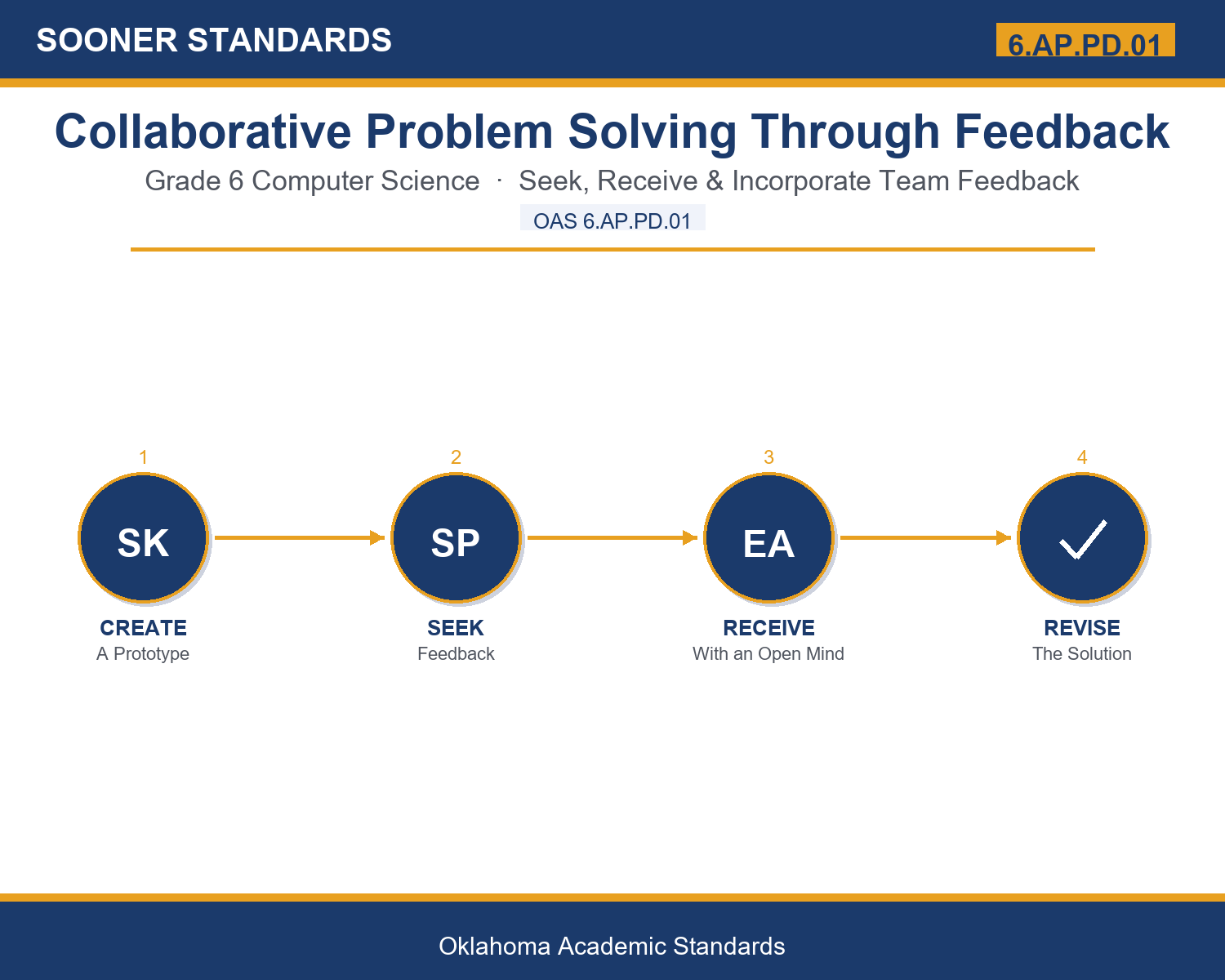
Seek and incorporate feedback from team members to refine a solution to a problem. — Oklahoma Academic Standards for Computer Science (February 2023)
In plain language: Oklahoma's standard asks sixth graders to seek feedback from team members and use it to make their solution to a problem better through revision.
In student-friendly terms, the learning target is: "I can seek and incorporate feedback from team members to refine a solution to a problem."
What Students Should Be Able to Do
- I can give specific, constructive feedback that names what works and what to improve.
- I can receive feedback without defensiveness, asking clarifying questions and evaluating suggestions fairly.
- I can revise a solution to directly address feedback I received.
- I can use unit vocabulary like feedback, iteration, and constructive correctly.
Along the way, students pick up the working vocabulary of the topic: feedback, collaboration, iteration, refinement, perspective, constructive, implementation, consensus, prototype, revision, stakeholder, validation.
Misconceptions to Watch For
These are the wrong turns students reliably take with this standard — knowing them ahead of time is half the lesson plan. Each correction strategy below comes straight from the unit's teacher guide (the paragraph and activity references point into the unit itself).
1. "Feedback is the same thing as criticism or pointing out what's wrong."
Use paragraph 4's distinction — constructive feedback also acknowledges what works well, not just what needs improvement, and focuses on specific, actionable observations rather than vague complaints.
2. "Good team members implement every single piece of feedback they receive."
Reference paragraph 5 — not all feedback needs to be implemented, but all of it deserves consideration. Evaluating feedback on its merits is part of receiving it well.
3. "Reaching consensus means everyone has to agree on everything."
Clarify from paragraph 8 — consensus means everyone feels heard and can support moving forward, even without complete agreement on every detail.
4. "Building a rough prototype is a waste of time since it isn't the final product."
Point to paragraph 7's 'fail fast and learn quickly' idea — prototypes let teams test fundamental decisions cheaply before they become expensive to change later.
Discussion Starters You Can Use Tomorrow
- Why might it be harder to receive feedback on something you worked really hard on?
- What's the difference between someone disagreeing with your idea and someone criticizing you personally?
- How might a team handle a situation where two members give completely opposite feedback?
Bringing It Home
This topic is a natural one for families. One ten-minute activity to try: Together, pick something you've made or written and ask a family member for specific feedback on it. Talk about which suggestions you'd actually use and why, and which you'd skip.
Where This Leads
Students who can seek and incorporate feedback from team members to refine a solution to a problem are building skills used every day in software engineering, UX research, technical writing/editing, software testing/QA, and computer science education.
See the Unit in Action
Get the Complete 6.AP.PD.01 Unit
I built a complete, no-prep unit for this standard — Collaborative Problem Solving Through Feedback — covering 3-4 days of instruction across 38 pages:
- Teacher guide — day-by-day pacing, misconceptions to watch for, discussion questions, differentiation for support / ELL / extension, and a 4-point rubric
- Student learning target page — a kid-friendly "I can" statement with success criteria
- Full content lesson with 3 embedded "Check Your Understanding" checkpoints
- 12-question assessment (6 multiple choice, 4 true/false, 2 short answer) with a complete answer key, explanations, and exemplar responses
- Group activity — "Design Challenge with Peer Review" (45-55 minutes)
- Individual activity — "Personal Problem Solution Reflection" (25-30 minutes initial work, plus one week implementation and final reflection)
- Crossword and word search built from all 12 vocabulary terms (with answer keys)
- Family connection letter — a plain-language page for parents, with dinner-table questions and a 10-minute home activity
- Certificate of achievement — ready to sign and send home
- Design Challenge Feedback Form (separate printable, 1 page)
- Personal Problem Solution Reflection (separate printable, 2 pages)
Get Collaborative Problem Solving Through Feedback on Teachers Pay Teachers →
Every Sooner Standards resource is built directly from the official Oklahoma Academic Standards for Computer Science (February 2023) — standard text verified, never paraphrased from memory.