Advanced Control Structures: Compound Conditionals, Nested Loops, and Procedures
Teaching Advanced Control Structures in Grade 8: Oklahoma Standard 8.AP.C.01
By eighth grade, students already know the three basic building blocks of any program: sequence, conditionals, and loops. Oklahoma's standard 8.AP.C.01 pushes them a level deeper — combining those basics into compound conditionals, nested loops, and reusable procedures that can actually handle real complexity. This post walks through what the standard means, the vocabulary students need, and a few discussion starters you can use tomorrow.
What Does Standard 8.AP.C.01 Actually Ask?
Develop programs that utilize combinations of nested loops, compound conditionals, procedures without parameters, and the manipulation of variables representing different data types. — Oklahoma Academic Standards for Computer Science (February 2023)
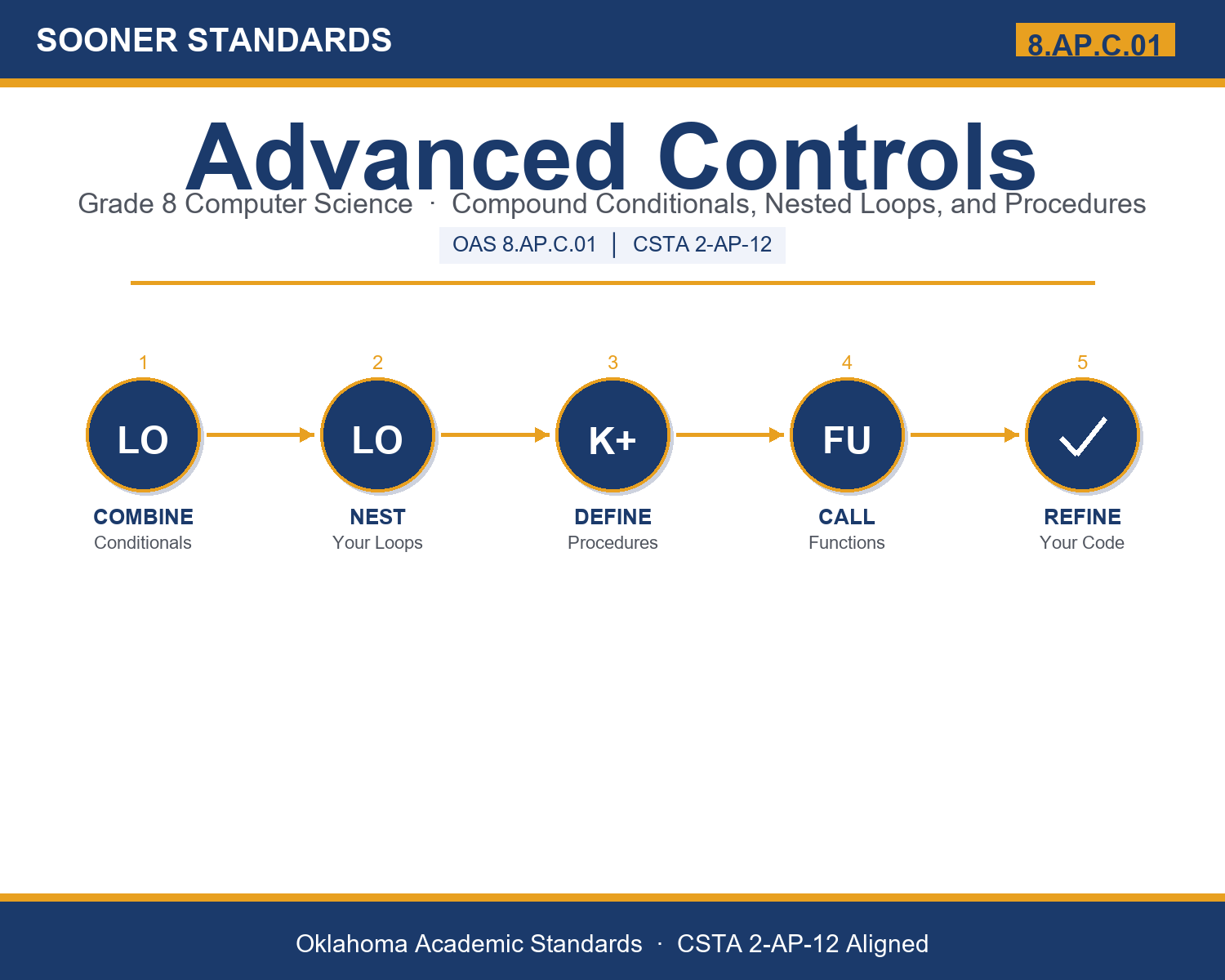
In plain language: students move from using one control structure at a time to combining them — a loop inside a loop, a condition that checks two things at once, a chunk of reusable code they can call by name instead of retyping.
Key Vocabulary Students Will Learn
Procedure, Function, Parameter, Argument, Nesting, Boolean, Operator, Scope, Return, Compound, Reusable, Call, Refinement
These terms are the vocabulary of "grown-up" programming — the words a student needs the moment their program is too complex to hold entirely in their head at once.
What's Inside the Lesson
The content reading starts from a simple observation: as programs grow more complex, the basic control structures beginners learn first — plain sequence, single conditionals, single loops — stop being enough on their own. Advanced control structures build on those basics by combining them: compound conditionals test multiple conditions at once using logical operators, and nested loops put one repeating structure inside another to handle multi-dimensional problems.
The reading frames this as a natural next step rather than a totally new topic — the same building blocks students already know, just combined more powerfully.
Discussion Starters You Can Use Tomorrow
- Can you think of a decision that depends on two conditions being true at the same time? How would you write that as a compound conditional?
- Why might a programmer put a loop inside another loop instead of writing two separate loops?
- What's the advantage of writing a procedure once and calling it by name, instead of retyping the same code every time you need it?
Where This Leads
Students who can combine nested loops, compound conditionals, and reusable procedures are building the exact skill that separates beginner scripts from real software — the ability to manage complexity instead of being overwhelmed by it.
See the Unit in Action
Get the Complete 8.AP.C.01 Unit
I built a complete, no-prep unit for this standard — Advanced Control Structures: Compound Conditionals, Nested Loops, and Procedures — across 22 ready-to-print pages:
- Vocabulary reference — all 13 terms with definitions and real-world examples
- Full content reading with embedded comprehension checkpoints
- 10-question assessment (6 multiple choice, 4 true/false) with a complete answer key and explanations
- Group activity — "Compound Logic and Nested Loop Challenge"
- Individual activity — "Write and Trace a Function"
- Crossword and word search built from all 13 vocabulary terms (with answer keys)
- Standards alignment verification page
- Function Worksheet (separate printable)
- Reference Guide (separate printable)
Get Advanced Control Structures on Teachers Pay Teachers →
Every Sooner Standards resource is built directly from the official Oklahoma Academic Standards for Computer Science (February 2023) — standard text verified, never paraphrased from memory.