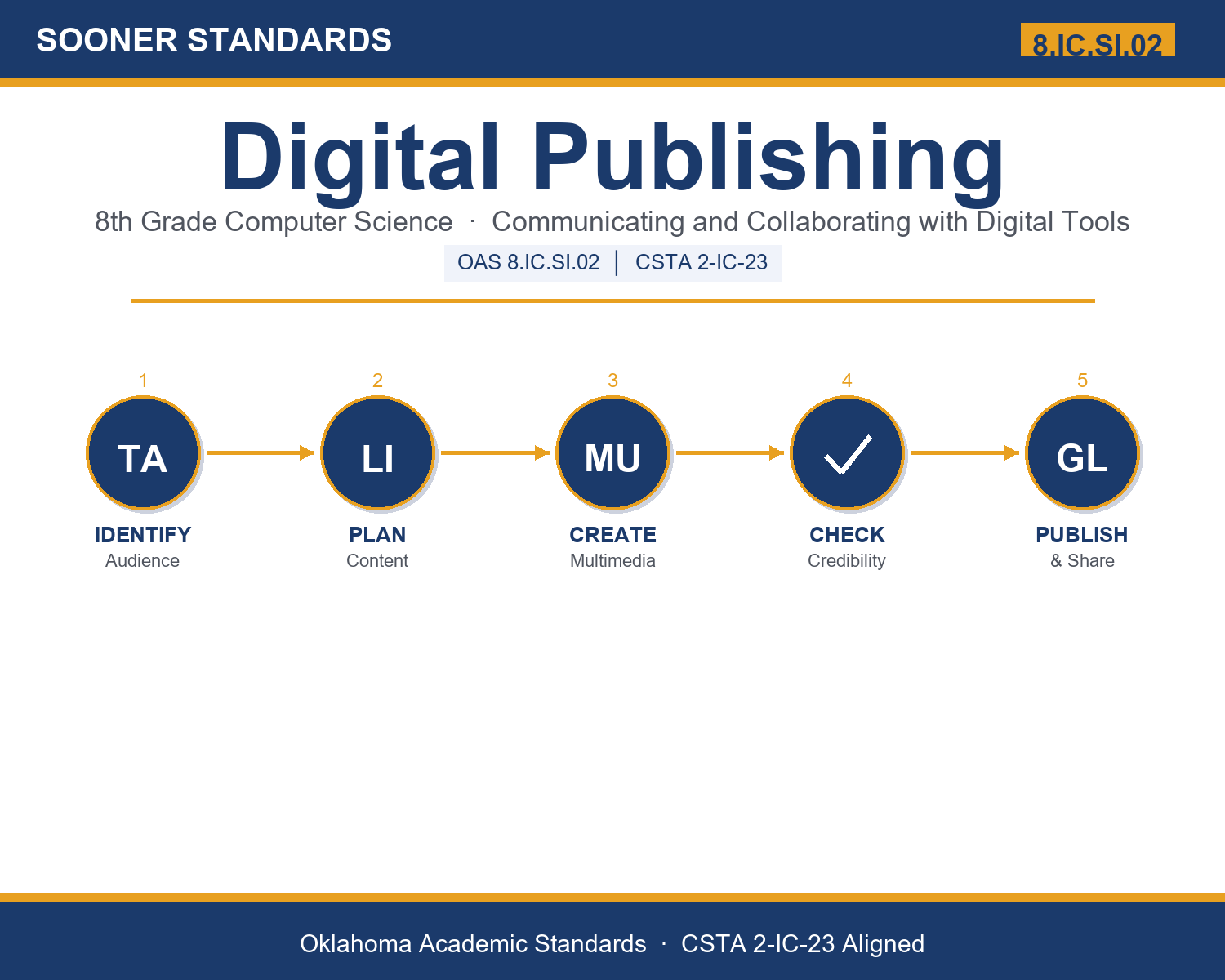
Digital Publishing: Communicating and Collaborating with Digital Tools
Teaching Digital Publishing in Grade 8: Oklahoma Standard 8.IC.SI.02
A student with a laptop today can create a podcast, publish a blog, release a video, or design an infographic that reaches thousands of people — no printing press or broadcast license required. Oklahoma's standard 8.IC.SI.02 asks eighth graders to use that access responsibly: communicating and publishing key ideas, individually or collaboratively, in ways that inform, persuade, or entertain using digital tools and media-rich resources. This post walks through what the standard means, the vocabulary students need, and a few discussion starters you can use tomorrow.
What Does Standard 8.IC.SI.02 Actually Ask?
Communicate and publish key ideas and details individually or collaboratively in a way that informs, persuades, and/or entertains using a variety of digital tools and media-rich resources. — Oklahoma Academic Standards for Computer Science (February 2023)
In plain language: students need to be able to create and share content — whether solo or as part of a team — with a clear purpose in mind, choosing digital tools and media deliberately to reach an audience effectively.
Key Vocabulary Students Will Learn
Publish, Audience, Persuade, Collaborate, Multimedia, Platform, Content, Credible, Narrative, Podcast, Infographic, Communicate, Media
These thirteen terms give students the vocabulary to talk precisely about both the craft of digital publishing (narrative, multimedia, infographic) and its responsibility (audience, credible, persuade).
What's Inside the Lesson
The content reading opens by naming just how much has changed: in earlier generations, publishing required printing presses, broadcast licenses, or traditional publishers, but today a student with a laptop can create a podcast, publish a blog, release a video, or design an infographic that reaches an audience of any size. The reading is careful to pair that opportunity with responsibility — when you publish digitally, you take on the role of a communicator, someone who makes real decisions about what information reaches other people and how.
Discussion Starters You Can Use Tomorrow
- If you were creating something to inform an audience versus something to entertain them, how might your approach change?
- Why might a podcast be a better format for one message and an infographic better for another?
- What responsibility comes with being able to publish something that thousands of people might see?
Where This Leads
Students who can communicate and publish effectively using digital tools are building a skill that matters far beyond a computer science classroom — the ability to reach and inform an audience responsibly, a skill used in journalism, marketing, education, and virtually every modern career.
See the Unit in Action
Get the Complete 8.IC.SI.02 Unit
I built a complete, no-prep unit for this standard — Digital Publishing: Communicating and Collaborating with Digital Tools — across 22 ready-to-print pages:
- Vocabulary reference — all 13 terms with definitions and real-world examples
- Full content reading with embedded comprehension checkpoints
- 10-question assessment (6 multiple choice, 4 true/false) with a complete answer key and explanations
- Group activity — "Mini Digital Publication Sprint"
- Individual activity — "Plan Your Own Digital Publication"
- Crossword and word search built from all 13 vocabulary terms (with answer keys)
- Standards alignment verification page
- Digital Publishing Reference Sheet (separate printable)
- Digital Publishing Worksheet (separate printable)
Get Digital Publishing on Teachers Pay Teachers →
Every Sooner Standards resource is built directly from the official Oklahoma Academic Standards for Computer Science (February 2023) — standard text verified, never paraphrased from memory.