Decomposing Problems: Modular Design and Program Structure
Teaching Decomposing Problems in Grade 8: Oklahoma Standard 8.AP.M.01
Professional software engineers rarely tackle a large program as one giant block of code — they break it into pieces small enough to actually understand. Oklahoma's standard 8.AP.M.01 asks eighth graders to practice that exact divide-and-conquer strategy: decomposing problems and subproblems into parts that make designing, building, and reviewing a complex program manageable. This post walks through what the standard means, the vocabulary students need, and a few discussion starters you can use tomorrow.
What Does Standard 8.AP.M.01 Actually Ask?
Decompose problems and subproblems into parts to facilitate the design, implementation, and review of complex programs. — Oklahoma Academic Standards for Computer Science (February 2023)
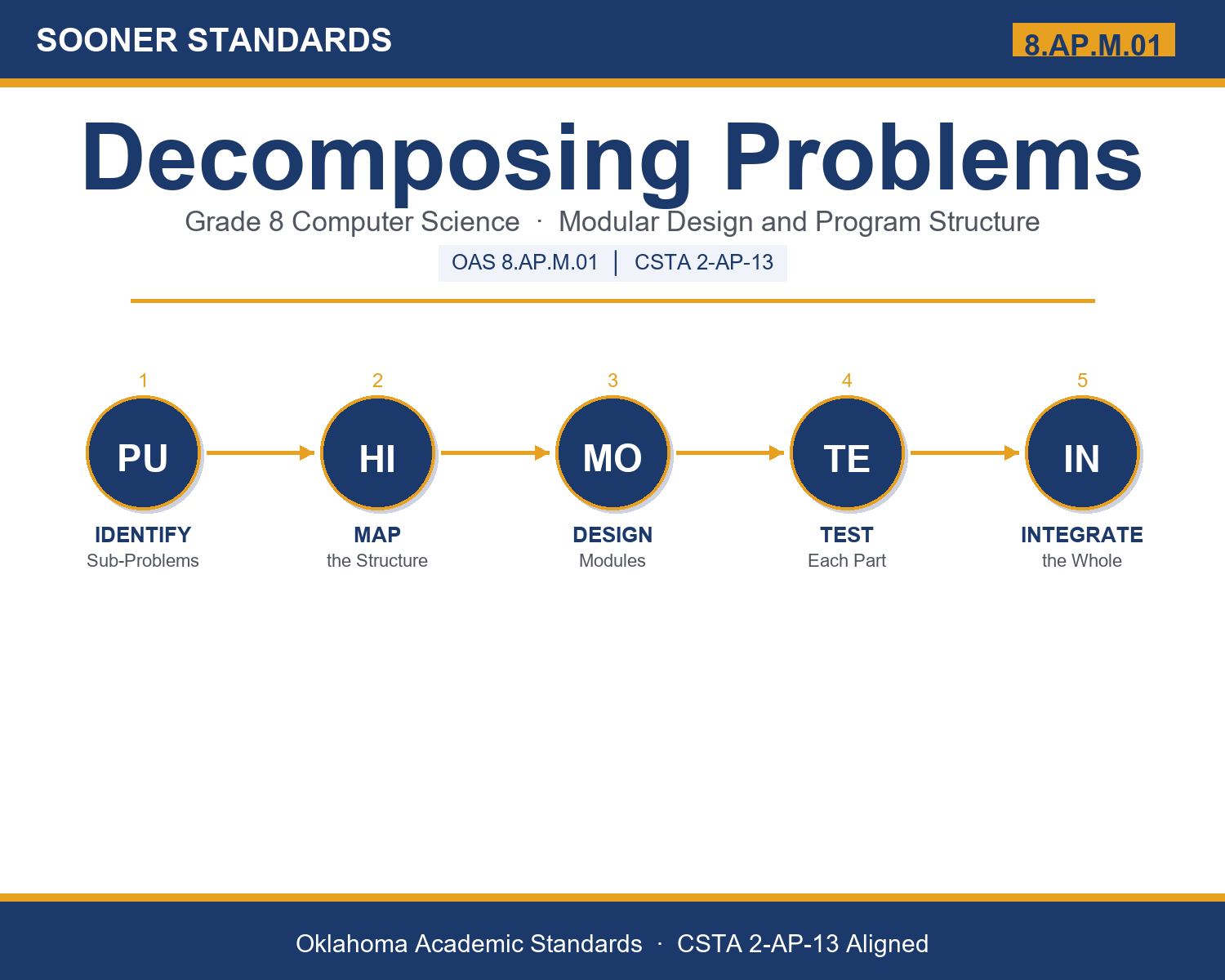
In plain language: when a program is too big to design, build, or check all at once, students need to be able to split it into smaller, independent pieces — solve each piece, then put the pieces back together into a working whole.
Key Vocabulary Students Will Learn
Modular, Subprogram, Reusable, Interface, Abstraction, Testing, Debugging, Maintenance, Documentation, Prototype, Integration, Hierarchy, Complexity
These words describe both the process of decomposition and the product of it — modules, subprograms, and interfaces that fit together into something bigger than any one piece.
What's Inside the Lesson
The content reading opens by naming the real problem: as programs grow in size and complexity, they become too difficult for a single programmer to design, build, and understand all at once. Decomposition is presented as the strategy that solves this — breaking a large program into smaller subproblems, each one small enough to understand and solve independently, with the individual solutions combined into the complete program.
This divide-and-conquer approach is framed the way professional software engineers actually work — not as a classroom simplification, but as the real strategy behind large-scale software.
Discussion Starters You Can Use Tomorrow
- If you were building an app with a login screen, a game, and a leaderboard, how would you split that into separate, smaller pieces?
- Why might it be easier to test a small module on its own than to test an entire complex program all at once?
- What could go wrong if two people work on different modules of the same program without agreeing on how those modules will connect?
Where This Leads
Students who can decompose problems into manageable parts are building the same skill professional developers use to build everything from mobile apps to operating systems — turning something too big to hold in your head into pieces you can actually finish.
See the Unit in Action
Get the Complete 8.AP.M.01 Unit
I built a complete, no-prep unit for this standard — Decomposing Problems: Modular Design and Program Structure — across 22 ready-to-print pages:
- Vocabulary reference — all 13 terms with definitions and real-world examples
- Full content reading with embedded comprehension checkpoints
- 10-question assessment (6 multiple choice, 4 true/false) with a complete answer key and explanations
- Group activity — "Program Decomposition Challenge"
- Individual activity — "Module Interface and Test Design"
- Crossword and word search built from all 13 vocabulary terms (with answer keys)
- Standards alignment verification page
- Module Worksheet (separate printable)
- Reference Guide (separate printable)
Get Decomposing Problems on Teachers Pay Teachers →
Every Sooner Standards resource is built directly from the official Oklahoma Academic Standards for Computer Science (February 2023) — standard text verified, never paraphrased from memory.