Grade 2 Computer Science Curriculum: Every Oklahoma OAS-CS Standard, No Prep
Grade 2 Computer Science Curriculum: Every Oklahoma OAS-CS Standard, No Prep
Second grade computer science builds directly on what students started in Grade 1 — but it pushes them one real step further, toward more independent thinking and two brand-new ideas: software (not just devices) and variables that actually change as a program runs. This bundle is a complete, no-prep Grade 2 computer science curriculum covering every Oklahoma Academic Standard for Computer Science at grade 2, in a format any teacher or homeschool parent can print and teach tomorrow.
What Oklahoma's Grade 2 CS Standards Actually Cover
Oklahoma's grade 2 computer science standards span five strands, and Grade 2 noticeably raises the bar on independence and precision compared to Grade 1:
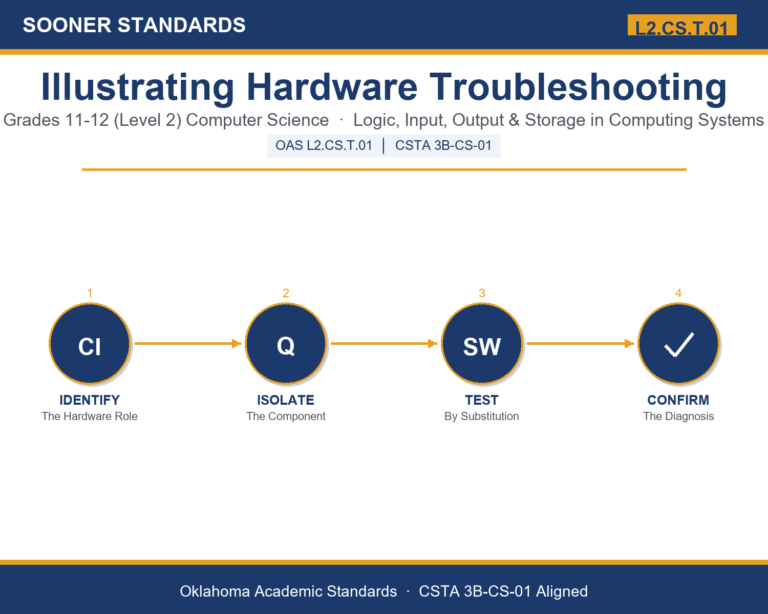
- Computing Systems (CS) — choosing a device and the right software for a task, naming the parts inside a computer (hard drive, memory) and its peripherals, and using accurate terminology to describe and discuss a problem with others (2.CS.D.01, 2.CS.HS.01, 2.CS.T.01).
- Networks & the Internet (NI) — recognizing that devices connect in a variety of ways (wired and wireless), and explaining not just identifying why passwords matter (2.NI.NCO.01, 2.NI.CY.01).
- Data & Analysis (DA) — actively building a file/folder organizational structure, collecting the same data in various visual formats, and constructing (not just reading) a chart with up to four categories to draw a conclusion (2.DA.S.01, 2.DA.CVT.01, 2.DA.IM.01).
- Algorithms & Programming (AP) — the largest strand at grade 2: creating and following algorithms, variables that store and change data, sequencing and repetition (now practiced both independently and collaboratively), precise problem decomposition, sequential story-planning artifacts, giving credit, debugging, and explaining a whole process using real terminology like input, output, and code (2.AP.A.01, 2.AP.V.01, 2.AP.C.01, 2.AP.M.01, 2.AP.PD.01–04).
- Impacts of Computing (IC) — comparing life before and after new technology, developing a class code of conduct for online spaces, and identifying safety habits both individually and as a group (2.IC.CU.01, 2.IC.SI.01, 2.IC.SLE.01).
Where Grade 1 leaned on "with guidance" for nearly everything, Grade 2's own standard language keeps dropping that phrase — the whole grade is genuinely designed to hand students more independent thinking, one standard at a time.
What's Inside the Grade 2 Computer Science Bundle
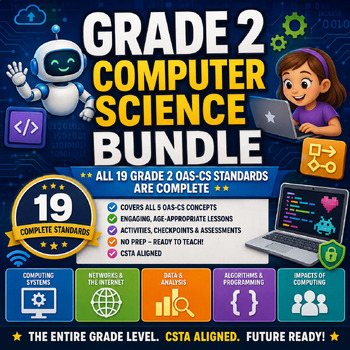
Every standard in the bundle comes as its own complete, standards-aligned unit — 19 resources, 620 total pages:
- No-prep lessons built for the grade-2 leap toward independence — every concept still uses concrete, K-2-appropriate examples, but the voice and expectations shift noticeably toward "try it yourself first."
- A full content lesson for each standard, with built-in comprehension checkpoints.
- Activities — a group activity and an individual activity per unit, with all printable materials included.
- Assessments and answer keys — multiple choice, true/false, and short-answer items tagged to the exact standard, with explanations and exemplar responses.
- Teacher guides — pacing, common misconceptions and how to fix them, discussion questions, and differentiation for support, ELL, and extension.
- Family connection letters and certificates — plain-language pages that bring the learning home, perfect for homeschool.
- A free bonus resource pack — a Standards at a Glance table, a full-year pacing calendar, an answer key compilation, and a standard mastery rubric compiled across all 19 units, for fast administrator walkthroughs and grading consistency.
New This Year: Software and Variables
Two ideas show up for the first time in Grade 2 that Grade 1 never touched. Students learn that choosing a device is only half the job — the software running on it is what actually determines what a task can accomplish, and the same device can do very different jobs depending on which app or program is open. Students also meet variables as more than just a labeled box: they practice modeling how a program stores, accesses, and manipulates a value, like a score that changes as a game is played. Both ideas are taught entirely with concrete, everyday examples — no coding experience required.
Aligned to Oklahoma — and Ready for Any Classroom
Every unit is built directly from the official Oklahoma Academic Standards for Computer Science (February 2023), with the standard text verified rather than paraphrased from memory, and cross-walked to its matching CSTA K-2 (1A) indicator. The materials are print-ready and LMS-ready, work fully offline, and collect no student data — so they fit a one-device classroom, a full lab, or a homeschool table equally well.
See the Bundle in Action
Get the Complete Grade 2 CS Curriculum Bundle
Skip months of lesson-building and cover your entire year of Oklahoma Grade 2 computer science with one no-prep resource.
Get the Grade 2 Computer Science Bundle on Teachers Pay Teachers →
Every Sooner Standards resource is built directly from the official Oklahoma Academic Standards for Computer Science (February 2023) — standard text verified, never paraphrased from memory. Aligned to the Oklahoma Academic Standards for Computer Science; not a state-adopted or state-approved curriculum.