Grade 8 Oklahoma Computer Science Standards vs. CSTA National Standards: The Full Comparison
Grade 8 closes out Oklahoma’s 6-8 CS band before students move into Level 1 (grades 9-10). Of the 22 Grade 8 standards, 19 have a direct CSTA 6-8 match, 2 are loose matches, and just 1 has no CSTA equivalent at all — the tightest alignment to the national framework of any middle-school grade we’ve compared. Here’s the full standard-by-standard breakdown, with a downloadable spreadsheet.
Sourcing note — read this one before the data: while auditing this product line’s Grade 8 build files, several contained CSTA reference text that didn’t match the real CSTA standards. In a few cases the exact same placeholder text had been copied across multiple different CSTA codes; some entries were even explicitly flagged as unverified by an earlier build pass. Rather than trust those fields, every CSTA code and text below was re-sourced independently against the official CSTA K-12 Computer Science Standards (6-8 band). Independently verify before citing this in a compliance or accreditation context.
Download the Full Comparison Spreadsheet
Every Grade 8 OAS-CS standard, its best-match CSTA code, the verbatim text of both, and a comparison note — sortable and printable.
The Headline Numbers
- 22 of 22 Grade 8 OAS-CS standards were checked against the CSTA 6-8 grade band.
- 19 standards have a direct CSTA match — the highest alignment rate of any grade in this series.
- 2 standards are loose matches.
- Only 1 standard has no direct CSTA equivalent: 8.IC.SI.01, on netiquette.
The Pattern Holds: Netiquette Is Oklahoma’s Own
Across Grades 6, 7, and 8, one standard has appeared with no CSTA match every single time: netiquette. 6.IC.SI.01, 7.IC.SI.01, and now 8.IC.SI.01 all ask students to describe and practice safe, appropriate online behavior — and none of them trace back to a CSTA 6-8 standard. This isn’t a one-off gap; it’s a consistent design choice. Oklahoma treats online-conduct instruction as a standalone standard at every middle-school grade level, where CSTA folds related ideas (bias, accessibility, public/private information) into its Impacts of Computing band without a dedicated netiquette standard.
Where Grade 8 Tightens the Language
8.AP.PD.03 and CSTA’s 2-AP-17 are nearly identical: “Systematically test and refine programs using a range of student created inputs” vs. “Systematically test and refine programs using a range of test cases.” 8.CS.HS.01 and 2-CS-02 line up almost exactly too. By Grade 8, Oklahoma’s programming and hardware standards read like light edits of the CSTA source rather than independent rewrites — a contrast to the social/ethical strand, where Oklahoma keeps building its own material.
Full Standard-by-Standard Comparison
| OAS-CS Code | CSTA Code | Oklahoma Standard | CSTA Standard |
|---|---|---|---|
| 8.AP.A.01 | 2-AP-10 | Design algorithms in natural language, flow and control diagrams, comments within code, and/or pseudocode to solve complex problems. | Use flowcharts and/or pseudocode to address complex problems as algorithms. |
| 8.AP.C.01 | 2-AP-12 | Develop programs that utilize combinations of nested loops, compound conditionals, procedures without parameters, and the manipulation of variables representing different data types. | Design and iteratively develop programs that combine control structures, including nested loops and compound conditionals. |
| 8.AP.M.01 | 2-AP-13 | Decompose problems and subproblems into parts to facilitate the design, implementation, and review of complex programs. | Decompose problems into smaller components through systematic analysis, using constructs such as procedures, modules, and/or objects. |
| 8.AP.PD.01 | 2-AP-15 | Seek and incorporate feedback from team members and users to refine a solution to a problem that meets the needs of different users. | Seek and incorporate feedback from team members and users to refine a solution that meets user needs. |
| 8.AP.PD.02 | 2-AP-16 | Incorporate existing code, media, and libraries into original programs of increasing complexity and give attribution. | Incorporate existing code, media, and libraries into original programs, and give attribution. |
| 8.AP.PD.03 | 2-AP-17 | Systematically test and refine programs using a range of student created inputs. | Systematically test and refine programs using a range of test cases. |
| 8.AP.PD.04 | 2-AP-18 | Model effective communication between participants and demonstrate successful collaboration when developing computational artifacts. | Distribute tasks and maintain a project timeline when collaboratively developing computational artifacts. |
| 8.AP.PD.05 | 2-AP-19 | Document text-based programs of increasing complexity in order to make them easier to follow, test, and debug. | Document programs in order to make them easier to follow, test, and debug. |
| 8.CS.D.01 | 2-CS-01 | Develop and implement a process to evaluate existing computing devices and recommend improvements to the design based on how other users interact with the device. | Recommend improvements to the design of computing devices, based on an analysis of how users interact with the devices. |
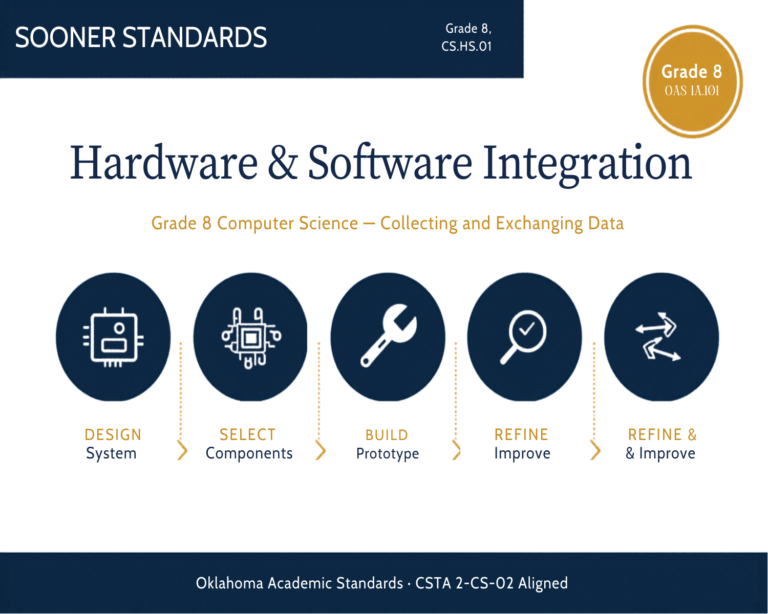
| 8.CS.HS.01 | 2-CS-02 | Design and refine projects that combine hardware and software components to collect and exchange data. | Design projects that combine hardware and software components to collect and exchange data. |
| 8.CS.T.01 | 2-CS-03 | Systematically identify, resolve, and document complex software and hardware problems with computing devices and their components. | Systematically identify and fix problems with computing devices and their components. |
| 8.DA.CVT.01 | 2-DA-08 | Develop, implement, and refine a process that utilizes computational tools to collect and transform data to make it more useful and reliable. | Collect data using computational tools and transform the data to make it more useful and reliable. |
| 8.DA.IM.01 | 2-DA-09 | Refine computational models based on the data generated by the models. | Refine computational models based on the data they have generated. |
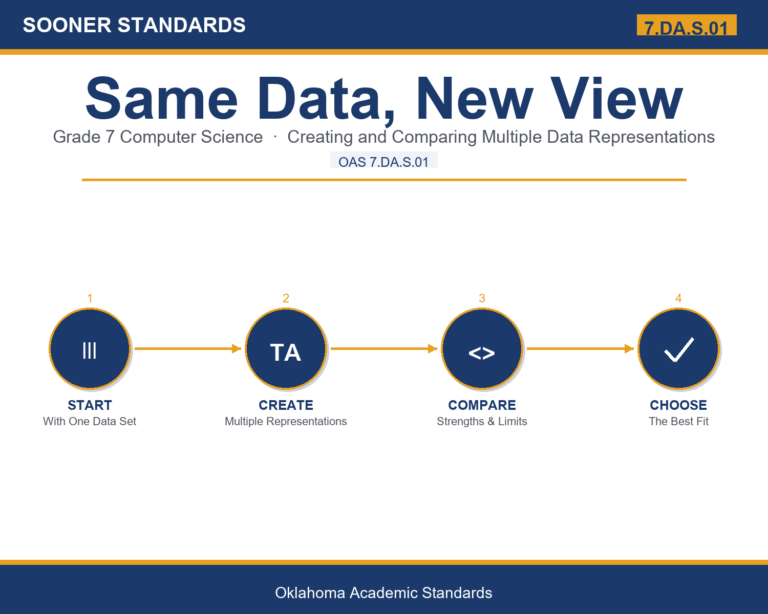
| 8.DA.S.01 | 2-DA-07 | Analyze multiple methods of representing the same data and justify the most appropriate method for representing data. | Represent data using multiple encoding schemes. |
| 8.IC.CU.01 | 2-IC-20 | Explore careers related to the field of computer science, and explain how computing impacts innovation in various career fields. | Compare tradeoffs associated with computing technologies that affect people’s everyday activities and career options. |
| 8.IC.CU.02 | 2-IC-21 | Evaluate and improve the design of existing technologies to meet the needs of different users and increase accessibility and usability. | Discuss issues of bias and accessibility in the design of existing technologies. |
| 8.IC.SI.01 | No direct match | Describe and use safe, appropriate, and responsible practices (i.e., netiquette) when participating in online communities and understand the impact of not using safe, appropriate, and responsible practices. | (No CSTA 6-8 standard addresses netiquette directly.) |
| 8.IC.SI.02 | 2-IC-22 (loose) | Communicate and publish key ideas and details individually or collaboratively in a way that informs, persuades, and/or entertains using a variety of digital tools and media-rich resources. | Collect and analyze data to identify cultural or social access to computing technologies. |
| 8.IC.SLE.01 | 2-IC-23 | Discuss the social impacts and ethical considerations associated with cybersecurity, including the positive and malicious purposes of hacking. | Describe tradeoffs between allowing information to be public and keeping information private and secure. |
| 8.NI.CY.01 | 2-NI-05 | Evaluate physical and digital procedures that could be implemented to protect electronic data/information; explain the impacts of cybersecurity threats and attacks. | Explain how physical and digital security measures protect electronic information. |
| 8.NI.CY.02 | 2-NI-06 | Compare the advantages and disadvantages of methods of encryption to model the secure transmission of information. | Apply multiple methods of encryption to model the secure transmission of information. |
| 8.NI.NCO.01 | 2-NI-04 | Explain protocols and their importance to data transmission; model how packets are broken down into smaller pieces and how they are delivered. | Model the role of protocols in transmitting data across networks and the Internet. |
Get the Complete Grade 8 Curriculum
Every standard in the comparison above has a matching no-prep unit — teacher guide, activities, assessment, and answer key — built directly from the verified Oklahoma standard text. All 22 are available individually or as a complete bundle on Teachers Pay Teachers.
Every Sooner Standards resource is built directly from the official Oklahoma Academic Standards for Computer Science (February 2023) — standard text verified against the source document, never paraphrased from memory.