Teaching Debating the Law: Software & Regulation in Grades 11-12 (Level 2): Oklahoma Standard L2.IC.SLE.01
Teaching Debating the Law: Software & Regulation in Grades 11-12 (Level 2): Oklahoma Standard L2.IC.SLE.01
Teaching software law and regulations in grades 11-12 (level 2) does not have to be complicated. Picture a technology attorney reviewing a company's open-source license choices before a product launch. That kind of thinking is exactly what Oklahoma's grades 11-12 (level 2) computer science standard L2.IC.SLE.01 asks students to practice — and it is very teachable with the right materials. This post walks through what the standard means, the misconceptions students bring to it, and discussion starters you can use tomorrow, whether you teach in a classroom or at your kitchen table.
What Does Standard L2.IC.SLE.01 Actually Ask?
Debate laws and regulations that impact the development and use of software. — Oklahoma Academic Standards for Computer Science (February 2023)
In plain language: This standard asks students to debate real laws and regulations that affect software — like licensing, copyright, privacy rules, and accessibility requirements — using specific evidence rather than just personal opinion.
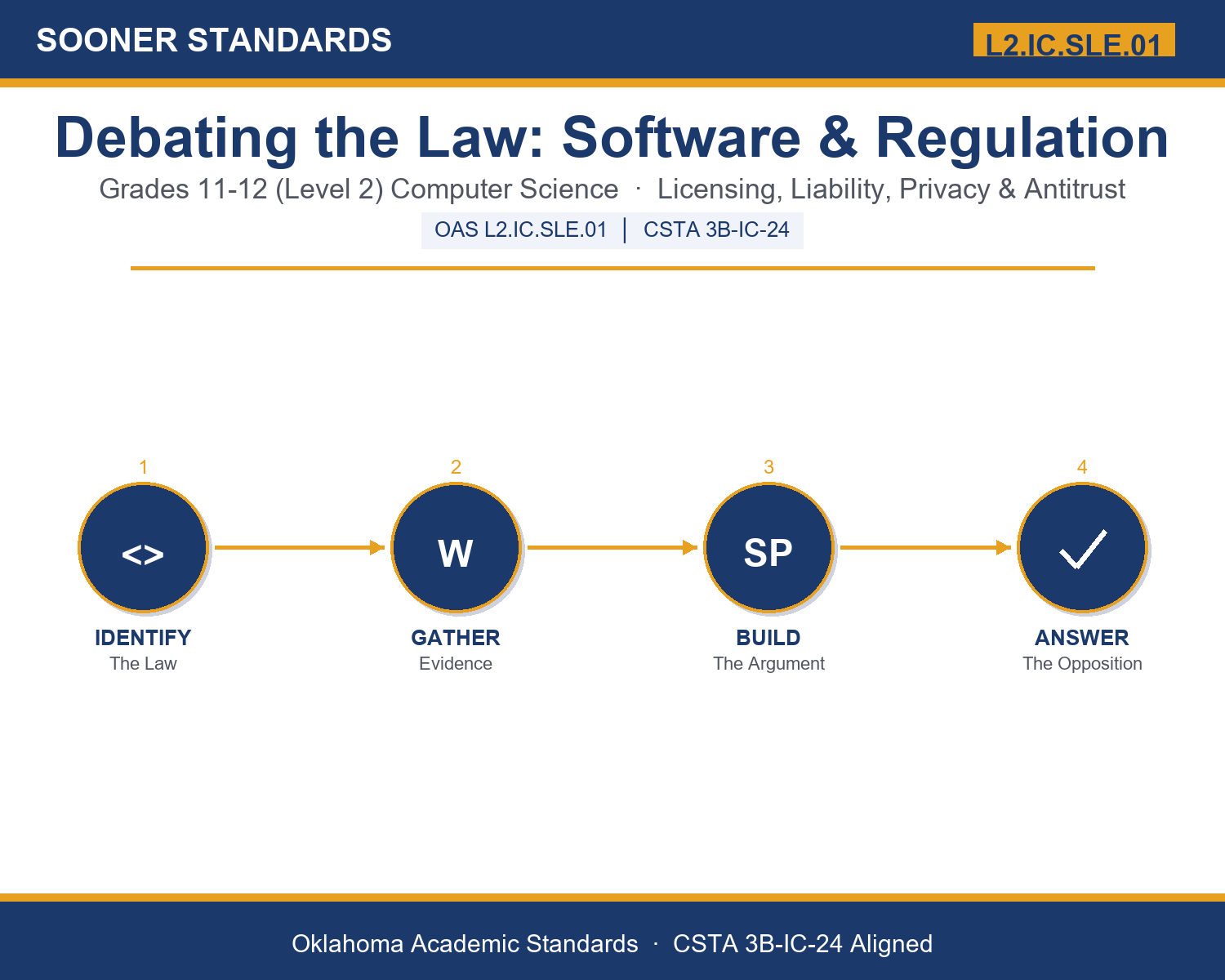
In student-friendly terms, the learning target is: "I can debate laws and regulations that impact the development and use of software by identifying the specific rule that applies, building an evidence-based argument, and responding to the strongest opposing argument."
What Students Should Be Able to Do
- I can explain the difference between proprietary and open-source software licenses, including the difference between permissive and copyleft licenses.
- I can distinguish what copyright protects from what a patent protects in software.
- I can identify how privacy, accessibility, liability, or antitrust regulation shapes how software is actually built, not just how it is described.
- I can build a debate argument that cites a specific law, regulation, or license term and directly answers the strongest opposing argument.
Along the way, students pick up the working vocabulary of the topic: license, copyright, patent, proprietary, opensource, liability, regulation, compliance, privacy, antitrust, infringement, jurisdiction, accessibility, precedent.
Software Law And Regulations: Misconceptions to Watch For
These are the wrong turns students reliably take with this standard — knowing them ahead of time is half the lesson plan. Each correction strategy below comes straight from the unit's teacher guide (the paragraph and activity references point into the unit itself).
1. "Copyright and patents protect the exact same thing in software."
Return to paragraph 3's distinction. Have students state, in one sentence each, what copyright protects (the specific code as written) versus what a patent protects (a novel process or method), then apply both terms to the same example app.
2. "If software is free to use, it must also be legal to copy, modify, and resell."
Use the freeware/EULA row of the comparison chart. Point out that a no-cost license still restricts copying and resale — free to use is not the same as free of legal restriction.
3. "Agreeing to a EULA or terms of service is not really binding because almost no one reads it."
Return to paragraph 4. Courts have generally enforced these agreements as binding contracts regardless of whether a user read them in full — clicking 'I agree' still counts as agreement in the eyes of the law.
4. "Privacy and accessibility regulations only affect a company's paperwork and policies, not the actual software."
Point to specific examples in paragraphs 6 and 7 — a regulation requiring a data-deletion feature, or a law requiring screen-reader compatibility — that force real engineering changes, not just a rewritten policy document.
Discussion Starters You Can Use Tomorrow
- Should software patents be allowed to cover broad, abstract processes, or only very specific technical methods? What's the strongest argument on each side?
- Is it fair for a small open-source contributor's free work to end up inside a large company's paid, proprietary product? Under what license would that be legal?
- Should the same accessibility requirements that apply to government websites also apply to every private company's website? Why or why not?
Bringing It Home
This topic is a natural one for families. One ten-minute activity to try: Together, open the privacy policy or terms of service for one app or service your family uses. Find one sentence that surprises you, and have your student explain what law or company policy they think it's connected to and why. There are no wrong answers — the goal is hearing their reasoning about a real document.
Where This Leads
Students who can debate laws and regulations that impact the development and use of software by identifying the specific rule that applies, building an evidence-based argument, and responding to the strongest opposing argument are building skills used every day in technology / intellectual property law, privacy and compliance, open source program management, product management, and software engineering.
See the Unit in Action
Get the Complete L2.IC.SLE.01 Unit
I built a complete, no-prep unit for this standard — Debating the Law: How Legal Regulation Shapes Software Development — covering 3-4 days of instruction across 45 pages:
- Teacher guide — day-by-day pacing, misconceptions to watch for, discussion questions, differentiation for support / ELL / extension, and a 4-point rubric
- Student learning target page — a kid-friendly "I can" statement with success criteria
- Full content lesson with 3 embedded "Check Your Understanding" checkpoints
- 12-question assessment (6 multiple choice, 4 true/false, 2 short answer) with a complete answer key, explanations, and exemplar responses
- Group activity — "The Software Law Debate Chamber" (25-30 minutes)
- Individual activity — "My Terms of Service Investigation" (20-25 minutes)
- Crossword and word search built from all 14 vocabulary terms (with answer keys)
- Family connection letter — a plain-language page for parents, with dinner-table questions and a 10-minute home activity
- Certificate of achievement — ready to sign and send home
- Debate Scenario Card Set: Software Law & Regulation (separate printable, 2 pages)
- Reference Notes: Software Law & Regulation (separate printable, 2 pages)
- My Terms of Service Investigation (separate printable, 2 pages)
Get Debating the Law: Software & Regulation on Teachers Pay Teachers →
Also aligned to CSTA 3B-IC-24: Compare tradeoffs associated with computing technologies that affect people's everyday activities and career options.
Every Sooner Standards resource is built directly from the official Oklahoma Academic Standards for Computer Science (February 2023) — standard text verified, never paraphrased from memory.