Teaching Formulating Investigations With Models & Simulations in Grades 11-12 (Level 2): Oklahoma Standard L2.DA.IM.01
Teaching Formulating Investigations With Models & Simulations in Grades 11-12 (Level 2): Oklahoma Standard L2.DA.IM.01
Teaching models and simulations in grades 11-12 (level 2) does not have to be complicated. Picture a data scientist validating a sales forecasting model against historical results the model never saw during training. That kind of thinking is exactly what Oklahoma's grades 11-12 (level 2) computer science standard L2.DA.IM.01 asks students to practice — and it is very teachable with the right materials. This post walks through what the standard means, the misconceptions students bring to it, and discussion starters you can use tomorrow, whether you teach in a classroom or at your kitchen table.
What Does Standard L2.DA.IM.01 Actually Ask?
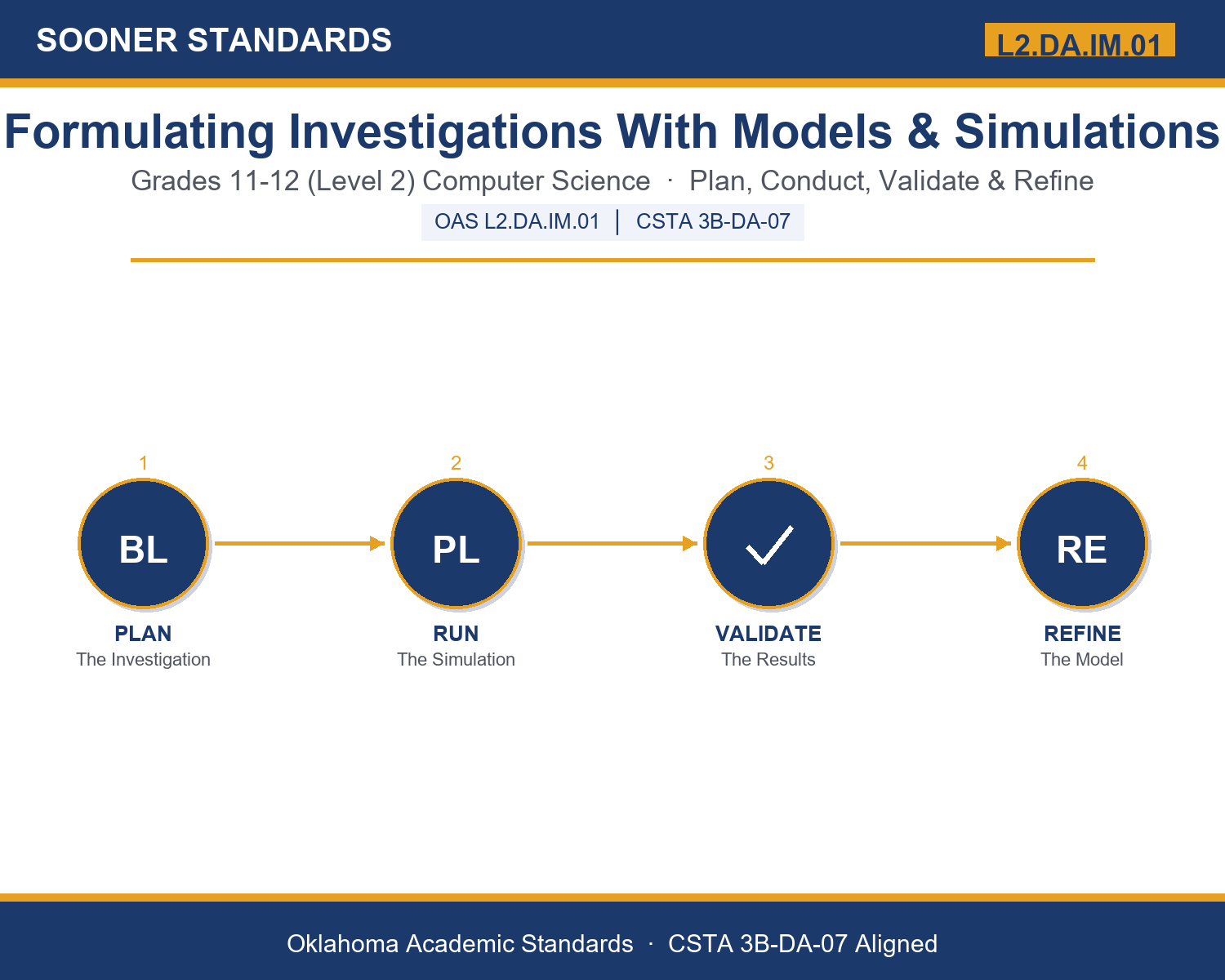
Use models and simulations to help plan, conduct, and refine investigations. — Oklahoma Academic Standards for Computer Science (February 2023)
In plain language: This standard asks students to use a simplified representation of a real system to plan an investigation, run it to see what it predicts, and check whether that prediction actually matches reality before trusting it.
In student-friendly terms, the learning target is: "I can use a model and a simulation to plan an investigation by naming its variables and a testable hypothesis, run it and interpret its output, and refine it based on how well it validates against real data."
What Students Should Be Able to Do
- I can explain what a model includes and what it deliberately leaves out, and justify why.
- I can identify a model's independent variable, dependent variable, and at least one parameter.
- I can judge whether a model is valid by comparing its output to data it was not built from.
- I can diagnose a likely source of model error and propose a specific refinement.
Along the way, students pick up the working vocabulary of the topic: model, simulation, variable, parameter, abstraction, validation, iteration, hypothesis, sensitivity, emergent, feedback, agent, calibration, refinement, investigation.
Models And Simulations: Misconceptions to Watch For
These are the wrong turns students reliably take with this standard — knowing them ahead of time is half the lesson plan. Each correction strategy below comes straight from the unit's teacher guide (the paragraph and activity references point into the unit itself).
1. "A more detailed model is always a better, more accurate model."
Return to paragraph 2's subway map example. Ask students to explain why adding exact street distances would make the map worse for its intended purpose, then connect that to a model becoming too complex to analyze or trust if it includes irrelevant detail.
2. "Running a simulation one time gives you the correct answer."
Use paragraph 5's stochastic simulation discussion. Have students explain why a single run of a model with randomness built in reports only one possible outcome among many, and why hundreds of runs are needed to see the real range of results.
3. "If a model's prediction and the real data are close, the model must be correct in every situation."
Revisit the rainfall constructed-response scenario. Show that a model can validate well under typical conditions but fail badly under extreme ones, and that validation only supports trust within the conditions actually tested.
4. "A model that fails validation should be thrown out and started over from scratch."
Connect to paragraph 7's iterative refinement discussion. Explain that failing validation is the normal starting point of investigation, and that diagnosing the specific source of error (a missing variable, a wrong relationship, a miscalibrated parameter) usually leads to a targeted fix rather than a full rebuild.
Discussion Starters You Can Use Tomorrow
- Why might two investigators studying the exact same real-world system reasonably build two different models of it?
- How is deciding what to leave OUT of a model similar to, or different from, deciding what to include?
- Describe a prediction in your own life (weather, sports, travel time) that you trust, and explain what evidence makes you trust it.
Bringing It Home
This topic is a natural one for families. One ten-minute activity to try: Together, pick a prediction you use in daily life (a weather forecast, a recipe's cook time, a travel-time estimate) and have your student describe, the way a data scientist would, what factors that prediction probably considers and what it probably ignores. Then ask: what would you check to decide whether to trust it next time? There are no wrong answers — the goal is hearing their reasoning about trustworthiness, not memorized facts.
Where This Leads
Students who can use a model and a simulation to plan an investigation by naming its variables and a testable hypothesis, run it and interpret its output, and refine it based on how well it validates against real data are building skills used every day in data science, public health / epidemiology, urban and transportation planning, game design / systems engineering, and computer science education.
See the Unit in Action
Get the Complete L2.DA.IM.01 Unit
I built a complete, no-prep unit for this standard — Formulating Investigations With Models and Simulations — covering 3-4 days of instruction across 45 pages:
- Teacher guide — day-by-day pacing, misconceptions to watch for, discussion questions, differentiation for support / ELL / extension, and a 4-point rubric
- Student learning target page — a kid-friendly "I can" statement with success criteria
- Full content lesson with 3 embedded "Check Your Understanding" checkpoints
- 12-question assessment (6 multiple choice, 4 true/false, 2 short answer) with a complete answer key, explanations, and exemplar responses
- Group activity — "Model Audit: Evaluate, Diagnose, Refine" (25-30 minutes)
- Individual activity — "Design My Own Investigation" (20-25 minutes)
- Crossword and word search built from all 15 vocabulary terms (with answer keys)
- Family connection letter — a plain-language page for parents, with dinner-table questions and a 10-minute home activity
- Certificate of achievement — ready to sign and send home
- Validation Data Card Set: Evaluate, Diagnose, Refine (separate printable, 2 pages)
- Reference Notes: Formulating Model-Based Investigations (separate printable, 2 pages)
- Design My Own Investigation (separate printable, 2 pages)
Get Formulating Investigations With Models & Simulations on Teachers Pay Teachers →
Also aligned to CSTA 3B-DA-07: Use models and simulations to help formulate, refine, and test scientific hypotheses.
Every Sooner Standards resource is built directly from the official Oklahoma Academic Standards for Computer Science (February 2023) — standard text verified, never paraphrased from memory.