Cybersecurity Ethics: Hacking, Security, and Social Responsibility
Teaching Cybersecurity Ethics in Grade 8: Oklahoma Standard 8.IC.SLE.01
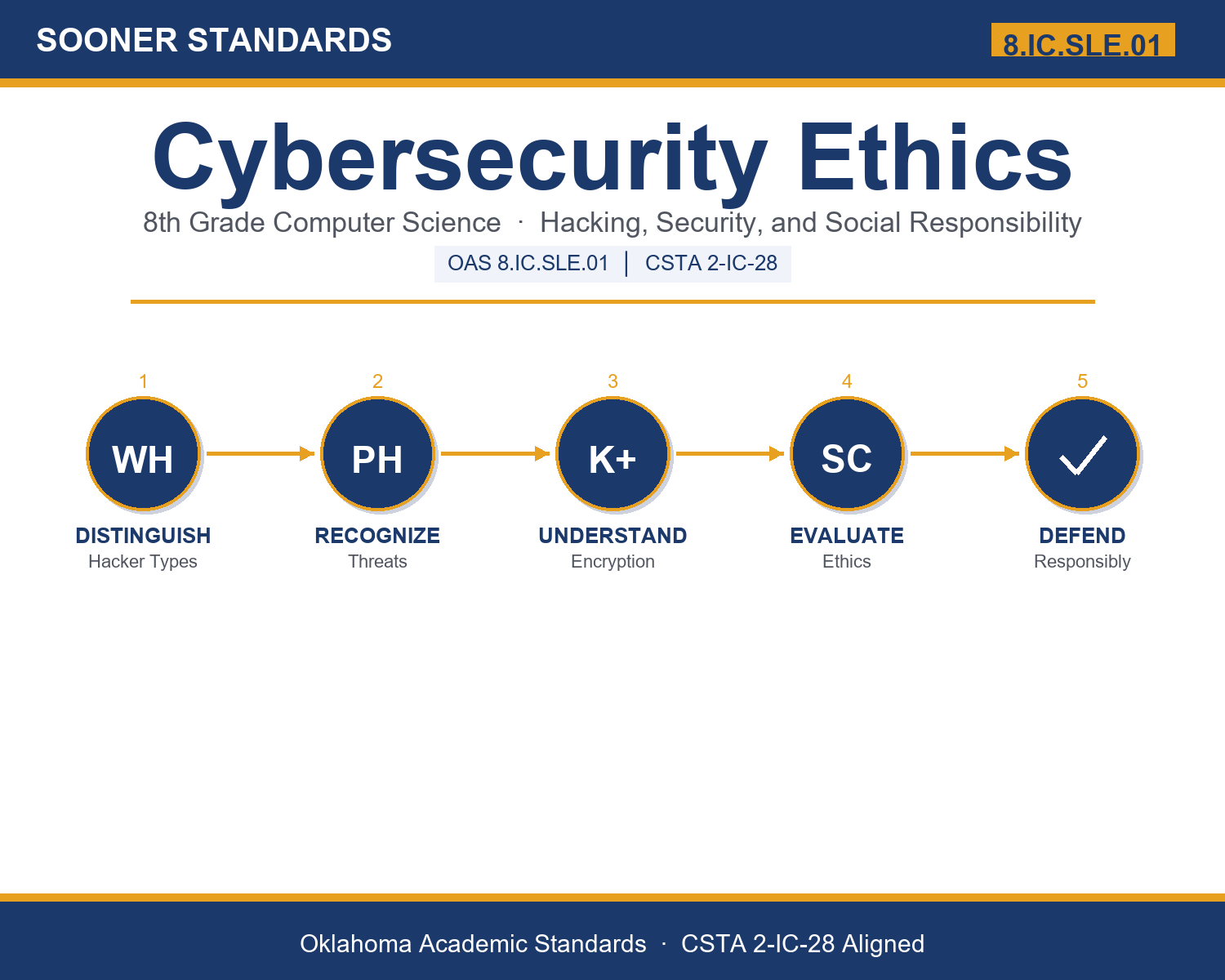
"Hacking" isn't a single act with a single moral value — the same technical skill can protect a hospital's systems or destroy them. Oklahoma's standard 8.IC.SLE.01 asks eighth graders to sit with that complexity honestly: discussing the social impacts and ethical considerations associated with cybersecurity, including the positive and malicious purposes of hacking. This post walks through what the standard means, the vocabulary students need, and a few discussion starters you can use tomorrow.
What Does Standard 8.IC.SLE.01 Actually Ask?
Discuss the social impacts and ethical considerations associated with cybersecurity, including the positive and malicious purposes of hacking. — Oklahoma Academic Standards for Computer Science (February 2023)
In plain language: students need to understand that hacking skills can be used to help (finding and fixing vulnerabilities) or to harm (stealing data, causing damage) — and think critically about the ethics and real-world consequences of both.
Key Vocabulary Students Will Learn
Hacking, Ethics, Malicious, Exploit, Phishing, Ransomware, Vulnerability, Encryption, Firewall, Breach, Cybercrime, Authentication, Penetration
This vocabulary gives students the shared language to talk precisely about a topic that's often discussed vaguely — the difference between an "exploit," a "breach," and an act of "cybercrime."
What's Inside the Lesson
The content reading frames cybersecurity as one of the most important — and most ethically complex — fields in modern computing. Individuals, businesses, hospitals, schools, and governments all rely on digital systems to store sensitive data, communicate, and provide critical services, and when those systems are compromised, the consequences can range from financial loss to physical danger. The reading is explicit that understanding cybersecurity requires more than knowing how attacks happen — it requires thinking carefully about the social and ethical dimensions involved.
Discussion Starters You Can Use Tomorrow
- What's the difference between someone who hacks a system to find and report a security flaw, and someone who hacks it to steal information?
- Why might a hospital's cybersecurity failure be more dangerous than a similar failure at a retail store?
- If you discovered a security flaw in an app you use, what do you think the responsible next step would be?
Where This Leads
Students who can reason through the ethics of cybersecurity are building judgment that matters far beyond a computer science classroom — the ability to weigh real consequences and responsibility whenever technical power intersects with other people's safety and privacy.
See the Unit in Action
Get the Complete 8.IC.SLE.01 Unit
I built a complete, no-prep unit for this standard — Cybersecurity Ethics: Hacking, Security, and Social Responsibility — across 22 ready-to-print pages:
- Vocabulary reference — all 13 terms with definitions and real-world examples
- Full content reading with embedded comprehension checkpoints
- 10-question assessment (6 multiple choice, 4 true/false) with a complete answer key and explanations
- Group activity — "Ethics Case Study: Hacking — Right, Wrong, or Complicated?"
- Individual activity — "Cybersecurity Ethics Position Paper"
- Crossword and word search built from all 13 vocabulary terms (with answer keys)
- Standards alignment verification page
- Cybersecurity Ethics Worksheet (separate printable)
- Cybersecurity Reference Sheet (separate printable)
Get Cybersecurity Ethics on Teachers Pay Teachers →
Every Sooner Standards resource is built directly from the official Oklahoma Academic Standards for Computer Science (February 2023) — standard text verified, never paraphrased from memory.