Teaching Decomposition: Breaking Down Problems in Grade 5: Oklahoma Standard 5.AP.M.01
Teaching Decomposition: Breaking Down Problems in Grade 5: Oklahoma Standard 5.AP.M.01
Teaching problem decomposition in grade 5 does not have to be complicated. Picture a software team breaking a huge app into smaller parts to build separately. That kind of thinking is exactly what Oklahoma's grade 5 computer science standard 5.AP.M.01 asks students to practice — and it is very teachable with the right materials. This post walks through what the standard means, the misconceptions students bring to it, and discussion starters you can use tomorrow, whether you teach in a classroom or at your kitchen table.
What Does Standard 5.AP.M.01 Actually Ask?
Decompose (break down) large problems into smaller, manageable subproblems and then into a precise sequence of instructions. — Oklahoma Academic Standards for Computer Science (February 2023)
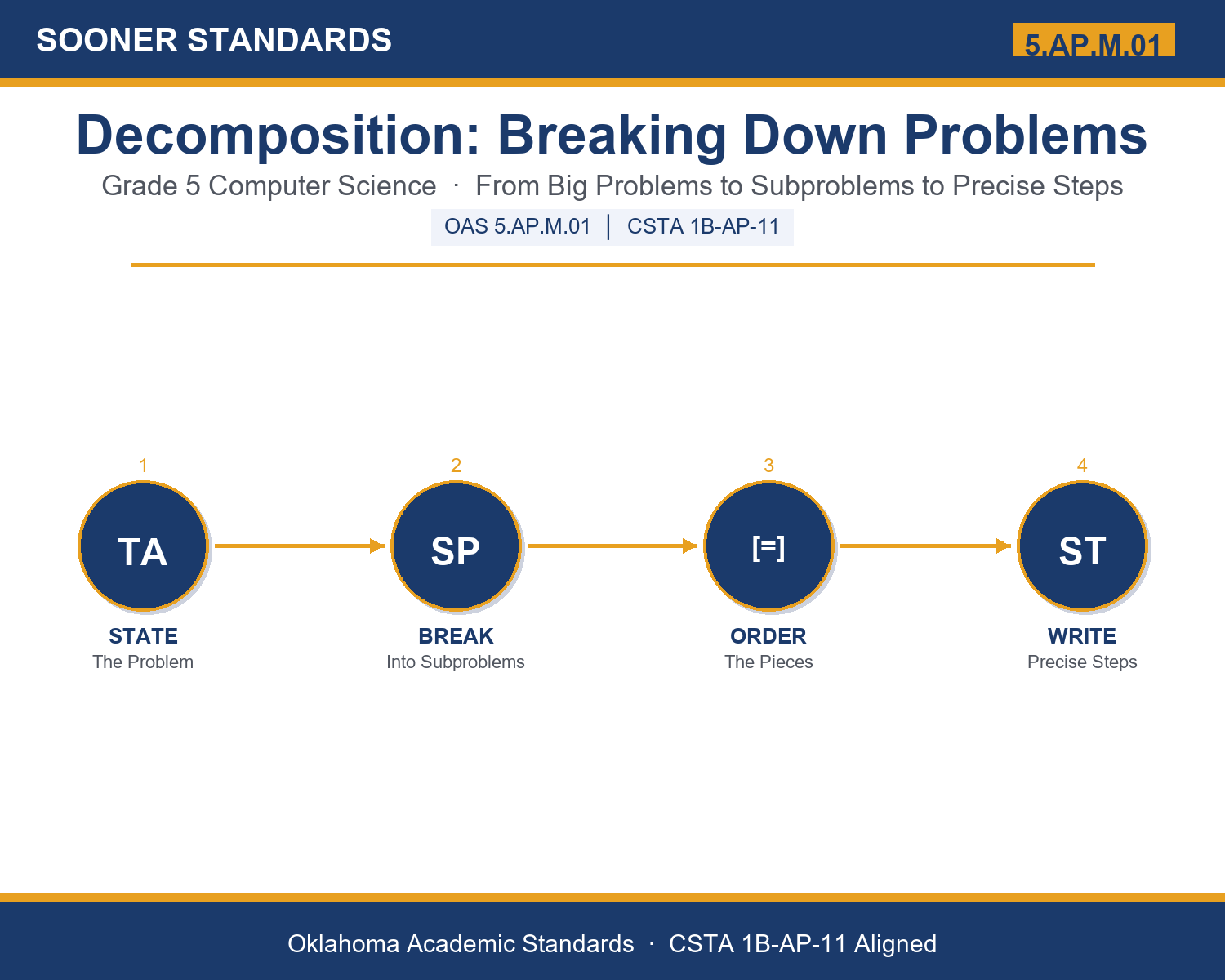
In plain language: Oklahoma's standard asks fifth graders to break large problems into smaller subproblems and then into an exact, ordered sequence of instructions, the same way programmers and problem solvers tackle big jobs.
In student-friendly terms, the learning target is: "I can decompose a large problem into smaller subproblems and break each subproblem into a precise sequence of instructions."
What Students Should Be Able to Do
- I can break a big problem into smaller, manageable subproblems.
- I can put the subproblems in a sensible order.
- I can turn a subproblem into a precise sequence of exact steps.
- I can explain why decomposing a problem makes it easier to solve.
Along the way, students pick up the working vocabulary of the topic: decompose, problem, subtask, sequence, step, algorithm, task, precise, order, solution, plan, parts, break.
Problem Decomposition: Misconceptions to Watch For
These are the wrong turns students reliably take with this standard — knowing them ahead of time is half the lesson plan. Each correction strategy below comes straight from the unit's teacher guide (the paragraph and activity references point into the unit itself).
1. "Decomposition makes a problem bigger or adds more work."
Use paragraphs 1-2. Decomposition does not add work; it organizes the same work into smaller, doable pieces. Compare cleaning a whole house versus one room at a time.
2. "Once you list subproblems, you are done."
Use paragraphs 4-6. After listing subproblems, you must order them and turn each into a precise sequence of exact steps. Naming the pieces is only the first half.
3. "The steps inside a subproblem can be vague or in any order."
Use paragraph 5. Computers follow steps exactly and in order. Show how an out-of-order or vague step (add some water) breaks the result.
4. "A subproblem can never be broken down further."
Use paragraph 3 (nesting boxes). If a subproblem is still too big, break it again. Plan the food becomes make a list, shop, and prepare snacks.
Discussion Starters You Can Use Tomorrow
- What is a big task in your life that would feel easier if you broke it into smaller pieces?
- How might two people decompose the same problem into different subproblems?
- Why do you think computers need such precise, exact instructions?
Bringing It Home
This topic is a natural one for families. One ten-minute activity to try: Together, pick a big task your family needs to do, like cleaning the garage or preparing a meal. Help your child break it into three or four smaller subproblems written on separate notes, put them in order, then pick one and write the exact steps to finish it. Talk about how the big job felt more doable once it was broken down.
Where This Leads
Students who can decompose a large problem into smaller subproblems and break each subproblem into a precise sequence of instructions are building skills used every day in software engineering, project management, engineering design, event planning, and scientific research.
Part of the Complete Grade 5 Computer Science Curriculum
This lesson covers just one standard. It is part of a complete grade 5 computer science curriculum aligned to every Oklahoma OAS CS standard. See the full listing — every standard, organized by strand — here: Grade 5 Computer Science Curriculum: Every Oklahoma OAS CS Standard.
See the Unit in Action
Get the Complete 5.AP.M.01 Unit
I built a complete, no-prep unit for this standard — Decomposition: Breaking Big Problems into Small Steps — covering 3-4 days of instruction across 36 pages:
- Teacher guide — day-by-day pacing, misconceptions to watch for, discussion questions, differentiation for support / ELL / extension, and a 4-point rubric
- Student learning target page — a kid-friendly "I can" statement with success criteria
- Full content lesson with 3 embedded "Check Your Understanding" checkpoints
- 12-question assessment (6 multiple choice, 4 true/false, 2 short answer) with a complete answer key, explanations, and exemplar responses
- Group activity — "Decompose It Together" (30-35 minutes)
- Individual activity — "Break It Down" (15-20 minutes)
- Crossword and word search built from all 13 vocabulary terms (with answer keys)
- Family connection letter — a plain-language page for parents, with dinner-table questions and a 10-minute home activity
- Certificate of achievement — ready to sign and send home
- Decompose It! Planner (separate printable, 1 page)
- Decomposition Reference Notes (separate printable, 1 page)
- Break It Down (separate printable, 1 page)
Get Decomposition: Breaking Down Problems on Teachers Pay Teachers →
Also aligned to CSTA 1B-AP-11: Decompose (break down) problems into smaller, manageable subproblems to facilitate the program development process.
Every Sooner Standards resource is built directly from the official Oklahoma Academic Standards for Computer Science (February 2023) — standard text verified, never paraphrased from memory.