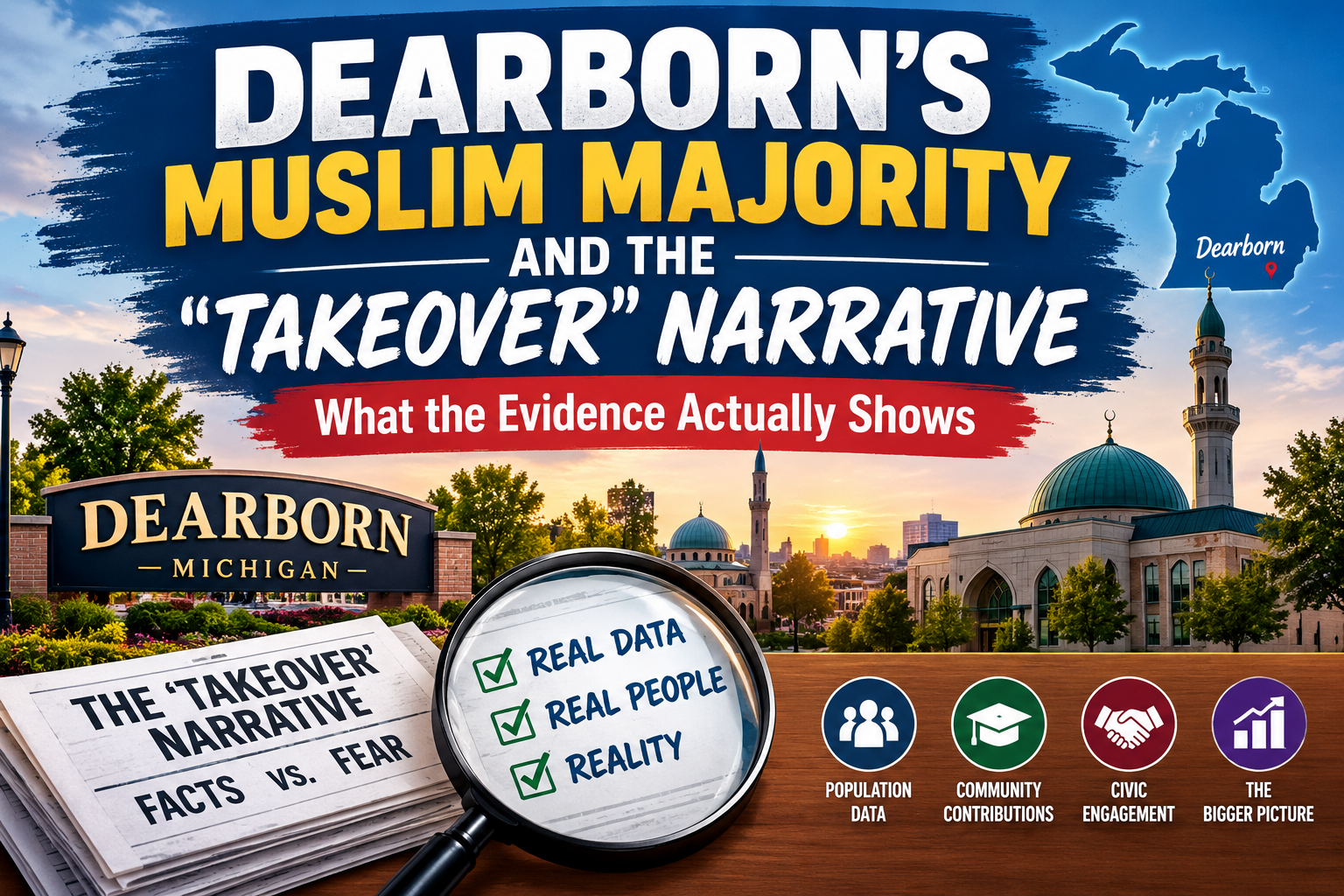
Dearborn’s Muslim Majority and the “Takeover” Narrative: What the Evidence Actually Shows
A recurring claim circulates online: that the growth of an Arab and Muslim population in Michigan cities—Dearborn most of all—represents an ethnic-religious bloc “approaching state dominance,” sometimes paired with a warning drawn from the fall of Rome. The strongest version of the concern is not trivial to dismiss. A concentrated, well-organized community has won local offices at a rapid clip, produced members of Congress and a mayor, and now stands behind a U.S. Senate nominee who would be the first Muslim to hold that office. It arrives with a distinct religious-legal tradition and sits in a swing state that can decide national elections. Testing that claim honestly means neither validating it by default nor waving it away, but running it against the historical record, the base rates, and the primary sources. When that is done carefully, the “dominance” framing does not survive contact with the data. What emerges instead is a pattern American cities have run many times before.
The Roman parallel, which often seeds the alarm, inverts on inspection. The argument holds that Rome fell because it let subject peoples keep their identities rather than forcing assimilation—an analogy meant to make Michigan’s demographic change read as a slow-motion collapse. But Rome’s actual growth engine was the opposite mechanism: it extended citizenship and legal status to conquered peoples as fast as they proved useful, converting potential enemies into stakeholders. Incorporation was the stability strategy, not the vulnerability. The one clear case in Gibbon of a ruling group deliberately keeping a conquered population separate—Theodoric’s Ostrogothic Italy—is framed as what preserved the regime, not what dissolved it. The fragmentation that came later, the foederati settlements of the Visigoths and others, was not about a group keeping its culture; it was about a group keeping its own army and independent command under treaty inside imperial borders. That is a military and structural fact, and collapsing it into a story about cultural assimilation does a great deal of unstated work in the analogy.
The pattern that genuinely fits has a name in American political science: ethnic succession in urban politics. An immigrant group settles a gateway city, builds mutual-aid and civic infrastructure over one to three generations, and wins local office roughly in step with its share of the population, eventually producing figures who reach state or national prominence. The Irish ran this exact sequence through Tammany Hall, where they held around 61 percent of the machine’s committee positions by the 1890s, before being displaced by Italian and Jewish coalitions in later decades. Black political leadership rose in Chicago under Harold Washington; Cuban Americans came to dominate Miami-Dade from the 1980s onward. Scholars from Robert Dahl in Who Governs? to Steven Erie in Rainbow’s End documented the mechanics of this cycle in detail. What the prior cycles produced was concentrated control of specific cities—not capture of state government—followed decades later by the next group’s rise as demographics kept shifting. Cambridge Core
Dearborn’s own timeline maps onto that geography rather than onto imperial collapse. The community’s founding wave came in the 1920s, when Ford’s River Rouge plant drew Lebanese Shia migrants to the city’s Southend. Organizing infrastructure followed—ACCESS in 1971, the American-Arab Anti-Discrimination Committee in 1980—the same mutual-aid-to-political-machine arc the earlier groups ran. Keith Ellison of Minnesota became the first Muslim elected to Congress in 2006, and Ilhan Omar followed in 2018. In 2021, Dearborn elected its first Arab American mayor, Abdullah Hammoud. By 2023, Dearborn had become the first Arab-majority city in the United States, with roughly 55 percent of residents claiming Middle Eastern or North African ancestry. Every element of this is concentrated, gateway-city political rise; Michigan’s legislature, governor’s office, and other cities show no version of the pattern. ClickOnDetroitWikipedia
The vote data cut hard against the idea of a disciplined bloc under central direction. In 2024, Dearborn gave Trump 42.48 percent, Harris 36.26 percent, and Stein 18.37 percent—a collapse from 2020, when Biden had carried the city with 68.72 percent. That is a swing of more than thirty points in Democratic vote share, driven overwhelmingly by anger over the administration’s Gaza policy. A community executing a coordinated dominance strategy protects its institutional leverage; it does not torch decades of bargaining power inside one party over a single foreign-policy grievance. What that swing actually resembles is ordinary single-issue American voting behavior—the same pattern shown by evangelicals, veterans, or labor unions when a party crosses their central concern. The officeholding tally tells the same story: a handful of offices held across two states with a combined population above fifteen million is a small fraction of total elected positions. “A handful of offices held roughly in proportion to a growing constituency’s vote share” is the phrase the numbers support; “approaching state dominance” is not. ArabAmericanNews
A precision point is worth isolating, because it quietly inflates every version of the claim. The Census figure that made headlines measures ancestry, not religion. Roughly 54–55 percent of Dearborn’s residents report MENA or Arab ancestry, a statistic journalists routinely equate with the size of the Muslim community but which cannot be read directly as religious affiliation. Fact-checkers caution that MENA and Arab ancestry includes Christians, secular people, and adherents of other faiths. “Majority Arab” and “majority Muslim” are not interchangeable, and the 2020 Census was the first to solicit MENA responses at all, so even the ancestry figure carries undercounting and methodology caveats. None of this erases the reality of a large, visible Muslim community; it simply means the specific numbers used to argue “takeover” are softer and less precise than the argument requires. Building a demographic-threat case on a religion figure the Census never actually collected is a shaky foundation. Factually
The sharper form of the concern asks whether Islamic law introduces something categorically different from prior succession cycles. Here the analysis has to be careful in both directions. Sharia is not one monolithic system: it spans personal and ritual practice—prayer, diet, most of what it means day to day—through family law to, in a minority reading, criminal and constitutional law. Treating that entire range as a single alarm category collapses a vast spectrum of belief. The instructive comparison is Halakha, Jewish religious law, which has the identical structure from personal observance at one end to a comprehensive legal theory at the other—yet the historical rise of Jewish political representation was never framed as “approaching Halakha takeover,” which is worth sitting with. More decisively, the structural barrier exists regardless of who holds office: the Establishment Clause, Article VI’s ban on religious tests, and Fourteenth Amendment incorporation bind every level of government, and no mayor or senator can unilaterally write religious law into civil statute. The genuinely checkable question is narrow and answerable: has any named officeholder proposed or voted for legislation importing religious-law content into civil statute? That is a specific test, distinct from inferring intent from the fact that an officeholder is Muslim.
The September 2026 lawsuit against Dearborn is the newest data point and needs to be unbundled, because coverage fuses three separable claims. Margot Cleveland, a senior legal correspondent for The Federalist and a Dearborn resident, filed a federal complaint represented by the American Freedom Law Center, alleging the city spent taxpayer money on Ramadan displays while ignoring her requests for equal recognition of Easter and Passover. The complaint cites roughly $1,500 on Ramadan banners and $5,000 on a lighted crescent moon, plus expanded crescent-and-star streetlight displays in 2026, and raises Establishment Clause, free-speech, and equal-protection claims. That first claim is a well-litigated pattern: government favoritism toward a locally dominant religion is the same fact structure behind decades of suits against Christian-majority towns over publicly funded nativity scenes and council prayer, from Lynch v. Donnelly to County of Allegheny v. ACLU. If the allegation holds, it is local-majority favoritism doing what it always does—not evidence the mechanism is unique to Islam. Yahoo!
The second and third strands should not be read as the first. The complaint also points to a September 2025 council meeting where Hammoud, responding to pastor Ted Barham’s objection to a street renamed for publisher Osama Siblani, called Barham a bigot and told him he was not welcome in Dearborn. That is inappropriate conduct from a sitting mayor toward a resident on its own terms—a governance problem, not proof of a coordinated plan. The “implementation of Sharia” language attached to the story in some coverage is framing, not a claim in the suit, which is about display funding and equal treatment; fusing a narrow, checkable Establishment Clause dispute with a sweeping Sharia narrative is exactly the amplification pattern worth watching for. Cutting the other way, the case itself is evidence the accountability system works: a Christian resident is suing the mayor in federal court and drawing coverage across PBS, the Associated Press, and Fox, with no sign of suppression—courts and a free press functioning as designed, not a captured local government. It is also landing in the middle of Michigan’s contested 2026 Senate race, where El-Sayed, who won the Democratic primary on August 4 with 48.5 percent and would be the first Muslim U.S. senator if elected, faces Republican Mike Rogers in a toss-up—a reason for the story’s amplification right now, independent of whether its underlying claims prevail. Yahoo!Wikipedia
That leaves a short list of honest open questions, and the discipline is to name them rather than file every new headline as confirmation. The lawsuit’s outcome is unresolved, and a finding for Cleveland, a finding for the city, or a settlement would each mean something different. The real test of whether the favoritism mechanism is Islam-specific is a cross-check that has not been run: do Christian-majority Michigan municipalities show the same public-spending pattern favoring Christian displays? The checkable Sharia question—whether any named officeholder has moved to import religious law into civil statute—remains unanswered and answerable. And the standing question applies to the reader as much as to the claim: across each round of new evidence, has anything actually been allowed to count against the original framing, or has every data point been absorbed as proof? On the record as it stands, the defensible read is ordinary and specific: ethnic succession plus single-issue voting behavior, operating inside constitutional limits that bind every officeholder equally, with a handful of genuinely open questions that are answerable by evidence rather than settled by inference.