4th Grade Computer Science Curriculum: Every Texas TEKS §126.9 Standard, No Prep
4th Grade Computer Science Curriculum: Every Texas TEKS §126.9 Standard, No Prep
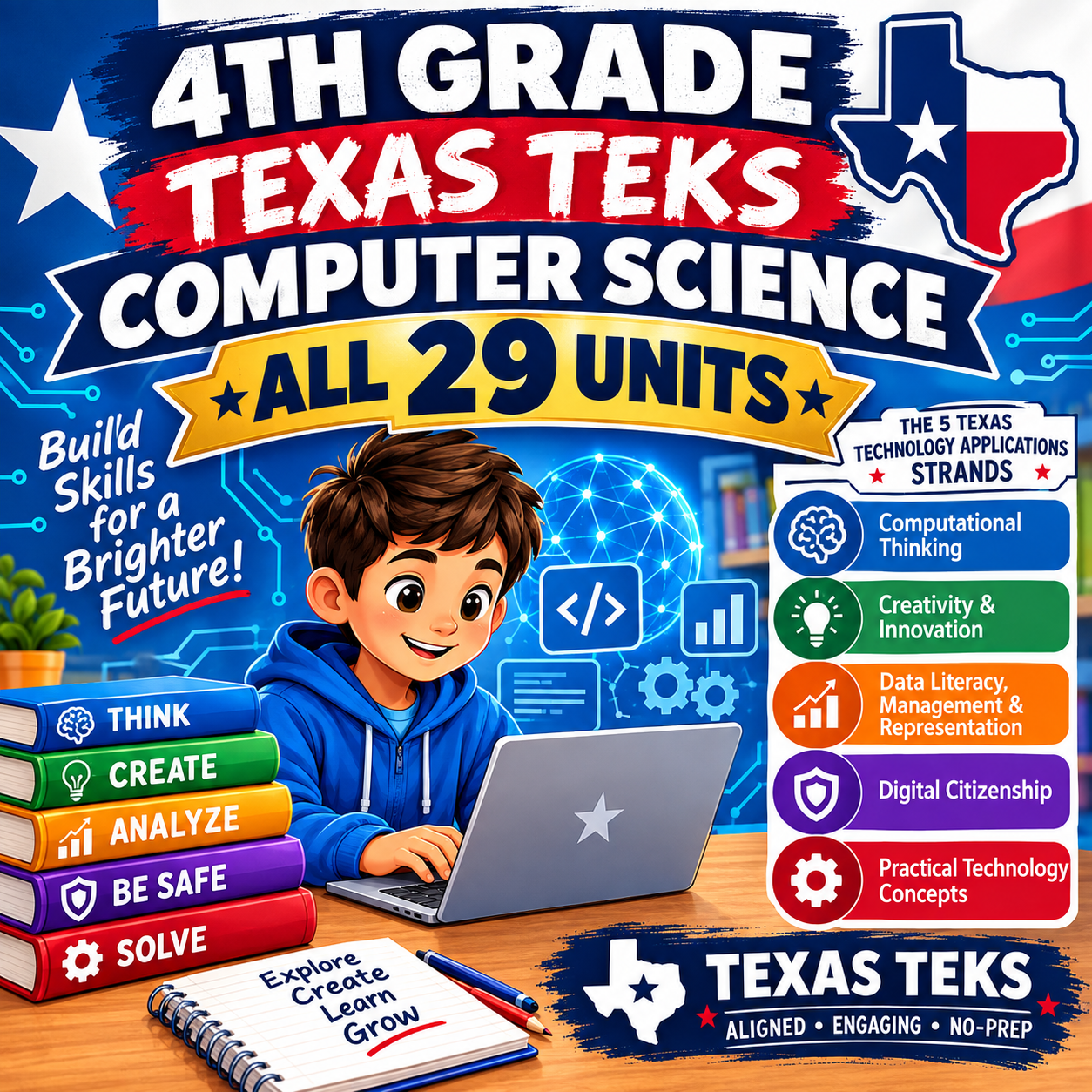
Teaching a full 4th grade computer science curriculum in Texas is a tall order — the TEKS §126.9 Technology Applications standards span twelve strands and 29 individual knowledge-and-skills statements, and few teachers have a single resource that covers all of them without stitching together products built for other states or another grade. This bundle solves that: it is a complete, no-prep 4th grade computer science curriculum that covers every Texas TEKS §126.9 standard at grade 4, authored directly from Texas's own TEKS text, in a format you can print and teach.
What Texas's 4th Grade CS Standards Cover
Texas TEKS §126.9 spans twelve strands:
- Computational Thinking — Foundations — decomposing story problems into smaller, manageable subproblems and discussing and documenting solutions, identifying patterns in story problems to make predictions, communicating design plans and solutions using a variety of options, and debugging algorithms by identifying and removing errors (§126.9(c)(1)(A)–(D)).
- Computational Thinking — Applications — using variables within a program to modify data, and using a design process to create programs that include sequences, loops, and conditionals to express ideas or address a problem (§126.9(c)(2)(A)–(B)).
- Creativity & Innovation — Design Process — explaining and demonstrating the personal skills and behaviors needed to implement a design process successfully (problem solving and questioning, effective communication, following directions, mental agility, and metacognition), and applying an appropriate design process that includes components to improve processes and refine original products (§126.9(c)(3)(A)–(B)).
- Creativity & Innovation — Emerging Technologies — identifying real-world examples of emerging technologies (§126.9(c)(4)).
- Data Literacy — Collect Data — classifying numerical and non-numerical data, and identifying and collecting data using various search strategies, including two or more keywords within specific parameters (§126.9(c)(5)(A)–(B)).
- Data Literacy — Organize, Manage, Analyze — using digital tools to transform and make inferences about data to answer a question (§126.9(c)(6)).
- Data Literacy — Communicate & Publish — using digital tools to communicate the results of an inquiry to an intended audience (§126.9(c)(7)).
- Digital Citizenship — Social Interactions — describing how information retained online creates a permanent digital footprint, describing appropriate digital etiquette for text, email, and online chat, and demonstrating appropriate digital etiquette for shared documents, video conferencing, and other collaborative platforms (§126.9(c)(8)(A)–(C)).
- Digital Citizenship — Ethics & Laws — demonstrating adherence to an acceptable use policy and explaining responsible and ethical technology use, describing the rights and responsibilities of a creator and how copyright law applies to creative work, and creating citations for digital forms of media with assistance (§126.9(c)(9)(A)–(C)).
- Digital Citizenship — Privacy, Safety & Security — demonstrating account safety practices including strong passwords and logging off devices, identifying and discussing data collection tools and why digital privacy matters, and discussing how to respond to cyberbullying, including advocating for self and others (§126.9(c)(10)(A)–(C)).
- Practical Technology Concepts — Processes — evaluating and choosing applications for relevance to an assigned task, and performing software application functions such as outline options, bulleting, numbering lists, and finding and replacing (§126.9(c)(11)(A)–(B)).
- Practical Technology Concepts — Skills & Tools — communicating an understanding of terminology related to virtual systems such as video conferencing, augmented reality, and virtual reality, evaluating where and how to save using effective file management strategies, demonstrating proper touch keyboarding technique with speed, accuracy, and ergonomic strategies, identifying and practicing keyboard shortcuts, and using troubleshooting strategies to solve minor hardware and software problems (§126.9(c)(12)(A)–(E)).
Most "coding worksheet" packs only touch one or two strands. A real elementary curriculum covers the whole picture — and that is exactly what this bundle does, with all 29 standards built as their own complete unit.
What's Inside the 4th Grade Texas Computer Science Bundle
Every standard in the bundle comes as its own complete, TEKS-aligned unit:
- No-prep lessons — teach real CS concepts without requiring a coding background or a full lab.
- A full content lesson for each standard, written for elementary readers with embedded comprehension checkpoints.
- Activities — group and individual activities per unit, with all printable materials included.
- A 12-question assessment with answer key — six multiple choice, four true/false, plus two short-answer prompts, tagged to the exact standard.
- Teacher guides — pacing, common misconceptions and how to fix them, discussion questions, and a 4-level standard mastery rubric.
- A crossword and word search, a Family Connection Letter, and a Certificate of Achievement for every unit.
- Standards-verification pages showing exactly where each unit sits in the Texas TEKS progression.
Every TEKS citation in this bundle has been verified verbatim against the official 19 TAC Chapter 126 source document — no guessed citations, no content carried over from another state or grade. The complete bundle totals 1,053 pages across 29 units.
Why It Works: Built on the Science of Learning
These are not busywork worksheets. Each unit is engineered with what cognitive science says actually makes learning stick: retrieval practice, spaced and interleaved review, and concrete-first instruction that turns abstract computer science ideas — decomposition, debugging, digital citizenship, data literacy — into something a fourth grader can reason about. Difficult elementary CS concepts become approachable, and they last.
Authored From Texas's Own Standards — Not Adapted From Another State
Every unit is built directly from the Texas Essential Knowledge and Skills for Technology Applications (TEKS §126.9, 19 TAC Chapter 126, Subchapter A), with the standard text verified rather than paraphrased from memory or relabeled from another state's content. The materials are print-ready and LMS-ready, work fully offline, and collect no student data — so they fit a one-device classroom, a full lab, or a homeschool table equally well.
See the Bundle in Action
Get the Complete 4th Grade Texas CS Curriculum Bundle
Skip months of lesson-building and cover your entire year of Texas 4th grade Technology Applications with one no-prep resource — all 29 standards, all twelve strands, 1,053 pages.
Get the 4th Grade Computer Science Curriculum Bundle on Teachers Pay Teachers →
Every Sooner Standards resource is built directly from the official state standards document — standard text verified, never paraphrased from memory. Aligned to the Texas Essential Knowledge and Skills for Technology Applications (TEKS §126.9); not a state-adopted or state-approved curriculum.