Teaching Inside the Network: Components, Protocols & Reliability in Grades 9-10 (Level 1): Oklahoma Standard L1.NI.NCO.01
Teaching Inside the Network: Components, Protocols & Reliability in Grades 9-10 (Level 1): Oklahoma Standard L1.NI.NCO.01
Teaching computer network components protocols in grades 9-10 (level 1) does not have to be complicated. Picture a network administrator diagnosing why a school's wifi slows down when every classroom is online at once. That kind of thinking is exactly what Oklahoma's grades 9-10 (level 1) computer science standard L1.NI.NCO.01 asks students to practice — and it is very teachable with the right materials. This post walks through what the standard means, the misconceptions students bring to it, and discussion starters you can use tomorrow, whether you teach in a classroom or at your kitchen table.
What Does Standard L1.NI.NCO.01 Actually Ask?
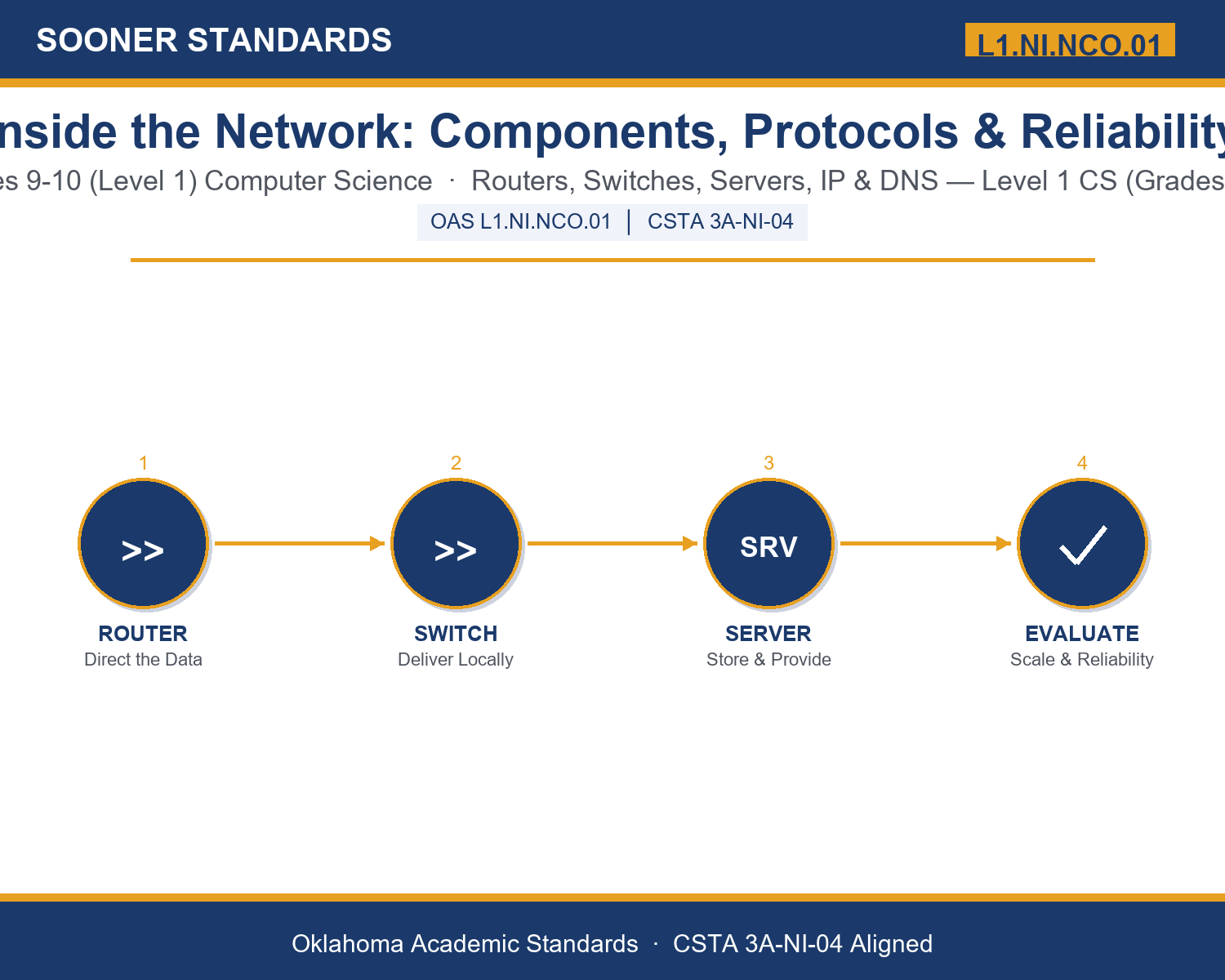
Evaluate the scalability and reliability of networks by identifying and illustrating the basic components of computer networks (e.g., routers, switches, servers, etc.) and network protocols (e.g., IP, DNS). — Oklahoma Academic Standards for Computer Science (February 2023)
In plain language: This standard asks Level 1 students (grades 9-10) to identify and illustrate the basic parts of a computer network (routers, switches, servers) and the rules, called protocols, that let devices communicate (IP and DNS), and then to judge whether a network could grow to handle more use (scalability) and keep working if something failed (reliability).
In student-friendly terms, the learning target is: "I can identify and illustrate the basic components and protocols of a computer network, and evaluate that network's scalability and reliability."
What Students Should Be Able to Do
- I can identify routers, switches, and servers in a network diagram and explain what each one does.
- I can explain what the IP and DNS protocols do and why networks need shared protocols at all.
- I can evaluate whether a network's design could scale to handle significant growth.
- I can evaluate whether a network's design would remain reliable if a component failed.
Along the way, students pick up the working vocabulary of the topic: network, router, switch, server, protocol, packet, scalability, reliability, topology, latency, bandwidth, redundancy, domain.
Computer Network Components Protocols: Misconceptions to Watch For
These are the wrong turns students reliably take with this standard — knowing them ahead of time is half the lesson plan. Each correction strategy below comes straight from the unit's teacher guide (the paragraph and activity references point into the unit itself).
1. "A router and a switch are the same device with two different names."
Return to paragraphs 2-3. A router moves data between different networks, while a switch moves data between devices inside one local network — they perform related but distinct jobs.
2. "A network is reliable only if it never experiences any component failure."
Point back to paragraph 8. A reliable network is designed so a single failure does not bring the whole network down; redundancy, not the total absence of failure, is what makes a network reliable.
3. "As long as the physical hardware is working, the network will always be reachable."
Revisit the DNS discussion in paragraph 6. A network can appear offline from the outside if a supporting protocol like DNS fails, even when every router, switch, and server is functioning correctly.
4. "Evaluating scalability just means checking how many devices are connected right now."
Emphasize paragraph 7's framing: scalability evaluation is about whether a network could handle significant future growth, not just its current load.
Discussion Starters You Can Use Tomorrow
- Think about a network you use daily (school wifi, a home network, a streaming service). Which components (routers, switches, servers) do you think are involved behind the scenes?
- Why might a company choose to spend extra money building redundancy into a network instead of just building the cheapest network that works today?
- Describe a real-world network you can think of where a reliability failure (like an outage) would cause serious problems for the people who depend on it.
Bringing It Home
This topic is a natural one for families. One ten-minute activity to try: Together, take a look at your home's wifi setup (the router, and any other devices connected to it). Ask your student to point out what they think is the router, guess how many devices are connected, and explain what would happen to your household's internet if that router stopped working. There are no wrong answers — the goal is hearing their reasoning.
Where This Leads
Students who can identify and illustrate the basic components and protocols of a computer network, and evaluate that network's scalability and reliability are building skills used every day in network administration, cloud infrastructure, IT support, and systems architecture.
See the Unit in Action
Get the Complete L1.NI.NCO.01 Unit
I built a complete, no-prep unit for this standard — Inside the Network: Components, Protocols, Scalability, and Reliability — covering 3-4 days of instruction across 41 pages:
- Teacher guide — day-by-day pacing, misconceptions to watch for, discussion questions, differentiation for support / ELL / extension, and a 4-point rubric
- Student learning target page — a kid-friendly "I can" statement with success criteria
- Full content lesson with 3 embedded "Check Your Understanding" checkpoints
- 12-question assessment (6 multiple choice, 4 true/false, 2 short answer) with a complete answer key, explanations, and exemplar responses
- Group activity — "Design a Scalable, Reliable School Network" (25-30 minutes)
- Individual activity — "My Network Evaluation Log" (20 minutes)
- Crossword and word search built from all 13 vocabulary terms (with answer keys)
- Family connection letter — a plain-language page for parents, with dinner-table questions and a 10-minute home activity
- Certificate of achievement — ready to sign and send home
- Network Scenario Card Set: Design a Scalable, Reliable Network (separate printable, 2 pages)
- Reference Sheet: Network Components and Protocols (separate printable, 1 page)
- My Network Evaluation Log (separate printable, 2 pages)
Get Inside the Network: Components, Protocols & Reliability on Teachers Pay Teachers →
Also aligned to CSTA 3A-NI-04: Compare transmission control methods used by computing networks to send data, and how they contribute to sending and receiving data reliably.
Every Sooner Standards resource is built directly from the official Oklahoma Academic Standards for Computer Science (February 2023) — standard text verified, never paraphrased from memory.