Teaching AI Algorithms in Software & Physical Systems in Grades 11-12 (Level 2): Oklahoma Standard L2.AP.A.01
Teaching AI Algorithms in Software & Physical Systems in Grades 11-12 (Level 2): Oklahoma Standard L2.AP.A.01
Teaching ai algorithms terminology in grades 11-12 (level 2) does not have to be complicated. Picture a machine learning engineer selecting the correct AI algorithm category before designing a new product feature. That kind of thinking is exactly what Oklahoma's grades 11-12 (level 2) computer science standard L2.AP.A.01 asks students to practice — and it is very teachable with the right materials. This post walks through what the standard means, the misconceptions students bring to it, and discussion starters you can use tomorrow, whether you teach in a classroom or at your kitchen table.
What Does Standard L2.AP.A.01 Actually Ask?
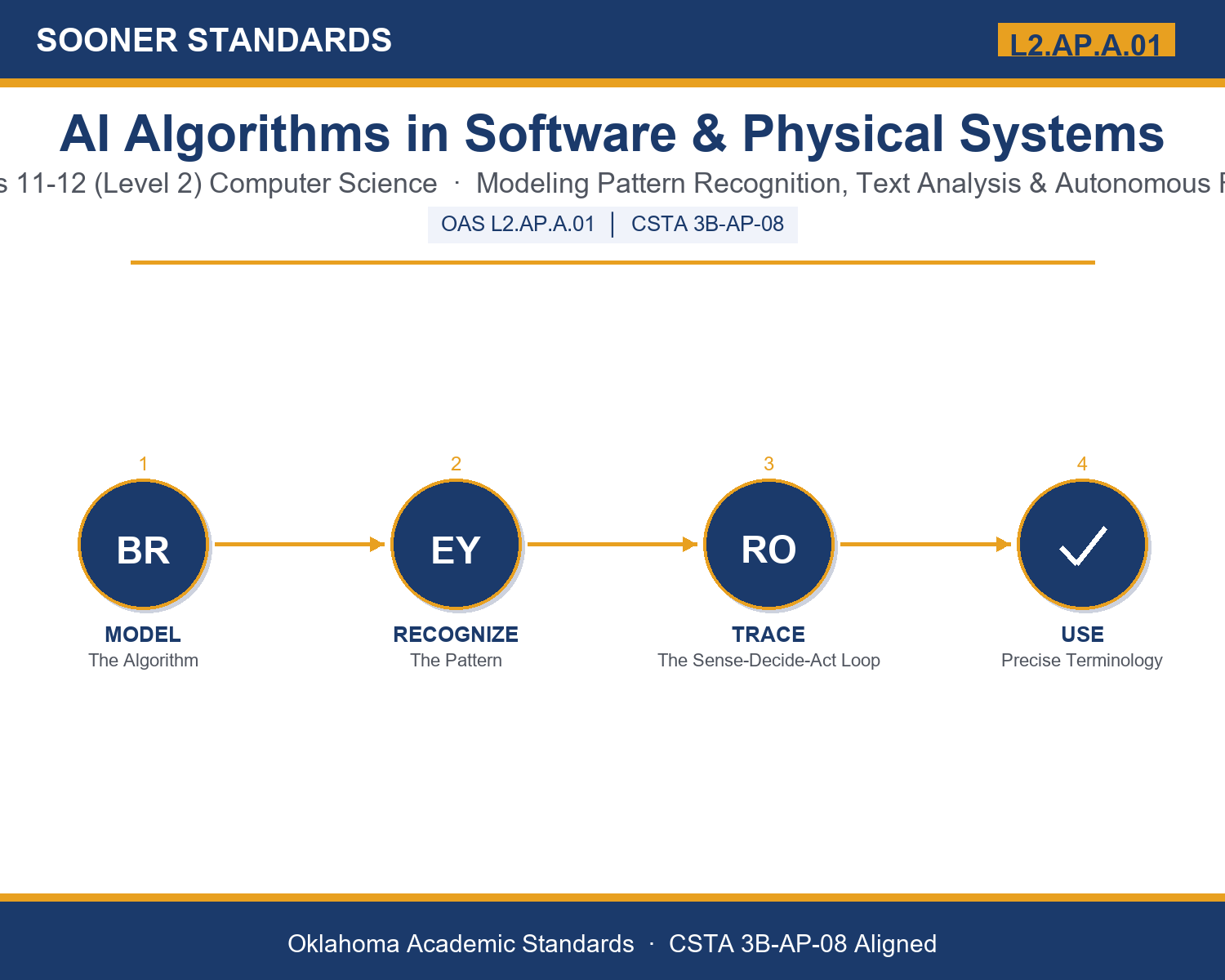
Model and use appropriate terminology to describe how artificial intelligence algorithms drive many software and physical systems (e.g., autonomous robots, pattern recognition, text analysis). — Oklahoma Academic Standards for Computer Science (February 2023)
In plain language: This standard asks students to describe, using accurate vocabulary, how artificial intelligence drives real systems — including robots that sense and move on their own, apps that recognize patterns like faces or objects, and tools that understand written or spoken language.
In student-friendly terms, the learning target is: "I can model and use appropriate terminology to describe how artificial intelligence algorithms drive software and physical systems, including autonomous robots, pattern recognition, and text analysis."
What Students Should Be Able to Do
- I can explain the difference between a traditional hand-coded algorithm and an artificial intelligence algorithm.
- I can name which category of AI algorithm — pattern recognition, text analysis, or autonomous control — best explains a given system's behavior.
- I can distinguish a software-only AI system from a physical AI system and explain what it senses and acts on if it is physical.
- I can evaluate whether a product's 'AI-powered' claim is technically accurate or likely marketing language.
Along the way, students pick up the working vocabulary of the topic: algorithm, model, training, pattern, autonomous, robotics, recognition, classify, sensor, language, sentiment, terminology, physical, prediction.
Ai Algorithms Terminology: Misconceptions to Watch For
These are the wrong turns students reliably take with this standard — knowing them ahead of time is half the lesson plan. Each correction strategy below comes straight from the unit's teacher guide (the paragraph and activity references point into the unit itself).
1. "Any product marketed as 'AI-powered' genuinely uses a trained AI algorithm."
Return to paragraph 7's microwave and thermostat comparison. Have students apply the rules-vs-learned-patterns test to a claimed 'AI' product and identify what specific evidence would confirm or contradict the claim.
2. "AI algorithms and traditional algorithms are completely unrelated ideas."
Return to paragraph 1. Both are algorithms — step-by-step procedures — but an AI algorithm's steps are learned from data rather than written by a person. Have students trace both a hand-written rule and a trained-model example side by side.
3. "A system must be a physical robot to count as artificial intelligence."
Use the spam filter and chatbot examples from paragraph 6. Show that software-only systems are fully legitimate AI systems; the software-versus-physical distinction is about whether the system senses and acts on the physical world, not about whether it 'counts' as AI.
4. "Pattern recognition, text analysis, and autonomous control are three separate systems that never appear together."
Return to paragraph 9's self-driving car example, which combines all three categories. Have students identify all the AI algorithm categories at work in one complex real system.
Discussion Starters You Can Use Tomorrow
- Why might a company describe an ordinary automated feature as 'AI-powered' even when no model was ever trained on data?
- What real-world consequences could result from a policymaker, journalist, or consumer being unable to distinguish genuine AI from marketing language?
- Describe a system from your own life that combines more than one AI algorithm category, the way the self-driving car example does.
Bringing It Home
This topic is a natural one for families. One ten-minute activity to try: Together, pick three devices or apps in your home and have your student decide, out loud, whether each one is likely running a genuine AI algorithm or simple automation, and why. There are no wrong answers — the goal is hearing their reasoning process, not reaching a 'correct' verdict on any specific product.
Where This Leads
Students who can model and use appropriate terminology to describe how artificial intelligence algorithms drive software and physical systems, including autonomous robots, pattern recognition, and text analysis are building skills used every day in machine learning engineering, robotics engineering, product management, AI ethics / policy analysis, and computer science education.
See the Unit in Action
Get the Complete L2.AP.A.01 Unit
I built a complete, no-prep unit for this standard — Artificial Intelligence Algorithms in Software and Physical Systems — covering 3-4 days of instruction across 44 pages:
- Teacher guide — day-by-day pacing, misconceptions to watch for, discussion questions, differentiation for support / ELL / extension, and a 4-point rubric
- Student learning target page — a kid-friendly "I can" statement with success criteria
- Full content lesson with 3 embedded "Check Your Understanding" checkpoints
- 12-question assessment (6 multiple choice, 4 true/false, 2 short answer) with a complete answer key, explanations, and exemplar responses
- Group activity — "AI or Automation? Naming the Algorithm" (25-30 minutes)
- Individual activity — "My AI Systems Field Notebook" (20-25 minutes)
- Crossword and word search built from all 14 vocabulary terms (with answer keys)
- Family connection letter — a plain-language page for parents, with dinner-table questions and a 10-minute home activity
- Certificate of achievement — ready to sign and send home
- Product Analysis Card Set: AI or Automation? (separate printable, 2 pages)
- Reference Notes: AI Algorithms in Software and Physical Systems (separate printable, 2 pages)
- My AI Systems Field Notebook (separate printable, 2 pages)
Get AI Algorithms in Software & Physical Systems on Teachers Pay Teachers →
Also aligned to CSTA 3B-AP-08: Use computing tools and techniques for creative expression, to create new knowledge, or to solve problems, e.g. 3D printing, robotics, physical computing.
Every Sooner Standards resource is built directly from the official Oklahoma Academic Standards for Computer Science (February 2023) — standard text verified, never paraphrased from memory.