Teaching Better Together in Grade 5: Oklahoma Standard 5.IC.SI.02
Teaching Better Together in Grade 5: Oklahoma Standard 5.IC.SI.02
Teaching student collaboration in grade 5 does not have to be complicated. Picture companies running user testing with thousands of outside people before launch. That kind of thinking is exactly what Oklahoma's grade 5 computer science standard 5.IC.SI.02 asks students to practice — and it is very teachable with the right materials. This post walks through what the standard means, the misconceptions students bring to it, and discussion starters you can use tomorrow, whether you teach in a classroom or at your kitchen table.
What Does Standard 5.IC.SI.02 Actually Ask?
As a team, collaborate with outside resources (other grade levels, online spaces) to include different perspectives to improve computational artifacts. — Oklahoma Academic Standards for Computer Science (February 2023)
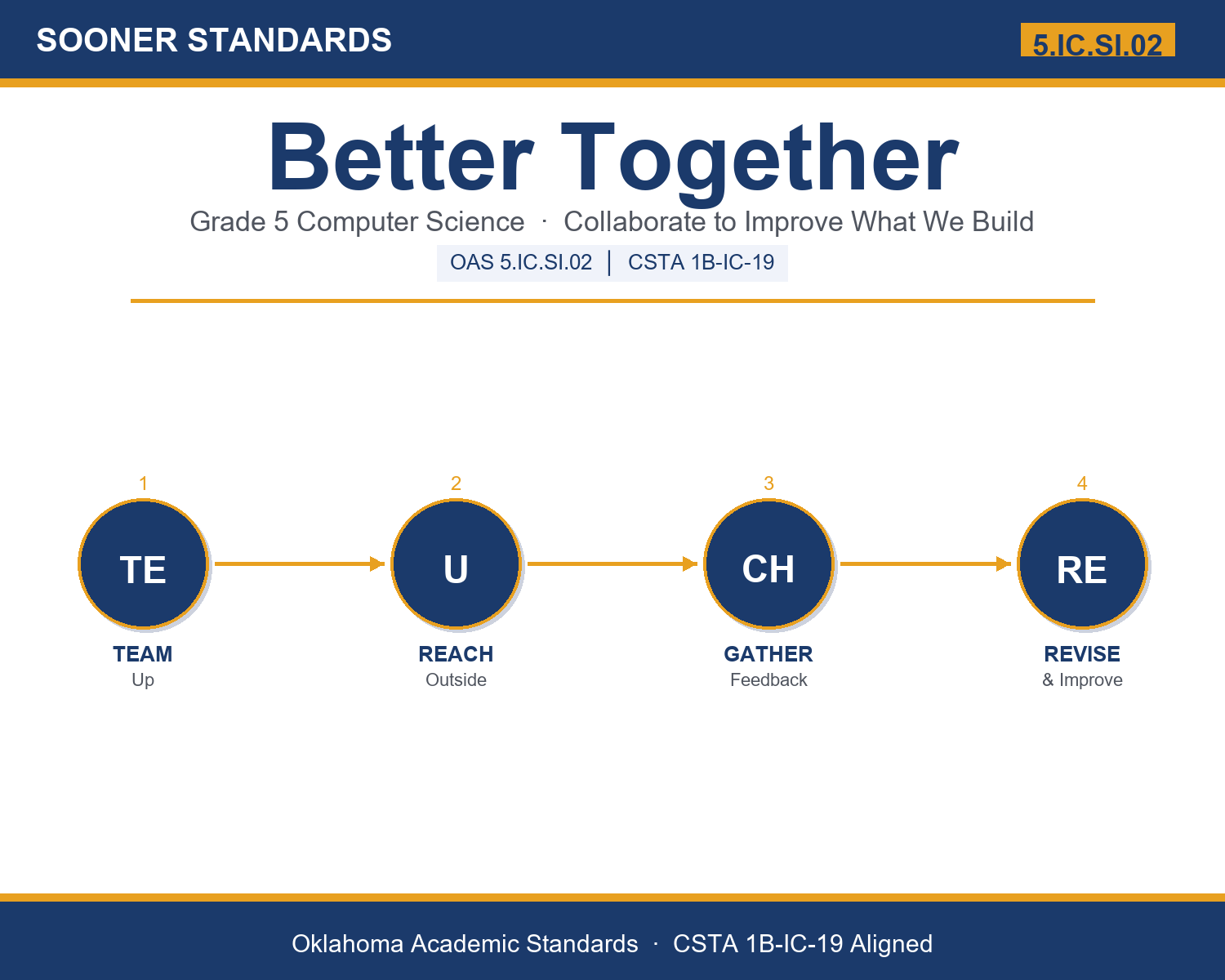
In plain language: Oklahoma's standard asks fifth graders to work as a team and collaborate with outside resources, like younger or older students and supervised online spaces, to gather different perspectives that improve the things they build with computers.
In student-friendly terms, the learning target is: "I can collaborate as a team and reach out to outside resources to include different perspectives that improve our computational artifacts."
What Students Should Be Able to Do
- I can explain why different perspectives make a computational artifact better.
- I can name outside resources (other grade levels, online spaces) and the perspective each brings.
- I can share my work, gather feedback, and use it to revise and improve.
- I can collaborate safely and respectfully, including in online spaces.
Along the way, students pick up the working vocabulary of the topic: expert, resource, team, perspective, collaborate, combine, revise, share, partner, artifact, feedback, improve.
Student Collaboration: Misconceptions to Watch For
These are the wrong turns students reliably take with this standard — knowing them ahead of time is half the lesson plan. Each correction strategy below comes straight from the unit's teacher guide (the paragraph and activity references point into the unit itself).
1. "The best work is done by one talented person alone."
Paragraphs 1 and 8: important technology is built by teams. Different perspectives find problems and add ideas no single person can. Collaboration is a strength, not a weakness.
2. "Feedback that points out a problem means your project failed."
Paragraph 5: every problem found is a gift that lets you fix it early. Reframe honest feedback as the most useful help a creator can get.
3. "Younger students are not useful for testing because they know less."
Paragraph 3: younger testers are perfect for usability, finding confusing parts and small buttons. If a younger student can use it, almost anyone can.
4. "Online collaboration has no rules and is the same as in person."
Paragraph 6: online collaboration requires supervision, privacy protection, respect, giving credit, and reporting problems. Reinforce good digital citizenship.
Discussion Starters You Can Use Tomorrow
- Think of something you built or did better because someone else helped. What did their perspective add?
- Why might a kindergartner notice a problem in your app that you would never see?
- How can a team disagree about an idea without anyone's feelings getting hurt?
Bringing It Home
This topic is a natural one for families. One ten-minute activity to try: Pick something your child made (a drawing, a story, a project) and act as their 'outside tester.' Share it, then give honest, kind feedback from your perspective, and watch them revise it. Talk about how your different perspective helped, and how real technology teams test their work with people outside the team before sharing it with the world.
Where This Leads
Students who can collaborate as a team and reach out to outside resources to include different perspectives that improve our computational artifacts are building skills used every day in software development, user experience design, project management, open-source communities, and education.
Part of the Complete Grade 5 Computer Science Curriculum
This lesson covers just one standard. It is part of a complete grade 5 computer science curriculum aligned to every Oklahoma OAS CS standard. See the full listing — every standard, organized by strand — here: Grade 5 Computer Science Curriculum: Every Oklahoma OAS CS Standard.
See the Unit in Action
Get the Complete 5.IC.SI.02 Unit
I built a complete, no-prep unit for this standard — Better Together: Collaborating to Improve What We Build — covering 3-4 days of instruction across 42 pages:
- Teacher guide — day-by-day pacing, misconceptions to watch for, discussion questions, differentiation for support / ELL / extension, and a 4-point rubric
- Student learning target page — a kid-friendly "I can" statement with success criteria
- Full content lesson with 3 embedded "Check Your Understanding" checkpoints
- 12-question assessment (6 multiple choice, 4 true/false, 2 short answer) with a complete answer key, explanations, and exemplar responses
- Group activity — "Perspective Partners: Improve It Together" (25-30 minutes)
- Individual activity — "My Collaboration Plan" (15-20 minutes)
- Crossword and word search built from all 12 vocabulary terms (with answer keys)
- Family connection letter — a plain-language page for parents, with dinner-table questions and a 10-minute home activity
- Certificate of achievement — ready to sign and send home
- Artifact Challenge Cards (separate printable, 2 pages)
- Collaboration Reference Sheet (separate printable, 2 pages)
- My Collaboration Plan (separate printable, 1 page)
Get Better Together on Teachers Pay Teachers →
Also aligned to CSTA 1B-IC-19: Collaborate with others, including outside resources, to include diverse perspectives and improve a computational artifact.
Every Sooner Standards resource is built directly from the official Oklahoma Academic Standards for Computer Science (February 2023) — standard text verified, never paraphrased from memory.