
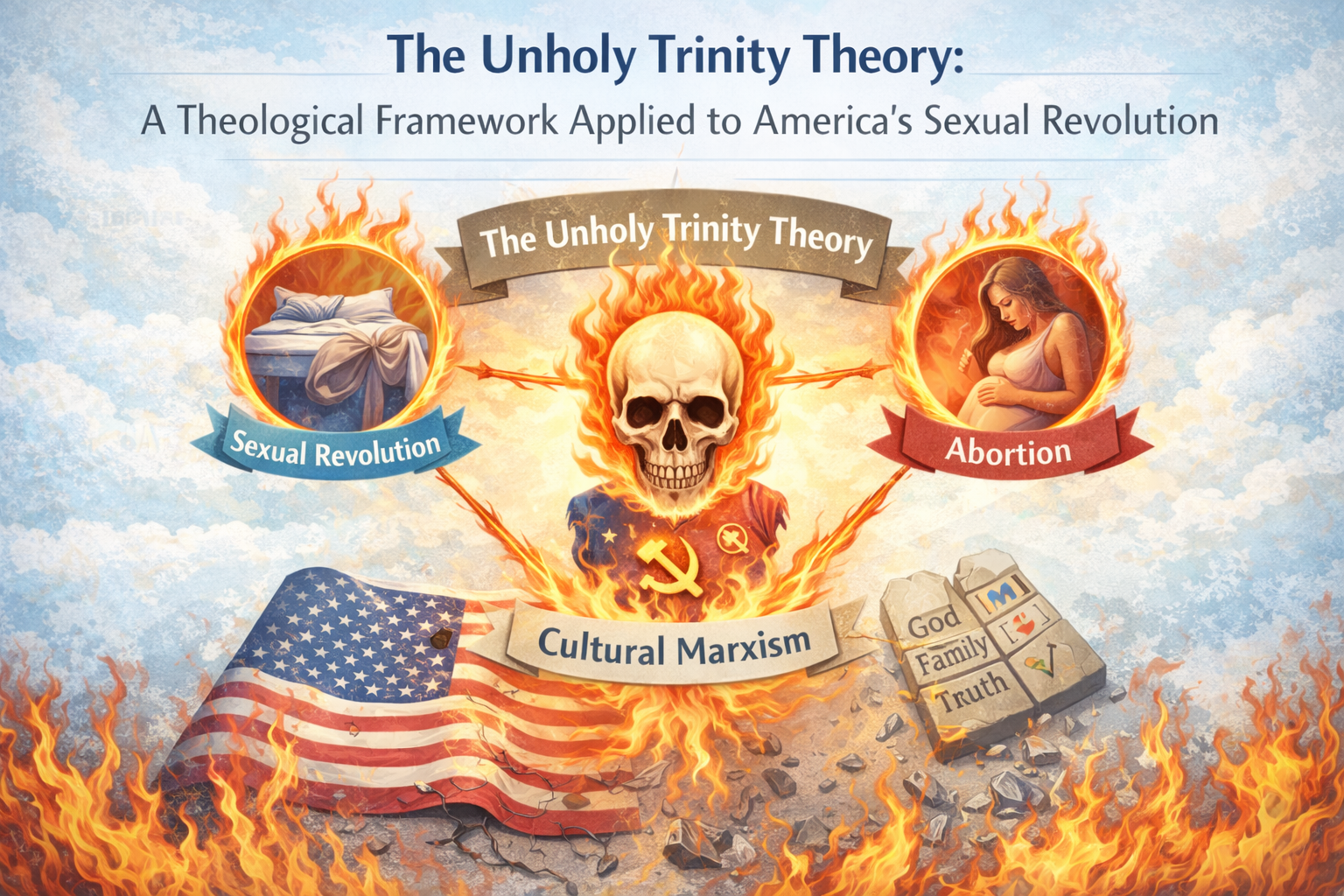
The Unholy Trinity Theory: A Theological Framework Applied to America’s Sexual Revolution
During a recent appearance on the Shawn Ryan Show, Dr. Dan Schneider, drawing from his experience as an exorcist, discussed a specific theological pattern involving three demonic entities and their sequential influence on human sexuality. This framework, sometimes referred to as the “Unholy Trinity” in demonological literature, proposes a deliberate progression through which sexuality becomes divorced from its traditional purposes. While such interpretations represent a particular religious worldview, the framework offers a lens through which to examine documented cultural transformations in American sexual history. This article first establishes the theological framework itself before analyzing how observable patterns in twentieth-century American culture align with its predictions, providing insight into one of the most significant social transformations in modern history.
The theological framework identifies three distinct entities working in a specific, sequential order to fundamentally alter human understanding and practice of sexuality. The first entity, Baal, identified in demonological tradition as the demon of impurity and described as “Lord” or “Husband,” functions to separate procreation from sexual activity. According to this framework, Baal specifically targets spousal and marital fidelity by corrupting the understanding that sexual union inherently connects pleasure with the potential for new life. This separation represents the foundational corruption—reframing sexual intercourse from an act with dual purposes (unitive and procreative) to one “ordered only toward pleasure.” The success of this first phase creates the necessary precondition for what follows. Once sex is culturally redefined as primarily about personal gratification rather than procreation, the conceptual foundation exists for sexuality to be organized around individual erotic desire rather than procreative potential.
The second and third entities can only exert significant cultural influence once Baal’s work is substantially complete. Asmodeus, identified as the principal demon of male homosexuality in traditional demonology, emerges following the successful separation of sex from childbearing. According to the framework, Asmodeus capitalizes on the newly established pleasure principle to normalize male same-sex activity, which is inherently non-procreative. Leviathan, described as the principal demon of “masculine” female homosexuality characterized by aggressive and dominant expressions, represents the parallel influence within female same-sex relationships. The framework presents these three entities not as acting independently but as components of a coordinated pattern—the “Unholy Trinity.” The logic is sequential and dependent: widespread cultural acceptance that sex need not result in children must precede the normalization of sexual relationships that cannot result in children. This theological model therefore predicts a specific historical pattern in any culture it influences: the mainstreaming of contraception and non-procreative heterosexual activity would necessarily and temporally precede the public emergence and acceptance of homosexuality.
This framework suggests why contemporary LGBTQ+ identity is understood primarily through the lens of sexual attraction and orientation. If sexuality’s organizing principle shifts from procreative potential to personal erotic desire, then sexual attraction itself becomes the foundational element of identity rather than one aspect of a larger procreative and familial vocation. The framework interprets the modern emphasis on sexual orientation as a core component of personal identity as a direct consequence of the pleasure principle established by Baal’s initial work. From this theological perspective, the progression from contraceptive acceptance to homosexual normalization is not coincidental but represents the logical unfolding of a spiritual pattern working through human culture, law, and technology. The question becomes whether American history demonstrates this predicted sequence or whether the correlation is superficial or coincidental.
Examining twentieth-century American sexual history reveals a pattern that, regardless of one’s acceptance of supernatural causation, remarkably corresponds to the sequence predicted by the Unholy Trinity framework. The separation of sexual activity from procreation in American culture was not a single event but an extended, contested process unfolding primarily across the twentieth century with roots in the late nineteenth century. The most dramatic and definitive shift occurred during the Sexual Revolution of the mid-to-late 1960s and 1970s. However, this revolution represented the culmination of nearly a century of incremental legal, technological, and ideological developments. Understanding whether the theological framework accurately predicts cultural development requires examining American sexual history in distinct phases, each assessed for alignment with the three-stage pattern of Baal, followed by Asmodeus and Leviathan.
The foundational shifts attributed to Baal’s influence began in the late nineteenth and early twentieth centuries. The “Voluntary Motherhood” movement of the 1870s through 1910s, led primarily by feminist reformers including Margaret Sanger in its later stages, advocated for women’s right to refuse sexual relations within marriage to avoid continuous pregnancy. While this movement did not explicitly promote sex for pleasure, it fundamentally reframed procreation as a choice rather than an inevitable consequence of marital sexuality, beginning the conceptual separation between sexual activity and childbearing. This ideological shift was accompanied by technological developments—the increasing availability of rudimentary contraceptive devices such as diaphragms and cervical caps—though such devices and information about them remained largely illegal under the Comstock Laws of 1873. Nevertheless, court cases throughout this period gradually eroded these restrictions. This era established the intellectual and practical groundwork for the explicit separation that would follow, representing the earliest American manifestation of what the framework identifies as Baal’s foundational work.
The post-World War II era from 1945 to 1960 served as a crucial transition period during which the separation of sex from procreation gained momentum while remaining culturally controversial. Alfred Kinsey’s landmark scientific studies, Sexual Behavior in the Human Male (1948) and Sexual Behavior in the Human Female (1953), revealed a dramatic gap between publicly professed sexual morality and actual private behavior among Americans. These reports documented that non-procreative sexual activities—including premarital sex, extramarital affairs, and significantly, homosexual experiences—were far more prevalent than American society publicly acknowledged. From the framework’s perspective, this revelation is significant: homosexual behavior existed but remained largely hidden and culturally unacceptable during the period when procreative sexuality still dominated cultural norms. Paradoxically, the Baby Boom era simultaneously celebrated prolific procreation while fostering a culture in which sexual satisfaction within marriage became increasingly emphasized through popular marriage manuals and advice columns. The suburban bedrooms of 1950s America, often mythologized as bastions of traditional values, were incubating ideas about sexual fulfillment that would fuel the coming transformation.
The Sexual Revolution of the mid-1960s through the 1970s represented the decisive historical break in which Baal’s work, according to the framework, reached completion. Multiple converging forces mainstreamed the principle of sex for pleasure and intimacy as conceptually distinct from reproduction. The FDA approval of oral contraceptives in 1960 functioned as the single most transformative technology. Unlike barrier methods that required intervention during sexual activity, the Pill was highly effective, female-controlled, and completely divorced from the sexual act itself. This physical separation of contraceptive action from sexual intercourse was psychologically revolutionary, enabling sexual spontaneity without procreative risk. Second-wave feminism simultaneously framed sexual freedom and reproductive control as essential to women’s liberation, captured in slogans like “Our Bodies, Ourselves.” Popular culture reflected these changes through increasingly explicit media discussion of sex, normalization of premarital relationships, and popularization of sexological research emphasizing sexual fulfillment as integral to personal identity and healthy relationships.
The legal institutionalization of this separation cemented its cultural triumph. The Supreme Court’s Griswold v. Connecticut (1965) decision struck down prohibitions on contraceptive use by married couples, establishing a constitutional “right to privacy” in marital sexual relations. Eisenstadt v. Baird (1972) extended this right to unmarried individuals, legally enshrining that sexual activity need not be linked to either marriage or procreation. Roe v. Wade (1973) legalized abortion nationwide, providing what the framework would interpret as the final mechanism ensuring that sex could be completely separated from compulsory pregnancy. These legal decisions, combined with technological and cultural changes, represented the complete triumph of the first phase. From the theological perspective, Baal’s foundational work was accomplished by the mid-1970s—American culture had fundamentally accepted that sexual activity was primarily about pleasure, intimacy, and personal fulfillment rather than procreation. The necessary precondition for the next phases had been established.
According to the Unholy Trinity framework, the normalization of homosexuality represents the second and third phases—the work of Asmodeus and Leviathan—which could only manifest after Baal’s success. The timing in American history appears to support this sequence. While homosexual behavior existed throughout American history, as the Kinsey Reports documented, the public emergence of homosexuality as a legitimate identity and the organized demand for legal recognition began in earnest only after the Sexual Revolution had substantially separated sex from procreation. The Stonewall riots of 1969 are often cited as the beginning of the modern LGBTQ+ rights movement, occurring precisely during the period when contraceptive use was becoming legally protected and culturally normalized. The movement gained significant momentum throughout the 1970s and subsequent decades, transforming from demands for tolerance of private behavior to assertions that sexual orientation constitutes a core component of personal identity deserving legal recognition and cultural celebration.
The progression from hidden behavior to public identity to legal rights follows the framework’s predicted pattern. The LGBTQ+ movement achieved major legal victories including Lawrence v. Texas (2003), which struck down remaining sodomy laws, and Obergefell v. Hodges (2015), which legalized same-sex marriage nationwide. The movement’s emphasis on sexual orientation and gender identity as fundamental aspects of personhood, rather than merely behaviors or preferences, aligns precisely with what the framework predicts once procreative potential is removed as sexuality’s organizing principle. If sex is primarily about personal erotic desire and fulfillment—the cultural understanding established by Baal’s phase—then relationships organized around same-sex attraction become logically equivalent to heterosexual relationships, differing only in the gender configuration rather than fundamental purpose. The framework interprets this logical progression as the spiritual influence of Asmodeus and Leviathan working through the cultural and legal structures established during the Sexual Revolution.
The contemporary American landscape reflects the complete integration of this three-phase pattern and ongoing resistance to it. The principles identified in the Unholy Trinity framework have achieved cultural dominance in mainstream media representation, corporate diversity initiatives, and educational curricula in many jurisdictions. Simultaneously, religious conservatives and traditional values advocates view these developments as fundamentally contrary to natural law and divine design, representing a spiritual battle over the essential meaning of human sexuality. This theological interpretation explains the intensity of contemporary culture wars over transgender rights, sex education, religious liberty, and family structure—these are not merely political disagreements but, from this perspective, surface manifestations of deeper spiritual conflict. The culture war shows no signs of resolution because the underlying question remains fundamentally contested: Is sexuality’s primary purpose procreative and unitive within marriage, or is it primarily self-expressive and oriented toward personal fulfillment?
Whether one accepts the theological framework of demonic influence or prefers purely sociological explanations involving technological innovation, economic development, and evolving cultural values, the historical sequence itself remains remarkably consistent with the pattern predicted by the Unholy Trinity model. The widespread separation of sex from procreation through contraceptive technology and legal changes did indeed temporally precede the mainstreaming of non-procreative sexual identities and relationships in American culture. For those who hold this theological worldview, twentieth-century American sexual history provides compelling evidence of a spiritual pattern unfolding through human institutions, technologies, and legal structures. The framework successfully predicted that cultures accepting contraception would subsequently normalize homosexuality, and American history appears to validate this prediction. For skeptics, the same history illustrates how technological innovation, particularly reproductive technology, combined with changing economic roles for women and evolving understandings of human rights and psychology, produced profound social transformation through purely naturalistic mechanisms. The correlation between the theological framework and historical events does not prove supernatural causation but does raise questions about whether cultural patterns follow predictable sequences regardless of their ultimate origin.
Understanding this theological framework and its application to American history illuminates why debates over sexuality remain so central to contemporary American cultural and political identity. If the framework is accurate, the culture war represents an ongoing spiritual conflict made manifest through legal battles, educational disputes, and media representation. If the framework is merely an interesting interpretive lens, it nevertheless provides insight into how religious traditionalists understand the dramatic sexual transformation of the past century and why they perceive recent decades as representing coordinated attack on fundamental human institutions rather than progressive evolution toward greater freedom and equality. Regardless of one’s interpretive framework, the historical progression from contraceptive normalization to homosexual mainstreaming remains an undeniable feature of twentieth-century American culture, and the Unholy Trinity model offers one coherent explanation for why this sequence unfolded in precisely the order it did.




One Comment
Comments are closed.