

Latimer County Undersheriff Remains in Office Despite Probation for Assault on Teenage Son
The case of Latimer County Undersheriff Markus Edwin Ward II has become a stark illustration of alleged preferential treatment within Oklahoma’s criminal justice system and the broader challenges of holding law enforcement officers accountable for violent crimes committed against their own children. On September 23, 2025, in a Stigler, Oklahoma courtroom, Ward entered a no contest plea to a single count of assault and battery for the violent assault of his teenage son. Despite a detailed probable cause affidavit documenting a pattern of severe physical abuse including choking, punching, beating with a belt, and threatening to kill the child, Ward received only six months of deferred probation and a one-hundred-dollar fine. The sentence makes Ward eligible to have the matter dismissed and his record expunged after six months if he complies with probation conditions. Most controversially, Ward has returned to active duty as undersheriff and continues serving on the Wilburton School Board, raising profound questions about accountability standards for law enforcement personnel who commit violent crimes against minors.
Attorney Brecken Wagner, who represented Ward’s teenage son under Marsy’s Law, appeared in court to object to both the state’s sentencing recommendation and the prosecution overall. Wagner was retained by the victim’s maternal family in October 2024 specifically because they feared Ward would receive special treatment due to his law enforcement position. Wagner has publicly stated that those fears were validated, describing the outcome as “an egregious act of injustice” and noting that “the circumstances described in that probable cause affidavit would be a felony in any case I have ever worked on, except this one.” The probable cause affidavit, prepared by Agent Morris “Sonny” Stewart of the Oklahoma State Bureau of Investigation after a thorough investigation, documents a disturbing pattern of escalating violence that Ward inflicted upon his son over an extended period. By entering his no contest plea based on the allegations in the affidavit, Ward effectively acknowledged that the facts described therein are undisputed, making the document a matter of public record that provides a detailed account of the abuse.
The probable cause affidavit reveals that the violence Ward inflicted on his son was neither isolated nor minor, but rather constituted a systematic pattern of increasingly severe physical abuse. According to the affidavit, in fall 2023, Ward backhanded his son across the face with an open hand in front of the boy’s mother, Jessica Littlejohn, causing his mouth to bleed. During the teenager’s spring break in 2024, Ward punched his son in the face with a closed fist after discovering a vape in the boy’s pocket, resulting in a busted lip and bleeding from cuts inside his mouth caused by his braces. Over Labor Day weekend 2024, Ward not only backhanded his son across the face but forced a vape into the teenager’s mouth, making him breathe through the device for approximately one minute, then grabbed him by the neck, pushed him against the exterior of a vehicle, and squeezed his neck to the point where the boy could not breathe. These incidents, witnessed by family members and documented by OSBI investigators, establish a clear pattern of escalating violence that culminated in the October 5, 2024 assault that finally led to criminal charges.
The assault on October 5, 2024, which ultimately resulted in Ward’s arrest, represents one of the most violent episodes documented in the investigation and demonstrates the life-threatening nature of Ward’s abuse. According to the probable cause affidavit, the incident began that morning when Ward threw a cellphone at his son’s face, then later threw charging blocks and cables at the back of the teenager’s head, causing a laceration that bled. That evening, after discovering his son had used a tablet without permission, Ward threw the teenager to the ground, kicked him, and told him to get out of the house. When the boy attempted to leave, Ward repeatedly threw him down each time he tried to stand up. Once outside, Ward ordered his son onto a trampoline and threatened to “beat his ass” if he got off it. Ward then returned with a belt and struck the teenager ten to fifteen times, bent him over and kneed him in the chest, then kicked him in the genital area. Ward subsequently threw his son to the ground and kneed him in the chest, knocking the air out of him.
The violence continued as Ward forced his son into a vehicle, where he struck the teenager in the face with a closed fist. After making the boy exit the vehicle, Ward grabbed him again, bent him over, and began hitting him repeatedly in the face. The teenager later reported that he feared Ward was going to knock him unconscious because every time he was struck, his eyes would flash white. The assault resulted in busted upper and lower lips that caused the inside of the boy’s mouth to bleed from his braces, swelling around both eyes, a laceration on the back of his head, and a belt mark across his buttocks with a buckle impression on his hip. The violence only ended when Ward drove his son to his mother’s residence, but not before calling her to say, “I am bringing you your son because if I don’t, I am going to kill him by the end of the night.” This explicit threat to kill his own child, made in the context of an ongoing violent assault, underscores the severe danger the teenager faced and raises questions about why felony charges were not pursued.
Multiple witnesses corroborated the teenager’s account and provided additional context about the pattern of abuse Ward inflicted on his son. Jessica Littlejohn, the victim’s mother, witnessed Ward backhand their son at her residence in fall 2023, causing his mouth to bleed. On October 5, 2024, she received Ward’s threatening phone call and witnessed her son arrive at her home with blood all over his face, walking quickly to the kitchen where he spit a large amount of blood into the sink. She observed that the inside of his mouth was cut all the way around the inside of his lips from being hit while wearing braces, both eyes were swelling, and she later felt a knot on the back of his head with a small laceration and discovered the belt mark across his buttocks. Kyle Littlejohn, the victim’s stepfather, witnessed Ward strike the teenager in the face in fall 2023 and observed him enter the residence covered in blood on October 5, 2024, spitting blood into the sink. Littlejohn spoke with Ward outside the residence, and Ward admitted to him that he had lost his temper during the assault.
Perhaps most damning, Ward’s own stepchild provided testimony during a forensic interview that corroborated and expanded upon the victim’s account of ongoing abuse. According to the probable cause affidavit, this witness disclosed witnessing Ward hit and punch the teenager more than ten times at Ward’s residence. On October 5, 2024, the witness observed Ward throw a large block charging port at the back of the victim’s head, causing it to bleed, and saw Ward grab the teenager by the throat and slam him against a door while “choking him out” and yelling “why do you do this!” The witness observed Ward take the victim outside and knee him in the stomach, though could not see what occurred after they went behind a trampoline. The witness provided several additional examples of Ward assaulting the teenager during the forensic interview. This testimony from a member of Ward’s own household, with no apparent motive to fabricate allegations, provides powerful corroboration of the systematic abuse and demonstrates that Ward’s violence was witnessed by multiple people over an extended period.
Ward’s own response to the investigation reveals an unwillingness to take responsibility for his violent conduct and an attempt to minimize the severity of his actions. Ward declined to be interviewed during the course of the OSBI investigation, but provided a written statement to an OSBI agent. In that statement, Ward confirmed that he disciplined his son with a belt but claimed he only “accidentally” hit the boy in the face with an open hand while attempting to block the teenager from swinging at him. Ward also claimed in his statement that his son’s bruising to his eyes was caused by “horseplay at school” rather than from Ward’s assault. These explanations stand in stark contrast to the detailed, corroborated accounts provided by the victim, his mother, his stepfather, and the witness from Ward’s own household, all of whom described deliberate, repeated acts of violence rather than accidental contact or schoolyard roughhousing. Ward’s refusal to participate in a full interview and his contradictory written statement suggest an awareness that a full account of his conduct would undermine any claim of justifiable discipline or accidental contact.
The charging decisions made by the Latimer County District Attorney’s Office have become a central focus of criticism and allegations of preferential treatment in Ward’s case. Despite the probable cause affidavit documenting conduct that legal experts believe clearly constitutes felony offenses including child abuse by injury, assault and battery with a dangerous weapon, domestic assault and battery by strangulation, and aggravated assault and battery, the district attorney initially charged Ward only with domestic assault and battery, a misdemeanor. Subsequently, earlier in 2025, the same district attorney amended the charge to the even lesser crime of simple assault and battery, reducing it from a domestic violence offense to a standard assault charge. Both the initial charging decision and the subsequent amendment were made over the objection of Wagner and his young client. The decision to charge Ward with only a misdemeanor offense, and then to further reduce that charge, appears to validate the family’s initial concerns about preferential treatment and has led to widespread criticism of the prosecution’s handling of the case.
The sentencing hearing on September 23, 2025, provided the victim with an opportunity to address the court and speak his truth, resulting in what Attorney Wagner described as “one of the most intense moments that I have experienced in a courtroom.” The night before the hearing, the teenage victim emailed Wagner a single typed page containing three paragraphs and one final sentence. The teenager asked Wagner to read his statement to the court because he did not believe he would be able to read it himself. The statement, which Wagner delivered on his client’s behalf while struggling to keep his voice from cracking, contained some of the most powerful victim impact testimony Wagner had ever encountered. The victim’s words provided a window into the profound and lasting harm that Ward’s violence had inflicted, not only physically but emotionally, psychologically, and socially. The teenager’s statement made clear that the consequences of speaking out about abuse had been nearly as devastating as the abuse itself, as he faced rejection from family members, loss of his savings, and ostracism from his community.
The victim’s statement began by confronting Ward directly about the violence he had endured, stating bluntly, “On the 5th day of October of 2024 you broke me.” The teenager recited the degrading names his father had called him, including “fucking piece of shit, fuck head, and dumbass,” and described how Ward told him that he “wasn’t his son.” In haunting detail, the victim described reliving “every single punch, slap, kick, head lock, choke hold, slamming me into doors and on the ground, slamming car doors on me, and shoving vapes down my throat.” Most chillingly, he described seeing “white lights” when he was being choked, a detail that underscores how close Ward’s violence came to causing serious injury or death. These descriptions, delivered in the victim’s own words, provide a visceral understanding of the terror and pain the teenager endured at his father’s hands. The fact that the victim could recount these specific acts of violence in such detail demonstrates that they were not isolated disciplinary incidents but rather traumatic events seared into his memory.
Beyond the physical abuse itself, the victim’s statement addressed the devastating secondary consequences he has suffered as a result of speaking out about the violence. The teenager wrote about losing his relationship with members of his father’s side of the family, whom he loves and misses. He described losing all the money in his savings account that he had worked for, because Ward refused to give it to him after he reported the abuse. Perhaps most painfully, he wrote about being viewed as “the worst kid in town” by people he thought were his friends, and feeling that he doesn’t “belong in my community because of the lies that you spread after that night to protect yourself.” The victim expressed feeling “unwanted and unwelcome in my community” and believing he was “a failure in life,” then emphasized in capital letters: “I AM JUST A KID.” This statement reveals the cruel reality that victims of abuse often face—not only the original violence but also social stigma, isolation, and retaliation when they have the courage to speak out. The fact that a teenage victim felt compelled to defend his own worth and remind the court of his status as a child speaks to the victim-blaming narratives that Ward and his defenders apparently propagated in the community.
Despite the trauma and loss he has endured, the victim’s statement also conveyed resilience, healing, and hope for the future. In the third paragraph, the teenager explained that he has found love and safety in his mother and stepfather’s home. He told Ward that he has found counseling and that as a result he is beginning to heal and starting to understand that the abuse he suffered was not his fault. The victim then listed his accomplishments and evidence of his recovery, stating “I am home by curfew. I have a job. I am doing better in school and made the Principal’s Honor Roll.” These statements serve as a powerful rebuttal to any suggestion that the victim was a troubled or defiant child who somehow deserved or provoked the violence inflicted upon him. Instead, they demonstrate that when removed from an abusive environment and provided with support and counseling, the teenager has thrived academically, maintained employment, and followed household rules. The final sentence of his statement, which Wagner delivered with great emotion, captured both the harm Ward inflicted and the victim’s determination to overcome it: “You might have broken me and knocked me down, but I got up.”
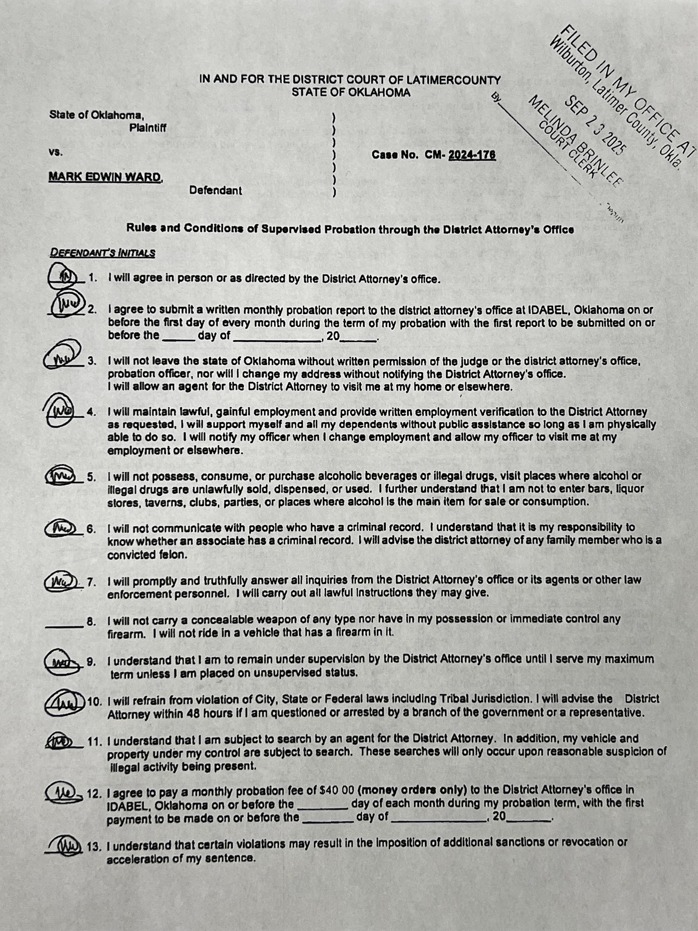
The conditions of Ward’s probation include a significant and highly unusual deviation from standard practice that has raised serious public safety concerns. Ward’s probation includes all standard requirements typically imposed on probationers in Oklahoma, with one critical exception: the prohibition on firearm possession that is routinely included in probation conditions for individuals convicted of violent offenses was specifically omitted from Ward’s probation terms. This omission is particularly significant because Ward’s position as undersheriff requires him to carry a firearm as part of his official duties. The decision to allow a person convicted of violently assaulting a minor child, who has been subject to a protective order sought by that child, to maintain unrestricted access to firearms while on probation represents a substantial deviation from standard criminal justice practice. Legal experts have noted that this exception appears tailored specifically to accommodate Ward’s law enforcement employment rather than being based on any legitimate public safety rationale.
The protective order obtained by Ward’s son against his father remains in effect and creates a troubling contradiction with Ward’s continued law enforcement employment. Despite this court order being in place to shield the teenage victim from further contact with his abusive father, Ward continues to serve in a law enforcement capacity that includes the authority to enforce protective orders against others and respond to domestic violence calls throughout Latimer County. This apparent contradiction has not been lost on critics who point out the fundamental incongruity of a law enforcement official who is himself subject to a protective order due to his own documented violent conduct being entrusted with protecting vulnerable community members from similar violence. The situation raises questions about what happens if Ward encounters a domestic violence call involving conduct similar to what he himself perpetrated, and whether his credibility as a law enforcement officer has been irreparably compromised by his criminal conviction and the protective order against him.
Sheriff Adam Woodruff’s decision to return Ward to active duty as undersheriff, despite the criminal conviction and ongoing probation, has generated significant controversy and criticism. When contacted by media outlets, Sheriff Woodruff confirmed that Undersheriff Ward is back at work and explained that Ward’s return to duty is permissible because “legally he can be.” This explanation, while potentially accurate from a narrow legal standpoint, fails to address the broader ethical considerations and public trust concerns that typically govern law enforcement employment decisions. Law enforcement agencies routinely terminate or refuse to hire individuals with far less serious criminal histories than Ward’s, and many jurisdictions maintain policies that prohibit the employment of officers with convictions for crimes of moral turpitude or domestic violence. The decision to allow Ward to continue serving as the second-highest-ranking law enforcement official in Latimer County while simultaneously serving probation for a violent crime against his own child has been widely criticized as sending a message that law enforcement personnel are held to lower standards of conduct rather than higher ones.
Ward’s continued service on the Wilburton School Board as vice president represents another dimension of the controversy that has particularly troubled parents, educators, and child advocates. The Wilburton School Board has not removed Ward from his position despite his criminal conviction for assaulting a minor and the detailed public record of his violent conduct toward his own teenage son. School board members are entrusted with making decisions that affect the safety, welfare, and education of children throughout the district, and they are expected to model appropriate conduct and prioritize student wellbeing in all their decisions. Ward’s documented pattern of violence against a child, his criminal conviction, and his admission through his no contest plea that the allegations in the probable cause affidavit are undisputed would seem to fundamentally undermine his fitness to serve in such a position. The school board’s apparent unwillingness to remove Ward or require his resignation has led to questions about whether the board is fulfilling its duty to prioritize student safety and whether having a convicted child abuser in a leadership position sends an unacceptable message to students, parents, and the community.
The defense strategy employed by Ward’s attorney, Wesley Cherry, has drawn criticism for attempting to shift partial blame onto the teenage victim while simultaneously citing sealed documents to avoid full accountability. Cherry declined to provide an on-camera interview but told reporters that “it’s their position the teen has some fault in the matter,” while also claiming that sealed documents prevent him from elaborating further. This approach—suggesting that a minor child bears some responsibility for being violently assaulted by his father while invoking confidentiality restrictions to avoid explaining that position—has been characterized by victim advocates as a classic victim-blaming tactic. The legal and moral consensus is clear that adults, particularly parents and law enforcement officers who are trained in appropriate use of force, bear sole responsibility for their own violent conduct toward children. The suggestion that a teenager somehow shares fault for being punched, choked, beaten with a belt, and threatened with death represents an attempt to deflect responsibility that many observers have found offensive and incompatible with child protection principles.
Attorney Brecken Wagner has indicated that the victim’s maternal family is considering filing a civil lawsuit against Ward, which could provide another avenue for accountability and potentially bring additional facts to light. Civil litigation operates under different standards than criminal prosecution, with a lower burden of proof and different evidentiary rules that sometimes allow for more complete discovery and disclosure than criminal proceedings. A civil case could potentially result in financial compensation for the victim’s medical expenses, counseling costs, pain and suffering, and other damages resulting from Ward’s violence. More importantly, civil litigation could serve an accountability function when criminal prosecution has resulted in what the victim and his family perceive as an inadequate outcome. The civil justice system has historically served as an important check on cases where criminal penalties seem disproportionately lenient, particularly in cases involving defendants who occupy positions of power or authority in their communities.
The broader implications of the Ward case extend far beyond one family’s tragedy and speak to fundamental questions about law enforcement accountability, equal justice, and public trust in Oklahoma’s criminal justice system. When law enforcement officers receive apparent preferential treatment in criminal cases—particularly cases involving violence against children—it erodes public confidence in the equal application of justice and reinforces perceptions that those in positions of power operate under different rules than ordinary citizens. The contrast between the severe conduct documented in the probable cause affidavit and the minimal consequences Ward has faced illustrates a troubling double standard. While prosecutors frequently pursue aggressive charges and seek significant prison time for ordinary citizens accused of child abuse, the decision to charge Ward with only a misdemeanor and to accept a plea agreement that includes no jail time and maintains his eligibility for expungement suggests that law enforcement personnel may be shielded from the full consequences of their criminal conduct.
The Ward case exemplifies systemic challenges in holding law enforcement officers accountable when they commit crimes, particularly crimes of domestic violence or child abuse. Research has consistently shown that domestic violence occurs at higher rates within law enforcement families than in the general population, yet prosecution and conviction rates for law enforcement offenders remain low. Multiple factors contribute to this accountability gap, including reluctance by fellow officers to report misconduct, hesitancy by prosecutors to aggressively charge law enforcement defendants, and the tendency of law enforcement defendants to receive more lenient plea agreements and sentences than similarly situated civilian defendants. The Ward case exhibits all of these troubling patterns: the violence occurred over an extended period before criminal charges were filed, the charging decision reflected unusual leniency given the documented conduct, and the plea agreement resulted in minimal consequences that preserved Ward’s ability to continue his law enforcement career and expunge his record after a brief probation period.
The mission of Wagner’s law firm, as he articulated it, is “to give voice to the voiceless and tell their story,” and in this case that mission took the form of ensuring that a teenage abuse victim’s truth was heard in a courtroom where power dynamics were starkly unequal. Wagner has stated that he will be “forever grateful for everything I learned and lived in my representation of him,” and described the honor of speaking the victim’s words while the victim’s voice was the one truly being heard. The fact that a teenage victim needed an attorney to advocate for him under Marsy’s Law—a statute designed to protect crime victims’ rights—in order to have any voice at all in the prosecution of his own father reveals the vulnerable position that abuse victims occupy within the criminal justice system. Without Wagner’s representation and advocacy, it seems likely that the victim would have had even less input into charging decisions and plea negotiations that directly affected his safety and wellbeing. The case underscores the critical importance of victim advocacy and legal representation in ensuring that victims’ interests are considered in criminal proceedings, particularly when the defendant occupies a position of power or authority.