
Public Meetings in Oklahoma and Arkansas: How to Schedule One, Hold One, and What Happens When It Goes Wrong
Education, not legal advice. This is a map of the process, drawn from statute text, enrolled bills, the Arkansas Attorney General's FOIA Handbook and court opinions as of 2026-11-18. Items I could not confirm in primary text are marked "confirm before relying on this." Laws change; check the official source before you act.
Watch the walkthrough: https://youtu.be/nUHBAUVh4jg
Why map it
A town council or school board does most of its business in a meeting. The law says how the meeting must be scheduled, how it must be run, and what a citizen can do when it is not. In Oklahoma that is the Open Meeting Act (25 O.S. §§ 301-314). In Arkansas it is the Freedom of Information Act (Ark. Code § 25-19-106 and related sections), plus extra rules for school boards (§ 6-13-619). Oklahoma school boards also have their own statute (70 O.S. § 5-118).
I read the statute text and organized it as a workflow: the expected steps, the deviations, and the remedies. The flow is in the swimlane below. The gold tag on each box is the clock.
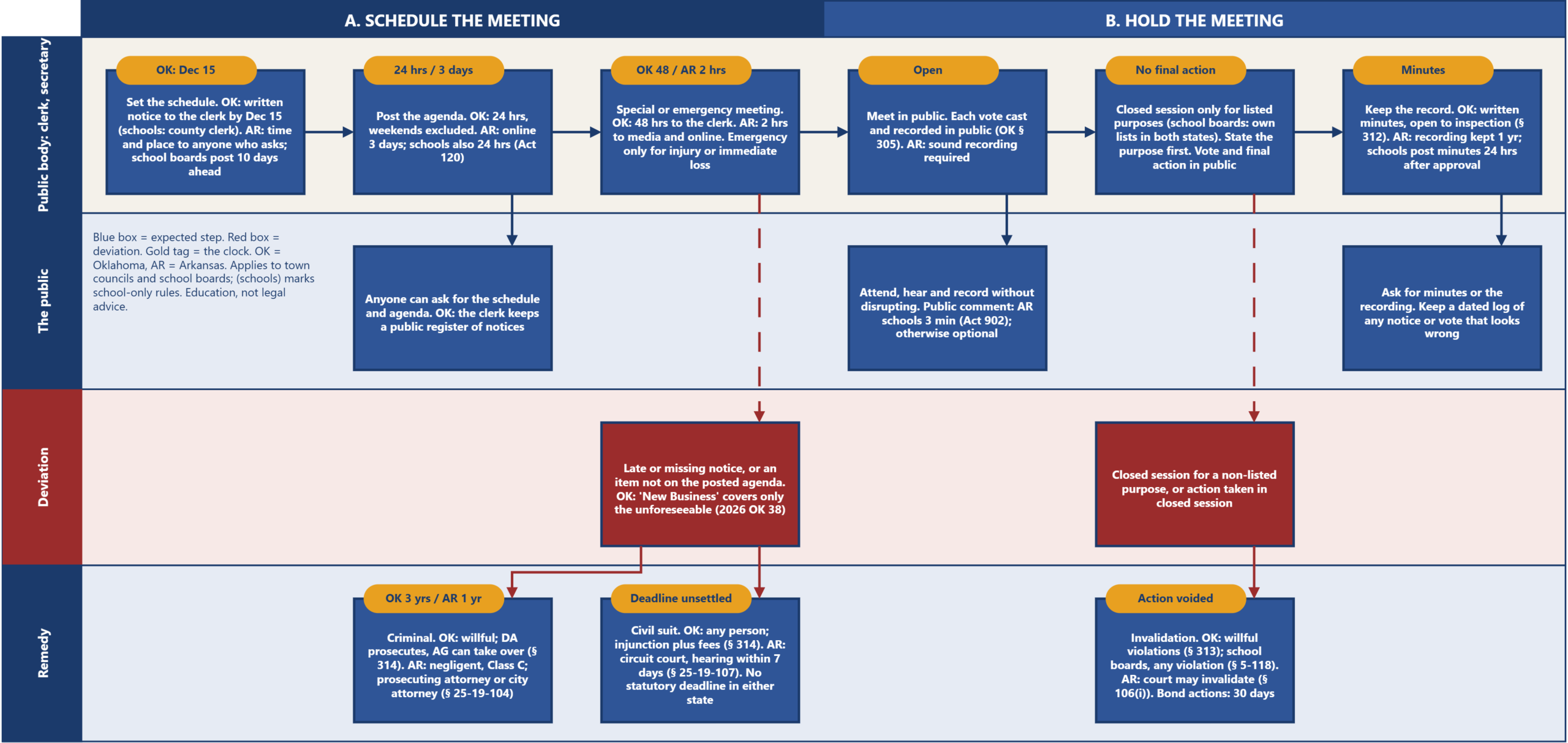
OK means Oklahoma and AR means Arkansas. It applies to town councils and school boards; where a rule is school-only, the box says so. Education, not legal advice.
A. Scheduling the meeting
| Step | Oklahoma | Arkansas |
|---|---|---|
| Regular schedule | Written notice by December 15 each year for the next year's regular meetings. Cities file with the municipal clerk; school boards with the county clerk (25 O.S. § 311). | Time and place furnished to anyone who asks, at least 3 days before (§ 25-19-106(b)). School boards also post the date, time and place on the district website at least 10 days before a regular meeting (§ 6-13-619). |
| Agenda | Posted at least 24 hours ahead, weekends and holidays excluded, and it must identify all items of business (§ 311). | Posted online at least 3 days before a regular meeting if the body has a website. School boards: Act 120 of 2025 adds 24 hours for regular meetings and 2 hours for special ones. |
| Special meeting | 48 hours' notice to the clerk; only posted matters may be considered (§ 311). | 2 hours' notice to the media that asked and online if there is a website (§ 25-19-106(b)). |
| Emergency meeting | Only for injury to persons, injury and damage to property, or immediate financial loss, and only where 48 hours is impractical (§ 304). The minutes state the nature of the emergency (§ 312). | Same 2-hour rule as a special meeting. |
Two points need care. Oklahoma's "New Business" agenda item covers only a matter not known and not reasonably foreseeable when the agenda was posted. And in Arkansas, how the general 3-day agenda rule and the school 24-hour rule fit together is not settled in any source I found.
B. Holding the meeting
- Open and recorded votes. Oklahoma: each member's vote must be publicly cast and recorded (§ 305). Arkansas: final action in a closed session is void unless the body holds a public vote (§ 25-19-106(i)).
- Closed sessions only for listed purposes. Oklahoma's list is in § 307(B), and school boards have a narrower list of their own (70 O.S. § 5-118(B)). Arkansas's list is in § 25-19-106(c), with additional school-board grounds in § 6-13-619(e). The body states the purpose first, then votes and takes final action in public.
- No decisions by side channel. Oklahoma bars informal or electronic decision-making by a majority (§ 306). Arkansas bars polling and outside-meeting deliberation on foreseeable action.
- The record. Oklahoma requires written minutes open to inspection (§ 312). Arkansas requires a sound recording kept at least one year, with a general exemption only for executive sessions and volunteer fire departments (§ 25-19-106(d)); school boards also keep minutes (§ 6-13-619(b)).
- The public. Anyone may attend, hear, and record without interfering (Oklahoma § 312(C)). Public comment is optional in Oklahoma. In Arkansas, school boards must allow residents, parents and employees to comment, at least 3 minutes each (Act 902 of 2025, § 6-13-619(f)).
C. Deviations and what follows
| Deviation | What it is |
|---|---|
| Notice | Late or missing notice, or an item not on the posted agenda. |
| Agenda | A vague heading that covers business known before posting. |
| Closed session | A closed session for a purpose not on the list, or action taken in closed session. |
| Remedy | Oklahoma | Arkansas |
|---|---|---|
| Criminal | A willful violation is a misdemeanor (§ 314(A)). Three years to bring a prosecution (22 O.S. § 152(H)). The district attorney is the default prosecutor; the Attorney General can take over. | A negligent violation is a Class C misdemeanor (§ 25-19-104). One year to bring a prosecution (§ 5-1-109). The prosecuting attorney is the default; inside a city, the city attorney may be the one who prosecutes. |
| Civil suit | Any person may sue for declaratory or injunctive relief; a prevailing plaintiff gets reasonable attorney fees (§ 314(B)-(C)). No deadline is written in the statute. | Appeal to circuit court, with a hearing within 7 days (§ 25-19-107). No deadline is written in the statute. |
| Invalid action | Action taken in willful violation is invalid (§ 313). For school boards, any violation makes the action invalid (70 O.S. § 5-118(C)). | A court may invalidate action taken at an unlawful meeting (§ 25-19-106(i)). |
| Bond actions | 30 days from the Attorney General's approval (62 O.S. § 13). | 30 days to invalidate; after that, the body can cure or pay a civil penalty (§ 25-19-106(j)). |
The recent Oklahoma cases
In 2026 the Oklahoma Supreme Court held in Oklahoma Schools Risk Management Trust v. Lexington School District (2026 OK 38) that a generic "New Business" item covering a vote already known before posting was a willful violation, and the action was invalid. In Randall v. Fields (2025 OK 91) the Court held that about 17 hours' notice for the State Board of Education's social studies standards violated the notice rule. I read both through secondary copies, so pull the opinions before quoting them.
What is not settled
I do not want to hand you a clean answer where the sources do not give one.
- No clear deadline for a civil suit in either state. Oklahoma's general statutes offer two-, three- and five-year candidates; Arkansas has three- and five-year candidates. No case I found picks one. Treat the shortest as the safe working limit, not as settled law.
- Who prosecutes. Neither state's criminal provision names a prosecutor, and I found no authority on compelling a prosecutor to act. A citizen's own route is the civil suit.
- Confirm before relying on this: the Arkansas Class C fine and jail figures (from a secondary reprint of the Code); Arkansas municipal minutes statutes; how Oklahoma's school-board closed-session list fits with the general list; and how § 313 interacts with the 30-day bond rule.
What to ask, not what to believe
Was the notice posted on time and in the right place? Is this item on the agenda in plain words? What is the stated purpose of the closed session, and was the vote in public? Where are the minutes or the recording? Keep a dated log of anything that looks wrong, and ask for the answer in writing.
If a child was harmed at a school, the records and reporting clocks are in a separate guide: When a Child Is Harmed at a Public School: The Process in Oklahoma and Arkansas.