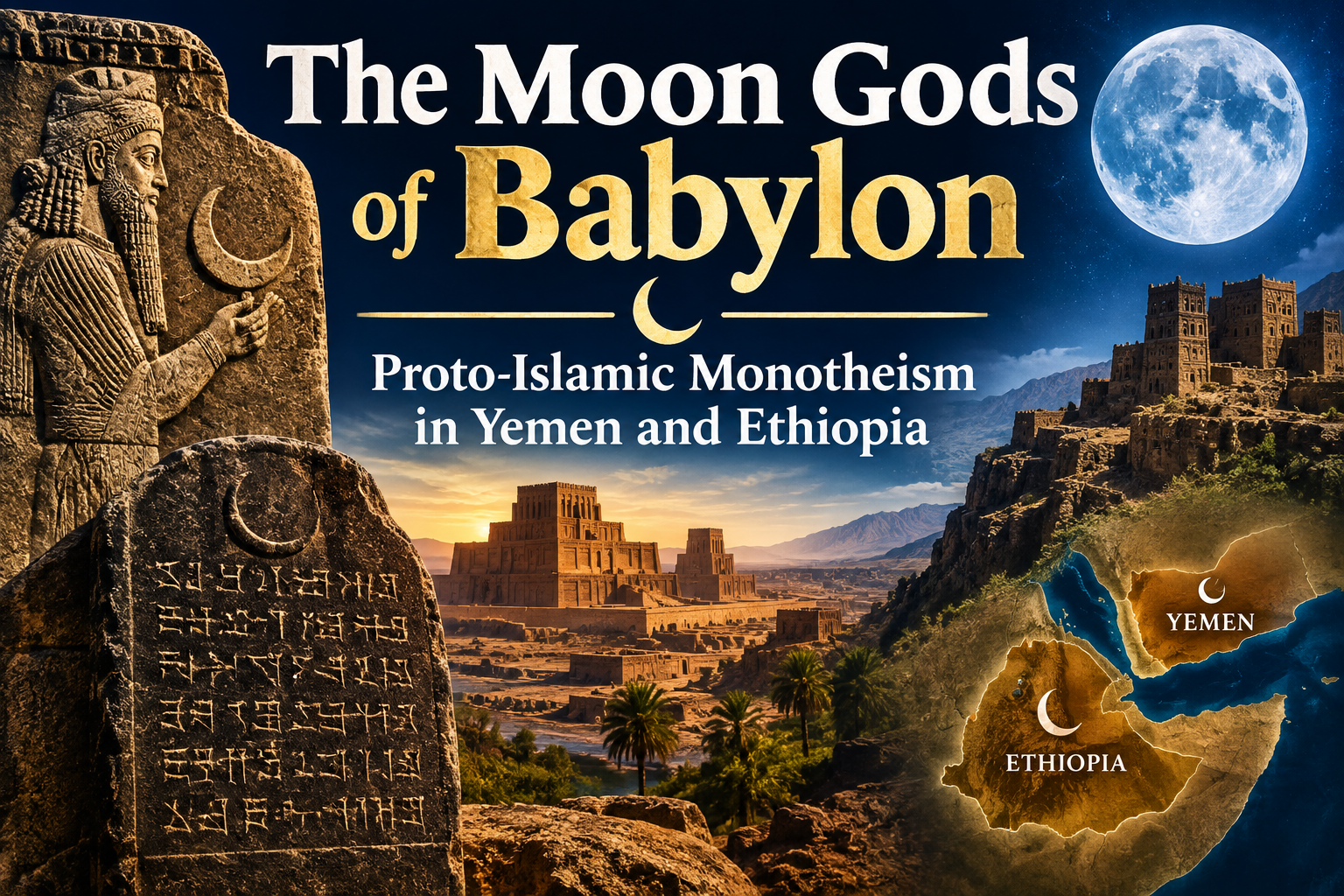
The Moon Gods of Babylon: Proto-Islamic Monotheism in Yemen and Ethiopia
Curated Knowledge Document
Source: YouTube Video (Livestream) Original Speaker/Channel: Lloyd de Young (guest), hosted by Maria/Nuria (host channel, name given phonetically as “Nuria” in transcript) Document Scope: Curated synthesis of key information, claims, and evidence presented in the transcription. This is Part 1 of a planned multi-part series; the speaker states this session is an introductory “scene-setting” overview, with deeper argumentation reserved for future installments. Curated On: September 26, 2026
Curator’s Note on Content Nature
This document curates the claims and argumentation presented by the guest speaker, Lloyd de Young, in a livestream framed as “Islamic Monotheism” — a thesis that proto-Islamic religion in Arabia derived from Babylonian/Sabaean moon-god paganism, transmitted via Yemen and Ethiopia. This is a single speaker’s argued position, not an established academic consensus. The “Islamic moon-god” thesis has circulated since roughly the 1990s and is contested; the speaker himself acknowledges this at the outset. Several claims in this transcript (e.g., etymological derivations, specific figures like “40% improvement” statistics are not present here but analogous claims of the type “X word derives from Y pagan term” are asserted without independent verification in this presentation) rest on the speaker’s own research and a self-described archive of ~1,200 sources that were not verified within this session. Where the speaker states something as his own inference versus a cited source, this document attempts to preserve that distinction. Readers should treat linguistic and historical claims as the speaker’s argued position requiring independent verification, not as this document’s endorsement of their accuracy.
Executive Summary / Core Thesis
The speaker argues that proto-Islamic religion, as practiced in Arabia before Muhammad, was not an isolated development but a regional variant of a shared Babylonian-derived pantheon centered on moon-god worship (the Babylonian god Sin, also called Makkah/Almaqah). He traces this thesis through the Sabaean kingdom of Saba (Yemen) and the Axumite Empire (Ethiopia), arguing that pre-Islamic Sabaean religious practice — pilgrimage, ritual washing, fasting, veneration of a black stone, multiple daily prayers — closely parallels later Islamic ritual. He further argues that key Islamic vocabulary (Allah, Rahman, Injil, Tawhid, Hanif) and symbolism (the crescent and star) have traceable pagan, Ethiopic, Zoroastrian, or Babylonian origins predating Islam, and that historical evidence for early Mecca as a significant trade or religious center is comparatively weak next to evidence for Yemeni sites bearing the same name and temple structure (“al-Makkah” temples).
Key Takeaways
- The central thesis: proto-Islamic Arabia’s pantheon was a regional copy of the Babylonian/Sumerian/Canaanite pantheon, with the chief deity Makkah (Almaqah) equated to the Babylonian moon god Sin.
- Multiple al-Makkah temples existed in Yemen (at Sirwah, Marib/Awam, and a third nearby site), predating and possibly informing the naming of Mecca; the speaker argues evidence for these Yemeni sites is stronger than early archaeological evidence for Mecca itself.
- A 10th-century Muslim writer, Muhammad Shukri al-Alusi, is cited as documenting that pre-Islamic Sabaean religious practice already included pilgrimage (Hajj/Umrah), circumambulation of a shrine, ritual running between two points, stone-throwing, post-coital washing, and fasting — practices the speaker maps directly onto later Islamic ritual.
- The Ka’aba is asserted (via a hadith from Sahih Muslim) to have once contained six pillars, mirrored by six-to-eight-pillar arrangements at the Sabaean Awam temple (Marib) — a parallel the speaker treats as architecturally significant, with “seven spaces” between pillars corresponding to the number of daily prayers in some Sabaean sects.
- Ethiopia (the Axumite Empire) is presented as a major, historically underrecognized world power (alongside Rome, Persia, and China) with early Christian conversion (2nd–4th century AD, formalized under King Ezana c. 320–360 AD), extensive trade links to Arabia, and direct biographical ties to Muhammad (his wet nurse, his muezzin Bilal, the First and Second Hijra to Abyssinia, and his own reported fluency in Ethiopic).
- The speaker argues several core Islamic terms have non-Arabic or pagan roots: Allah as a generic title rather than a proper name; Rahman as a name for God already in use by South Arabian Christians/Jews before Muhammad adopted it; Hanif as derived from a Syriac word for “pagan/heathen”; Tawhid as derived from the Ethiopic Orthodox term tewahedo (“unification”); Injil (Gospel) as derived via Ethiopic from Greek evangelion.
- The Islamic crescent-and-star symbol is traced through pre-Islamic Sabaean/Babylonian iconography (the god Sin/Ishtar), Parthian and Sasanian Persian coinage (linked to Zoroastrian Mithra/Tishtrya symbolism), and Byzantine-derived coin designs retained after the Arab conquest of Persia — predating the commonly cited 1843 Ottoman flag adoption by many centuries.
- Under classical Sharia (citing The Blunt Sword Against the One Who Insults the Messenger / doctrine of sabb al-rasul), the speaker states there is scholarly consensus across the four major Sunni legal schools that insulting Muhammad is a capital offense for Muslims and non-Muslims alike, distinct from — and treated as more severe than — insulting Allah.
- The speaker asserts a documented historical gap: he claims that written records from Arabia largely disappear for roughly two centuries around the rise of Islam, despite surrounding literate cultures (Yemen, Ethiopia) having active scripts, and that Arabic historical writing resumes only with the later hadith compilations (~150–200 years after Muhammad’s death).
- The earliest full biography of Muhammad (attributed to Ibn Ishaq, redacted by Ibn Hisham) dates to roughly 150–200 years after his death; the six canonical hadith collections (al-Kutub al-Sittah) are dated by the speaker to approximately two centuries post-Muhammad and are explicitly compared to the structure of the Jewish Talmud.
Section 1: Speaker Background and Framing
Lloyd de Young identifies himself as South African, resident in Warsaw, Poland, with 11 years of residence in the Middle East and extensive regional travel. He describes a professional background in national defense engineering and consulting, designing long-range wide-area surveillance systems to protect borders and critical infrastructure (airports, oil pipelines, military bases) from sabotage and terrorism, working with regional government, industry, law enforcement, and military.
He traces his research interest to a counterterrorism course in which religiously-motivated terrorism from Hindu and Christian contexts was openly discussed, but discussion of Islamic religious terrorism was reportedly discouraged by faculty and students. He states that following the discovery of a cache of documents in Raqqa (ISIS-linked material), he found the material to reflect “standard orthodox Sunni Islam” rather than aberrant doctrine, and that he was subsequently “banned from the class” after introducing this material — an event he describes as the catalyst for his subsequent research into Islamic law (Sharia), centered on the manual Reliance of the Traveller.
Methodological framing offered by the speaker:
- He states his research diverges from the mainstream focus on northern Arabia (Petra, Mesopotamia, Iraq, Turkey) and 6th–7th century timeframes, instead focusing on the south (Yemen and Ethiopia) and reaching back centuries to a millennium earlier.
- He explicitly states he does not consider his research to reject the Petra-origin hypothesis for Islam’s origins, describing his work as complementary (“filling in the blank, which was the South and Africa”).
- He states Islamic law permits deception in service of “keeping the peace,” which he offers as a caveat regarding the reliability of self-reported Islamic tradition — noting this is a topic reserved for future discussion rather than elaborated here.
- He states he will make his source archive (described as roughly 1,200–1,600 books, academic papers, and PhD theses) publicly available via his channel’s community page.
Section 2: Geography and the Sabaean/Axumite Kingdoms
Yeha and the Sabaean Presence in Ethiopia
Yeha is identified as a Sabaean/Sabaic kingdom archaeological site near Axum, Ethiopia — described as the largest archaeological site in the Horn of Africa evidencing African contact with South Arabia. It was established in the 8th century BC and includes a temple, an elite residence (“the Grand Building”), and rock-cut shaft tombs. The Sabaeans are described as a Semitic people from a kingdom in western Yemen, identified with the biblical “Sheba” (queen of Sheba narrative, also referenced in the Quran).
The Axumite Empire
The Axumite Empire is presented as one of four major world powers of its era (alongside Rome, Persia, and China), flourishing from roughly the 8th century BC to 275 AD (with continued cultural influence afterward). Key claims:
- Axum minted its own coinage in gold, silver, and bronze, calibrated to Roman weight standards, and was the first African kingdom to place Christian crosses on its coins.
- The Axumite king held the title Negusa Nagast (“King of Kings”); King Ezana (reigned c. 320–360 AD) is cited as converting to Christianity, evidenced by a shift in coin iconography from a star-and-crescent symbol (linked to the moon god Almaqah) to the Christian cross.
- Axum developed Ge’ez, described by the speaker as, on the basis of preserved-language comparison, potentially the world’s oldest largely unchanged written language — and as the Semitic language most closely related to Arabic.
- A 4th-century church discovery near Axum (referenced via Smithsonian reporting) is cited as evidence that Christianity reached Ethiopia significantly earlier than previously assumed by mainstream scholarship — on a timescale comparable to, or preceding, Christianity’s spread into Armenia.
- In the 6th century, the Axumite king Kaleb is described as sending a military force across the Red Sea to subdue Yemen, ruling South Arabia for roughly 70 years, with Byzantine support motivated by Yemen’s persecution of Christians.
Trade Routes and Cultural Transmission
The speaker emphasizes long-distance trade networks (connecting Yemen, Ethiopia, Egypt, Mesopotamia, Syria, and points north to Damascus/Turkey) as the primary mechanism for the spread of religious ideas, language, and iconography in antiquity — a framework he applies throughout to argue for southern Arabian/Ethiopian influence on the religious environment in which Islam emerged.
Section 3: Almaqah/Makkah — The Moon God and the Temple Network
Definition: Almaqah (also transliterated al-Makkah, al-Muqah, LMQ) is presented as the principal deity of the Sabaean kingdom, equated by the speaker with the Babylonian moon god Sin.
- The speaker notes a phonetic shift: the Yemeni Sabaic pronunciation carries a “q” sound (Maqah), which in Arabian Arabic hardens to “k” (Makkah) — the same consonant cluster as the name Mecca.
- He identifies three named al-Makkah temples in Yemen predating Islam: one at Yeha (Ethiopia), the Awam temple near Marib (Yemen, also called the “Mahram Bilqis,” associated with the Queen of Sheba), and a temple at Sirwah.
- Architectural parallel claimed: The Yeha temple measured approximately 60 by 40 feet; a later church built on the same site retained these dimensions. The speaker connects this to the Awam temple’s pillared entrance (“propylon”) of six-to-eight pillars, which he compares to a hadith from Sahih Muslim describing the Ka’aba’s interior as once containing six pillars. He interprets the “seven spaces” between the Awam temple’s eight pillars as symbolically corresponding to the seven daily prayers observed by some Sabaean religious sects (as opposed to five in others).
- The site of Sawa/Suwa (near Najran) is cited as evidence of early Arabic-speaking populations within Yemen, and as a location that, while playing no direct role in Islamic-era events, became significant in later Islamic historical mythology and pre-Islamic Arabic poetry.
- Excavations at the Awam temple were conducted by Wendell Phillips and a Smithsonian-funded team (initial 1950s effort halted by tribal unrest; resumed and continuing per a cited 2014 report), explicitly identifying Almaqah as a moon god.
[SUPPORT — noted but not independently verified in this document]: The claim that Islamic apologetics dispute Almaqah’s status as a moon god is noted by the speaker as a point of ongoing contention he intends to address with further sourcing in later installments.
Section 4: Sabaean Religious Practice as a Precursor to Islamic Ritual
The speaker cites the 10th-century Muslim writer Muhammad Shukri al-Alusi, who documented similarities between pre-Islamic (“Jahiliyyah”) Arab religious practice and later Islamic law (Sharia). Practices attributed to the pre-Islamic period and paralleled in Islam include:
- Prohibitions on marrying both a mother and daughter, or two sisters simultaneously; censure of marrying one’s stepmother.
- Performance of the major pilgrimage (Hajj) and minor pilgrimage (Umrah) to the Ka’aba.
- Circumambulation (tawaf) of the Ka’aba, and running seven times between the sites later known as Safa and Marwa.
- Stone-throwing rituals, and ritual washing after sexual intercourse.
- Nasal water irrigation (a component of wudu, ritual ablution), fingernail clipping, and pubic hair removal.
- Circumcision.
- Amputation of a thief’s hand and stoning for adultery.
- Observance of five (or, per other sects, seven) daily prayers.
- Praying over the dead without kneeling or bending the knee.
- A month-long lunar fast (linked explicitly by the speaker to Ramadan), observed from before dawn until sunset by some sects.
- Facing the Ka’aba during prayer; veneration of Mecca as a pilgrimage site.
- Prohibitions on consuming blood, pork, and dead (carrion) meat.
- Observance of four sacred months (Dhu al-Qi’dah, Dhu al-Hijjah, Muharram, and Rajab per standard Islamic reckoning) during which raiding, warfare, and revenge-taking were forbidden — a practice the speaker states is preserved directly in Quranic text (citing Abdullah Abdel Fadi, Is the Qur’an Infallible?, p. 127).
Curation note: The speaker draws a sharp distinction between two similarly-named but historically distinct groups referenced in Islamic and biblical sources — the Sabaeans (of Yemen, subject of most of this presentation) and the Sabians (a separate group referenced in the Quran and identified by the speaker with Mandaean Gnostics, associated with veneration of John the Baptist and a prophet figure called Enoch/Enosh). He cautions against conflating the two and notes that translation ambiguity in some sources obscures which group is meant.
Section 5: Linguistic Evidence — Foreign Vocabulary and Ethiopic Influence
[SUPPORT] The speaker references Arthur Jeffery’s The Foreign Vocabulary of the Qur’an (cited as a scholarly work by a professor of Semitic languages) as cataloguing loanwords in the Quran from Syriac, Aramaic, Hebrew, Greek, Ethiopic, Persian, Akkadian, South Arabian, Armenian, Phoenician, Mandaic, Sanskrit, Nabataean, and Latin. The speaker states that when Ethiopic and Amharic are grouped together, their combined vocabulary share may rival or exceed the Greek contribution, and asserts (without citing the book directly for this point) that additional Ethiopic-origin words exist beyond Jeffery’s list.
Terms the speaker derives from Ethiopic or other non-Arabic sources:
- Injil (the Quranic term for the Gospel/New Testament) — argued to derive via Ethiopic wangel from the Greek evangelion (“good news”), introduced by Abyssinian Christians in the early 6th century. The speaker also notes the Quranic Injil more closely resembles Gnostic gospel material than the canonical New Testament.
- Tawhid (Islamic monotheism/”oneness of God”) — argued to derive from the Ethiopian Orthodox Tewahedo Church’s term tewahedo, meaning “unification,” reflecting that church’s distinct Christological position on the nature of Christ.
- Rahman (“the Merciful,” the first name given to Allah in the Quran) — argued to have already been in use as a divine title among South Arabian Jews and Christians from at least the 4th century AD, and shared by a rival prophet figure named Musaylimah, described as a monotheistic religious competitor of Muhammad who also referred to his deity as Rahman.
- Hilal (“crescent,” Islam’s lunar symbol) — stated to be the name of a specific pre-Islamic Arabian pagan moon god of the crescent, not merely a generic descriptive term.
- Hanif (“true monotheist,” a term the Quran applies to Abraham, Muhammad, and Islam itself) — argued to derive from the Syriac word hnp, meaning “heathen” or “pagan,” originally used by Christians and Jews as a pejorative for early Muslims/believers before being adopted as a positive self-designation (a pattern the speaker compares to the term “Christian”).
- Salam/Islam (root S-L-M) — the speaker states the root’s earliest attested meaning is “graven idol,” with an intermediate historical usage referring to a Canaanite star-god, Shalim, before the commonly cited meaning “peace” (itself disputed by the speaker in favor of “submission”).
- Malik (“king,” as in the title Abd al-Malik) — the speaker connects the triliteral root M-L-K to the god Molech/Moloch, associated in the Hebrew Bible with child sacrifice, framing “Abd al-Malik” as literally “slave of the king/Molech” rather than a personal name.
- Muhammad/Mahmud — presented as a title meaning “the praised one” rather than a personal name, with the speaker citing a South Arabian inscription referencing “Rahmanan” alongside the phrase “Muhammad,” which he interprets as a pre-Islamic reference to a Christian/Jewish deity, not the historical Muhammad.
Linguistic claim regarding Ethiopic phonology: The speaker states that every phoneme found in Arabic is also present in Ethiopic, and that Ethiopic is philologically the Semitic language most closely related to Arabic — framing this as support for a south-to-north transmission of religious vocabulary into the Quranic milieu.
Section 6: Ethiopian-Islamic Historical and Biographical Connections
The speaker lists a series of documented (per standard Islamic sources) connections between Muhammad and Abyssinian/Ethiopian figures and events:
- The First Hijra (c. 614 AD): Muhammad’s early followers fled persecution in Mecca to seek refuge with the Christian Axumite king (referred to as the Negus/Najashi), remaining there for roughly 15 years before some returned to Mecca and later migrated to Medina (622 AD) or Ethiopia again (628 AD).
- Muhammad’s wet nurse, present “from birth until death” per Islamic tradition, is identified as Ethiopian.
- Bilal ibn Rabah, described in Islamic tradition as the first person to call the Muslim call to prayer (adhan), is identified as Ethiopian (Habashi) and noted in tradition as skilled in the Ethiopic language.
- The individual who repaired the Ka’aba is identified in tradition as Ethiopian.
- Arabic and Ethiopic are stated to be the only two languages Muhammad is traditionally recorded as speaking.
- The speaker references the “Year of the Elephant” narrative (traditionally dated to Muhammad’s birth year, 570 AD), describing an Abyssinian army under a commander named Abraha marching on Mecca with war elephants, including a lead elephant reportedly named Mahmud — which the speaker notes shares a root with “Muhammad” — that refused to advance, halting the assault.
- The speaker notes that Islamic tradition holds Muhammad presented an edited or incomplete account of Islamic Christology to the Abyssinian king to secure sanctuary, and that the resulting claim of shared belief (“Jesus is God’s servant, his prophet, his spirit, his word”) reflects vocabulary with a different theological meaning in Christian versus Islamic usage.
Section 7: Symbolism — The Crescent, Star, and Pentagram
Definition — Hilal: The crescent moon symbol used in Islamic iconography, argued by the speaker to derive its name from a specific pre-Islamic Arabian pagan moon-god figure rather than functioning purely as a generic term for “crescent.”
- The star-and-crescent motif is traced to Babylonian Sin/Ishtar iconography (with the Babylonian cuneiform term shipu, glossed as “incantation,” cited as an early linguistic antecedent used for warding off evil).
- A boundary stone attributed to Nebuchadnezzar I (Babylon, c. 1200 BC) is cited as bearing a star-within-crescent motif associated with the deities Sin (moon) and Ishtar (Venus).
- The symbol is traced through Parthian coinage (Phraates V era, associated with Zoroastrian deities Mithra or Tishtrya) and the succeeding Sasanian Empire, where it appeared alongside Zoroastrian fire-altar imagery on royal coinage.
- Following the Arab conquest of Persia in the 7th century, the speaker states Sasanian coin designs — including the star-and-crescent — were initially retained; the caliph Abd al-Malik is credited with replacing the fire-altar imagery with Arabic text while preserving the crescent-and-star motif.
- The speaker disputes the commonly cited claim that the crescent-and-star became an Islamic symbol only in 1843 under the Ottomans, citing earlier examples from Harran, Turkey (1st century AD and pre-BC), Byzantine coinage, and Hittite iconography (Baal-Hadad).
- Pentagram: The speaker identifies the pentagram (as it appears on the flag of Morocco) as originating from the Babylonian symbolism of Ishtar and Marduk, also historically associated with the “Seal of Solomon.”
Section 8: The Naming of Allah and the Rahman Inscriptions
The speaker argues that Allah functions grammatically and historically as a generic title (“the God”) rather than a proper name — paralleling the use of “Abd al-Malik” as a title (“slave of the king”) rather than a personal name — and states that Arab Christians of the pre-Islamic period also used the term “Allah” as a title for the Christian God, who separately carried other names.
He states that the first instance in the Quran where God is given an explicit name occurs in the chapter he identifies as Surah 59 (or 49, per his verbal qualification), where God is named Rahman (“the Merciful”). He connects this to:
- Epigraphic evidence that South Arabian Jews and Christians were already referring to their God as “Rahman”/”Rahmanan” (Lord of Heaven) from at least the 4th century AD.
- A rival prophetic figure, Musaylimah, who preached a competing monotheistic religion using the same divine name.
- An inscription attributed to the Ethiopian/Abyssinian commander Abraha, which the speaker states invokes “Rahman, his Messiah [Rahman Christos], and his Holy Spirit” — a Trinitarian Christian formula — and separately references a “Muhammad” in a phrase the speaker translates as “by the Lord of the Jews, by the highly praised,” which he interprets as referring to the Judeo-Christian God rather than the historical Muhammad, treating “Muhammad” here as a title (“the praised one”).
- The speaker also raises, without fully resolving in this session, a claim regarding Quran 53:49 (the reference to “Lord of Sirius”) as potentially connecting Allah to the star god Sirius/Ishtar and, by extension, to Almaqah/Sin — flagged explicitly by the speaker as connected to Surah al-Ikhlas (“the sincerity/purity chapter”), a point he defers to a future session.
Section 9: Islamic Law on Blasphemy and the Status of Muhammad
The speaker presents material from a Sharia text he identifies as al-Sarim al-Maslul ‘ala Shatim al-Rasul (“The Blunt/Unsheathed Sword Against the One Who Insults the Messenger”), attributed to Ibn Taymiyyah, addressing the doctrine of sabb al-rasul (insulting the Messenger):
- [SUPPORT — direct claim from source text read on-stream]: The text states there is scholarly consensus (ijma) that whoever insults the Prophet is to be killed, whether Muslim or non-Muslim, and that this applies even to a dhimmi (protected non-Muslim) who continues paying a protection tax.
- The text distinguishes this from insulting other prophets, which is stated to carry a lesser penalty of lashing.
- The speaker states this consensus is attributed to the founders of the four major Sunni legal schools he lists as Hanafi, Hanbali, Maliki, and Shafi’i (Note: the transcript records “Malik, light, Ahmed, Isra and Ashafi” as the eponymous founders cited from the text — likely referring to Malik ibn Anas, al-Shafi’i, Ahmad ibn Hanbal, and Abu Hanifa, though the transcript audio/naming here is imprecise).
- The speaker further states that Islamic legal theory allows for extensive internal variation and even apparent contradiction between rulings via a doctrine he terms azima (rendered by the speaker as “dispensation,” relating to strictness versus relaxation of a rule), attributing the harmonization of the four schools’ differences to a scholar named al-Sha’rani and his work al-Mizan al-Kubra (“The Great/Supreme Scale”).
- [SUPPORT — deification claim]: The speaker cites a hadith (“None of you believes until I am more beloved to him than his wife, his child, and all people”) as evidence that Muhammad is placed in a position analogous to the biblical commandment to love God above all else, and asserts (without a specific citation given in this segment) that later biographical/devotional literature describes Muhammad as pre-existent, present with Allah before creation, and identified as “the light of Allah” — which the speaker again connects thematically to lunar rather than solar light imagery.
Section 10: Claims Regarding the Historical Record and Manuscript Evidence
- The speaker asserts that surrounding literate cultures (Yemen, Ethiopia, and multiple regional scripts) had active writing traditions before and after the rise of Islam, but that written records from Arabia largely disappear for a period he estimates at roughly two centuries around Islam’s emergence, with Arabic historical writing resuming only alongside the production of the hadith literature.
- In response to an audience question, the speaker states the earliest full biography of Muhammad is attributed to Ibn Ishaq, later redacted into the surviving form by Ibn Hisham, dated approximately 150–200 years after Muhammad’s death.
- He references a scholar he names as “Matsky” (likely Harald Motzki, though rendered phonetically in the transcript) as identifying an earlier hadith collection dated to roughly a century after Muhammad.
- The six canonical hadith collections (al-Kutub al-Sittah, “the six books”) are dated by the speaker to roughly two centuries after Muhammad’s death; he explicitly compares this structure to the Jewish Talmud’s six-part Mishnah order, framing Islamic legal/hadith literature as modeled on Talmudic structure.
- [Speaker’s stated epistemic caveat]: The speaker states that “proof” within classical Islamic legal epistemology (‘ilm) differs from Western evidentiary standards — describing it as oral, rhetorical, and persuasive rather than empirical — and states that oral transmission was treated as authoritative within this framework.
- Responding to a question about whether the god Molech is a documented deity outside the Bible, the speaker states that multiple regional cultures independently attest Molech worship (citing Assyrian sources) and that Molech is also identified under alternate names, including Baal, which the speaker connects to the pre-Islamic Ka’aba deity Hubal.
- In response to a question about Saudi restrictions on archaeological excavation near Mecca, the speaker references (without providing a specific primary citation in this segment) hadith traditions describing Adam as buried near the Ka’aba at a height of “60 arms” (translated by the speaker as approximately 90 feet/36 meters), alongside 70–300 unnamed prophets said to be interred in a non-decomposed state — offered by the speaker as a rhetorical point regarding the absence of independent verification (e.g., ground-penetrating radar surveys) rather than as a claim he endorses as literally true.
Important Direct Quotes
“The Arabian pagan god, the main Arabian pagan god was called Makkah… and Makkah was also known as the Babylonian moon god, Sin, the main god of Babylon.” — Lloyd de Young, stating the core thesis linking the Arabian deity Makkah to the Babylonian moon god Sin.
“There is not a single rule in Islam that cannot be violated if you feel it is necessary.” — De Young, describing the doctrine of azima (dispensation) within Islamic legal theory.
“Malik means king… if the king, if he is the slave of the king… whose slave are you? Well, you’re the slave of God.” — De Young, explaining his proposed etymology connecting the title “Abd al-Malik” to the deity Molech.
“It is agreed that Hanif is derived from the Syriac word… meaning heathen or pagan.” — De Young, on the disputed etymology of the Quranic term hanif.
“So the son is the star god, Ishtar… and the lord of Sirius is al-Makkah, sin… if Allah is the lord of Sirius, then Allah is Makkah.” — De Young, connecting Quran 53:49 (“Lord of Sirius”) to his broader thesis.
Unresolved Questions / Open Loops
The speaker explicitly deferred the following topics to future installments of the series:
- A planned in-depth session on Sharia law generally, referenced multiple times but not developed here.
- Full elaboration of the connection between Surah al-Ikhlas (the “Ikhlas chapter”) and the Sirius/Lord-of-Sirius argument regarding Allah’s identity — raised but not completed.
- Further detail on the hanif/mu’minun terminology shift and the historical relationship between the Umayyad-era “believers” movement and the later emergence of “Muslim” as a self-designation, tied to the Almoravids as a sub-group within the Abbasid period (this section of the presentation was interrupted and not fully completed).
- The full connection between the deity Hubal and the god Molech/Baal, and Muhammad’s reported childhood consecration to Hubal by his grandfather — introduced but not fully substantiated in this session.
- A pending audience question on Saudi Arabian restriction of archaeological excavation near Mecca — the speaker indicated he would research this further for a future session rather than answering definitively here.
- The relationship between the gods Allat, Manat, and al-‘Uzza (associated with Petra) and the Yemen/Ethiopia thesis — the speaker affirmed these deities’ association with Petra and stated his research does not discount that connection, but did not reconcile the two geographic theses in this session.
- General note: the speaker states the full presentation series runs to roughly eight hours in total; this transcript represents an introductory segment, with the stated intention of “picking up pace” in subsequent installments.
Curator’s closing note: Several claims in this document — particularly etymological derivations (e.g., Salam→Shalim→”graven idol”; Malik→Molech; Muhammad-as-title rather than proper name) and the interpretation of specific inscriptions — are presented by the speaker as settled conclusions but are, by his own account, drawn from a personal research archive not independently cross-checked within this document. Readers seeking to evaluate this thesis should consult the primary and academic sources the speaker references directly (Arthur Jeffery’s Foreign Vocabulary of the Qur’an, Ibn Ishaq/Ibn Hisham’s Sirat Rasul Allah, the Encyclopaedia of Islam, and the epigraphic/archaeological reports on Yeha, Marib, and Axum) rather than relying on this synthesis alone.