Teaching Design a Study: How Technology Reshapes Culture in Grades 11-12 (Level 2): Oklahoma Standard L2.IC.CU.03
Teaching Design a Study: How Technology Reshapes Culture in Grades 11-12 (Level 2): Oklahoma Standard L2.IC.CU.03
Teaching technology impact research project in grades 11-12 (level 2) does not have to be complicated. Picture a user researcher testing early versions of a product and using the findings to plan the next release. That kind of thinking is exactly what Oklahoma's grades 11-12 (level 2) computer science standard L2.IC.CU.03 asks students to practice — and it is very teachable with the right materials. This post walks through what the standard means, the misconceptions students bring to it, and discussion starters you can use tomorrow, whether you teach in a classroom or at your kitchen table.
What Does Standard L2.IC.CU.03 Actually Ask?
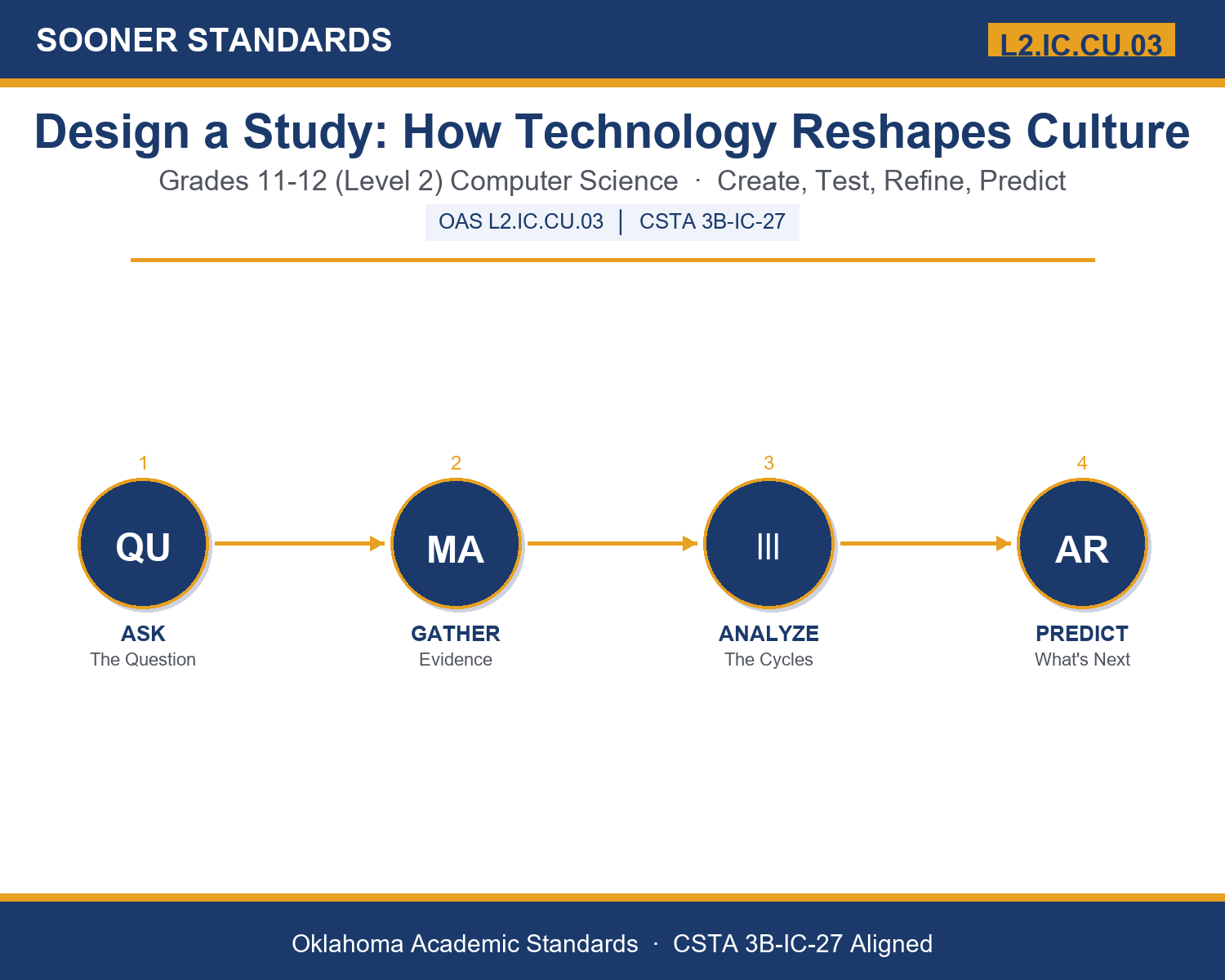
Design and implement a study that evaluates or predicts how creating, testing, and refining computational artifacts has revolutionized an aspect of our culture and how it might evolve (e.g., education, healthcare, art/entertainment, energy). — Oklahoma Academic Standards for Computer Science (February 2023)
In plain language: This standard asks students to plan and carry out a study about how creating a tool, testing it, and improving it over and over has changed an area of daily life, and then to use their findings to explain what happened or predict what comes next.
In student-friendly terms, the learning target is: "I can design and carry out a study that evaluates or predicts how creating, testing, and refining computational artifacts changed one part of our culture and how it may keep changing."
What Students Should Be Able to Do
- I can write a research question and hypothesis that evidence could confirm or contradict.
- I can choose a method that fits my question and explain its main weakness.
- I can collect and log traceable evidence and tell correlation from causation.
- I can extend a documented pattern into a prediction with assumptions and warning signs.
Along the way, students pick up the working vocabulary of the topic: artifact, iteration, prototype, hypothesis, evidence, method, variable, correlation, causation, prediction, adoption, sample, trend, source.
Technology Impact Research Project: Misconceptions to Watch For
These are the wrong turns students reliably take with this standard — knowing them ahead of time is half the lesson plan. Each correction strategy below comes straight from the unit's teacher guide (the paragraph and activity references point into the unit itself).
1. "One famous invention changed a whole field overnight."
Return to paragraph 1 and the Worked Example. Have students find the earlier and later versions of one artifact and mark what each iteration changed.
2. "If two things change together, one caused the other."
Use paragraph 6 and Checkpoint #2. Ask students to list three other things that could explain the same change, then ask what comparison would help rule them out.
3. "A prediction is just a guess, so it cannot be wrong or right."
Return to paragraph 9. Have students add assumptions and a warning sign to a vague forecast until it can be checked.
4. "Any source that supports my hypothesis is good evidence."
Use paragraph 5. Have students rate sources by who produced them and why, and find the strongest source that argues against the hypothesis.
Discussion Starters You Can Use Tomorrow
- Which is more valuable for a researcher: the first version of an artifact or the tenth? Why?
- What evidence would convince you that a tool truly changed a field rather than merely arrived while the field was already changing?
- Who might be left out when an artifact is tested on a narrow group, and how would a study detect that?
Bringing It Home
This topic is a natural one for families. One ten-minute activity to try: Pick one thing your family uses every day, such as a phone feature, a streaming service, or a thermostat. Together, ask what an earlier version was like and what problem each change tried to fix. Then ask your student to predict one thing that might change next and to name one sign that would show the prediction was wrong. There are no wrong answers; the goal is hearing their reasoning.
Where This Leads
Students who can design and carry out a study that evaluates or predicts how creating, testing, and refining computational artifacts changed one part of our culture and how it may keep changing are building skills used every day in user research, data analysis, health informatics, technology policy, and software engineering.
See the Unit in Action
Get the Complete L2.IC.CU.03 Unit
I built a complete, no-prep unit for this standard — Design a Study: How Create-Test-Refine Cycles Reshape Culture — covering 3-4 days of instruction across 47 pages:
- Teacher guide — day-by-day pacing, misconceptions to watch for, discussion questions, differentiation for support / ELL / extension, and a 4-point rubric
- Student learning target page — a kid-friendly "I can" statement with success criteria
- Full content lesson with 3 embedded "Check Your Understanding" checkpoints
- 13-question assessment (6 multiple choice, 4 true/false, 3 short answer) with a complete answer key, explanations, and exemplar responses
- Group activity — "The Culture Study Design Studio" (25-30 minutes)
- Individual activity — "My Prediction Brief" (15-20 minutes)
- Crossword and word search built from all 14 vocabulary terms (with answer keys)
- Family connection letter — a plain-language page for parents, with dinner-table questions and a 10-minute home activity
- Certificate of achievement — ready to sign and send home
- Study Design Template: How Artifacts Change Culture (separate printable, 3 pages)
- Worked Example: How Learning Artifacts Changed Access to Computing and Learning (separate printable, 2 pages)
- Reference Notes: Designing a Study of Technology and Culture (separate printable, 2 pages)
- My Prediction Brief (separate printable, 2 pages)
Get Design a Study: How Technology Reshapes Culture on Teachers Pay Teachers →
Also compared with CSTA 2017 3B-IC-27
Every Sooner Standards resource is built directly from the official Oklahoma Academic Standards for Computer Science (February 2023) — standard text verified, never paraphrased from memory.