Texas TEKS Computer Science vs. CSTA Standards: What the Crosswalk Actually Shows
Texas TEKS Computer Science vs. CSTA Standards: What the Crosswalk Actually Shows
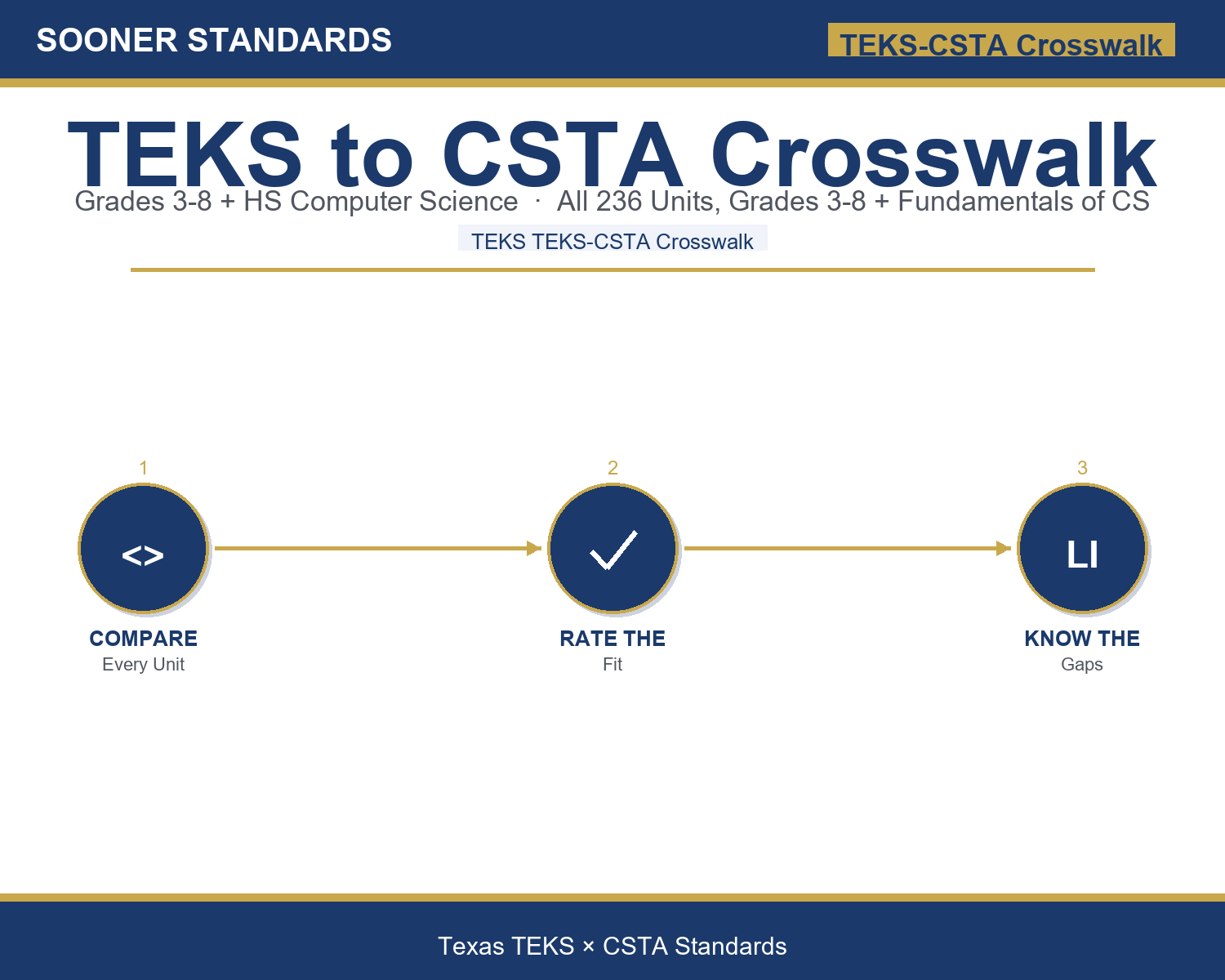
If you teach computer science in Texas, you've probably seen "aligned to national standards" claims on curriculum materials without much explanation of what that actually means. So we did the comparison for real: every one of the 236 Texas TEKS Computer Science / Technology Applications sub-points across Grades 3–8 and the high school Fundamentals of Computer Science course, checked individually against the CSTA K-12 Computer Science Standards (2017) — the standards framework published by the Computer Science Teachers Association and used as the reference point for most state CS standards nationwide.
The Headline Number
Across all 236 units:
- 24% (57 units) are a strong match — the same skill, at the same CSTA grade band.
- 15% (36 units) are a partial match — a related CSTA standard exists, but with different scope or depth.
- 11% (26 units) are a match at a different CSTA band — CSTA covers the exact skill, just one grade band earlier or later than Texas places it.
- 50% (117 units) have no CSTA equivalent at all.
That last number is the one worth sitting with. Half of what Texas asks computer science teachers to cover has no counterpart in the national framework — not because either framework is wrong, but because they're built for different purposes. TEKS blends true computer science with general "Technology Applications" skills; CSTA is scoped tightly to five computing concepts. Knowing exactly where those two things diverge is useful whether you're writing a program justification, building a curriculum map, or moving between a Texas district and a CSTA-aligned one.
Where the Two Frameworks Genuinely Overlap
The strongest, most consistent matches show up in a predictable place: core programming and computational-thinking skills.
- Decomposition — breaking a problem into subproblems — matches CSTA's decomposition standards at every grade band tested.
- Variables, loops, and conditionals — Texas's "building programs" standards at Grades 3–8 map cleanly onto CSTA's control-structure and variable standards.
- Debugging and testing — present and matched at nearly every grade.
- Cybersecurity basics — password practices and real-world cybersecurity threats match well from Grade 3 through Fundamentals of Computer Science.
- Data representation — Texas's Boolean, binary, and data-type standards at Grades 6–8 are close, sometimes exact, matches to CSTA's data-encoding standards.
Where the Two Frameworks Genuinely Diverge
Six findings stood out as we worked through all 236 comparisons:
1. Texas's "Practical Technology Concepts" strand has almost no CSTA counterpart, at any grade. Choosing the right app for a task, formatting a document, naming and organizing files, keyboarding technique, keyboard shortcuts — none of it appears in CSTA's five core concepts (Computing Systems, Networks, Data and Analysis, Algorithms and Programming, Impacts of Computing). This isn't a small gap: it's dozens of TEKS units, every single grade, with zero CSTA overlap.
2. CSTA drops "communicate data" and "digital etiquette" as explicit standards after grade 5. Both subconcepts exist in CSTA's elementary bands (K-2 and 3-5), but neither is restated at Level 2 (grades 6-8). Texas keeps teaching both skills every year regardless — meaning Texas's middle-school standards are, in a real sense, more explicit than CSTA's on these two topics.
3. CSTA's copyright and citation standards stop at grades 3-5. Once you get past CSTA's Level 1B band, there's no standard that names copyright, attribution, or citation again — not at Level 2 (6-8), not at Level 3A (9-10). Texas keeps teaching it explicitly all the way through Fundamentals of Computer Science, three grade bands after CSTA's only coverage of the topic.
4. "Cyberbullying" and "digital footprint" don't appear anywhere in CSTA's 2017 standards document. Texas names both terms explicitly, repeatedly, starting in Grade 3. CSTA's closest standards address online safety and cybersecurity in general terms, but never use either phrase.
5. CSTA's own standards have an internal testing gap. There's an explicit "test and debug" standard at the 1B band (grades 3-5) and another at Level 2 (grades 6-8) — but nothing explicit at Level 3A (grades 9-10). Texas's Fundamentals of Computer Science course still asks students to test their solutions; the nearest CSTA match is a standard written for two grade bands earlier.
6. Texas's Fundamentals of Computer Science course is really two courses in one. About a third of its 39 units are genuine 9th-10th-grade CS content (algorithms, binary conversion, security recommendations) that match CSTA's Level 3A standards well. The rest — resumes, certifications, interview skills, comparing university programs — is career-readiness content that sits entirely outside any computer-science-standards framework, CSTA included.
How the Comparison Was Done
Every TEKS sub-point was read against the full text of CSTA's 2017 standards for the appropriate grade band (Level 1B for grades 3-5, Level 2 for grades 6-8, Level 3A for the high school course). A match was only called "strong" when both standards covered the same skill at the same depth. Where the fit was real but partial, or where CSTA covered the same idea at a different band, that distinction is called out rather than smoothed over. Where nothing matched, the crosswalk says so — no standard gets force-fit to make the numbers look better.
Get the Full Crosswalk
The complete unit-by-unit table for all 236 units — TEKS locator, unit title, nearest CSTA code, fit rating, and a plain-English explanation for every single row — is available as a printable reference guide.
Get the Complete Texas TEKS to CSTA Crosswalk on Teachers Pay Teachers →
This is an independently produced correlation guide. CSTA standard codes are cited as identifiers only; this article and the accompanying product do not reproduce CSTA's copyrighted standard text (CSTA K-12 CS Standards, Revised 2017, are licensed CC BY-NC-SA 4.0). Full CSTA standard text is available free at csteachers.org/k12standards. This guide is not endorsed by CSTA, the Association for Computing Machinery, or the Texas Education Agency.