8th Grade Computer Science Curriculum: Every Texas TEKS §126.19 Standard, No Prep
8th Grade Computer Science Curriculum: Every Texas TEKS §126.19 Standard, No Prep
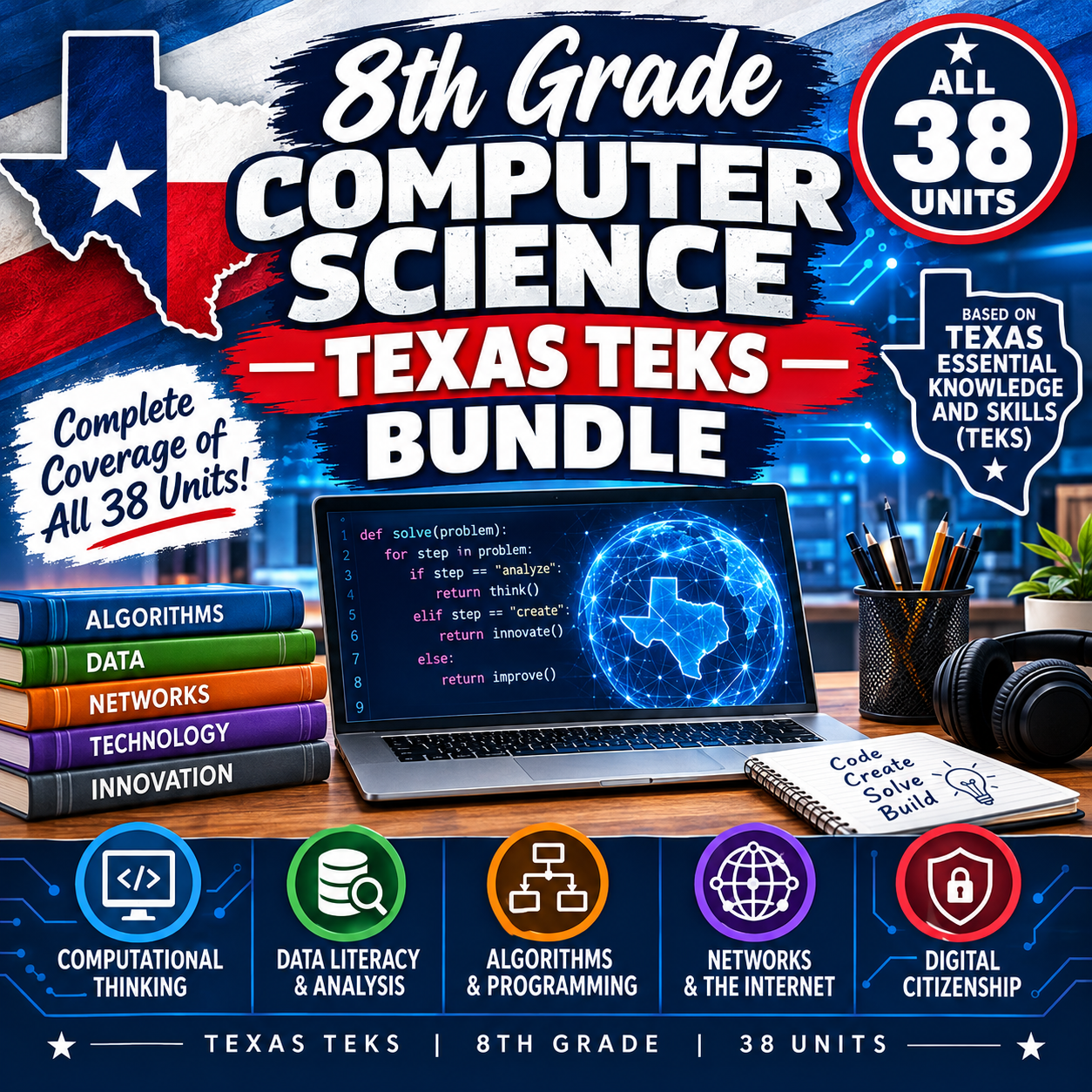
Teaching a full 8th grade computer science curriculum in Texas is a tall order — the TEKS §126.19 Technology Applications standards span twelve strands and 38 individual knowledge-and-skills statements, and few teachers have a single resource that covers all of them without stitching together products built for other states or simply reused from Grade 7. This bundle solves that: it is a complete, no-prep 8th grade computer science curriculum that covers every Texas TEKS §126.19 standard at grade 8, authored directly from Texas's own TEKS text, in a format you can print and teach.
What Texas's 8th Grade CS Standards Cover
Texas TEKS §126.19 spans twelve strands, and 8th grade raises the rigor in each one:
- Computational Thinking — Foundations — decomposing real-world problems and analyzing patterns using pseudocode, generalizing an algorithm through abstraction, designing a collaborative plan, developing and comparing algorithms, and applying iteration to tasks of unknown size and ongoing maintenance (§126.19(c)(1)(A)–(F)).
- Computational Thinking — Applications — constructing variables with multiple data types, using nested loops for pairwise comparisons, and modifying previously written code to improve an existing program (§126.19(c)(2)(A)–(C)).
- Creativity & Innovation — Design Process — demonstrating innovation through goal setting and risk-taking, evaluating design limitations and refining a prototype, and how design-process stakes differ across industries (§126.19(c)(3)(A)–(C)).
- Creativity & Innovation — Emerging Technologies — evaluating how technology has impacted areas of study, evaluating and predicting global technology trends, and transferring conceptual patterns to new tools (§126.19(c)(4)(A)–(C)).
- Data Literacy — Collect Data — comparing and contrasting data types and applying search strategies for a specified outcome (§126.19(c)(5)(A)–(B)).
- Data Literacy — Organize, Manage, Analyze — moving from data trends to an innovative product plan (§126.19(c)(6)).
- Data Literacy — Communicate & Publish — publishing data to persuade a real, intended audience (§126.19(c)(7)).
- Digital Citizenship — Social Interactions — analyzing how a digital footprint affects the future, publishing a formal communication for a global audience, and collaborating to publish video for a global audience (§126.19(c)(8)(A)–(C)).
- Digital Citizenship — Ethics & Laws — advocating for safe and ethical online behavior, adhering to intellectual property law when creating, citing AI-generated and remixed digital content, and evaluating bias in digital information sources (§126.19(c)(9)(A)–(D)).
- Digital Citizenship — Privacy, Safety & Security — analyzing scenarios to identify cybersecurity threats, and recognizing cyberbullying warning signs and their outcomes for both victim and bully (§126.19(c)(10)(A)–(B)).
- Practical Technology Concepts — Processes — combining file formats for a specific project or audience, and sharing files and seeking feedback across text, raster and vector graphics, video, and audio formats (§126.19(c)(11)(A)–(B)).
- Practical Technology Concepts — Skills & Tools — technology terminology in discussion and writing, independent file management, selecting platforms and tools to transfer data, keyboarding improvement goals, cross-application shortcuts, troubleshooting and seeking technical assistance, local and remote data storage, and integrating productivity tools into artifacts of increasing complexity (§126.19(c)(12)(A)–(H)).
Most "coding worksheet" packs only touch one or two strands. A real middle-school curriculum covers the whole picture — and that is exactly what this bundle does, with all 38 standards built as their own complete unit.
What's Inside the 8th Grade Texas Computer Science Bundle
Every standard in the bundle comes as its own complete, TEKS-aligned unit:
- No-prep lessons — teach real CS concepts without requiring a coding background or a full lab.
- A full content lesson for each standard, written for middle-school readers with built-in comprehension checkpoints.
- Activities — group and individual activities per unit, with all printable materials included.
- A 10-question assessment with answer key — six multiple choice, four true/false, plus two constructed-response prompts, tagged to the exact standard.
- Teacher guides — pacing, common misconceptions and how to fix them, discussion questions, and a 4-level standard mastery rubric.
- A crossword and word search, a Family Connection Letter, and a Certificate of Achievement for every unit.
- Standards-verification pages showing exactly where each unit sits in the Texas TEKS progression, citing the Grade 7 §126.18 statement immediately before it, where one exists.
Every TEKS citation in this bundle has been verified verbatim against the official 19 TAC Chapter 126 source document — no guessed citations, no content carried over from another state or grade. Where a Grade 8 statement repeats a Grade 7 statement word for word or nearly so (as happens with keyboarding speed and accuracy, application shortcuts, and combining productivity tools into artifacts of increasing complexity), the unit was still written with entirely fresh examples rather than reused content, so nothing in this bundle duplicates the Grade 7 bundle. The complete bundle totals 1,323 pages across 38 units.
Why It Works: Built on the Science of Learning
These are not busywork worksheets. Each unit is engineered with what cognitive science says actually makes learning stick: retrieval practice, spaced and interleaved review, and concrete-first instruction that turns abstract computer science ideas — algorithmic abstraction, evaluating design tradeoffs, digital ethics, cybersecurity reasoning — into something an eighth grader can reason about. Difficult middle-school CS concepts become approachable, and they last.
Authored From Texas's Own Standards — Not Adapted From Another State
Every unit is built directly from the Texas Essential Knowledge and Skills for Technology Applications (TEKS §126.19, 19 TAC Chapter 126, Subchapter B), with the standard text verified rather than paraphrased from memory or relabeled from another state's content. The materials are print-ready and LMS-ready, work fully offline, and collect no student data — so they fit a one-device classroom, a full lab, or a homeschool table equally well.
See the Bundle in Action
Get the Complete 8th Grade Texas CS Curriculum Bundle
Skip months of lesson-building and cover your entire year of Texas 8th grade Technology Applications with one no-prep resource — all 38 standards, all twelve strands, 1,323 pages.
Get the 8th Grade Computer Science Curriculum Bundle on Teachers Pay Teachers →
Every Sooner Standards resource is built directly from the official state standards document — standard text verified, never paraphrased from memory. Aligned to the Texas Essential Knowledge and Skills for Technology Applications (TEKS §126.19); not a state-adopted or state-approved curriculum.