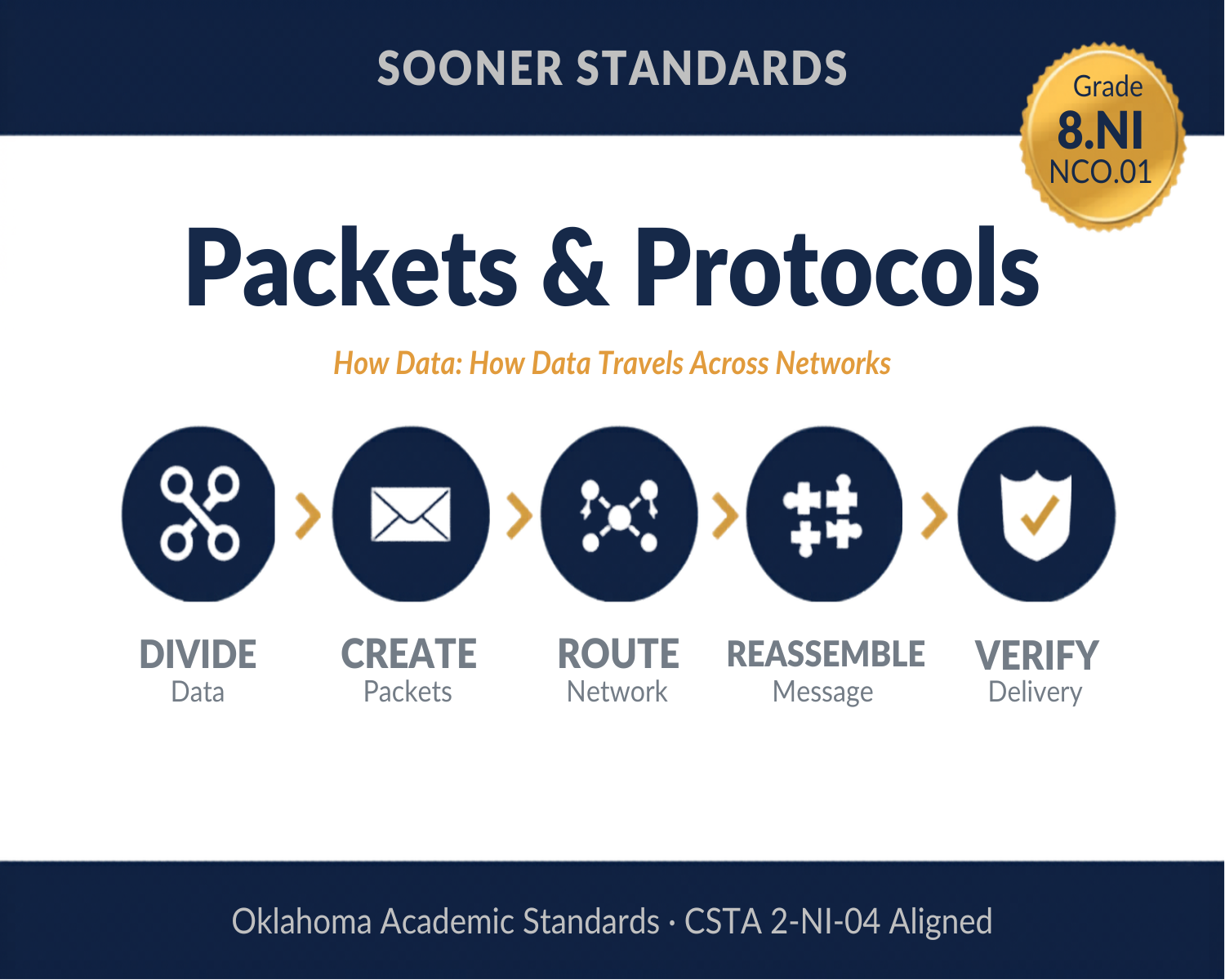
Packets and Protocols: How Data Travels Across Networks
Teaching Packets and Protocols in Grade 8: Oklahoma Standard 8.NI.NCO.01
Every time a message is sent, a webpage loads, or an assignment is submitted online, data travels across a complex web of cables, routers, and wireless signals — and it almost always arrives correctly, in full, and within fractions of a second. Oklahoma's standard 8.NI.NCO.01 asks eighth graders to understand why that reliability isn't accidental: explaining protocols and their importance to data transmission, and modeling how packets are broken down into smaller pieces and delivered. This post walks through what the standard means, the vocabulary students need, and a few discussion starters you can use tomorrow.
What Does Standard 8.NI.NCO.01 Actually Ask?
Explain protocols and their importance to data transmission; model how packets are broken down into smaller pieces and how they are delivered. — Oklahoma Academic Standards for Computer Science (February 2023)
In plain language: students need to understand that data doesn't travel across the internet in one piece — it's broken into packets, each one addressed and routed independently, then reassembled correctly at its destination, all governed by agreed-upon rules called protocols.
Key Vocabulary Students Will Learn
Packet, Protocol, Router, Switching, Bandwidth, Latency, Header, Payload, Reassembly, Checksum, Handshake, Transmission, Network, Sequence, Destination
These fifteen terms describe the actual mechanics of how the internet moves information — vocabulary students will recognize the moment they start reading about network speed, buffering, or connection issues.
What's Inside the Lesson
The content reading opens with the everyday reliability students already take for granted — sending a message, loading a webpage, submitting an assignment — and points out that this reliability is the result of carefully designed systems called protocols that govern how data is packaged, addressed, transmitted, checked for errors, and reconstructed at the other end. The reading builds toward the core mechanism: breaking data into packets, each traveling independently, rather than sending everything as one enormous, fragile transmission.
Discussion Starters You Can Use Tomorrow
- Why might breaking a large file into smaller packets make it more reliable to send than sending it all as one piece?
- If a packet gets lost or damaged on its way, what do you think needs to happen for the message to still arrive correctly?
- Why do you think all devices on a network need to follow the same protocol to communicate with each other?
Where This Leads
Students who understand packets and protocols are building literacy for the invisible infrastructure behind everything they do online — the reason a video call, an online game, and a text message can all travel across the same networks reliably at the same time.
See the Unit in Action
Get the Complete 8.NI.NCO.01 Unit
I built a complete, no-prep unit for this standard — Packets and Protocols: How Data Travels Across Networks — across 28 ready-to-print pages:
- Vocabulary reference — all 15 terms with definitions and real-world examples
- Full content reading with embedded comprehension checkpoints
- 10-question assessment (6 multiple choice, 4 true/false) with a complete answer key and explanations
- Group activity — "Packet Relay Simulation"
- Individual activity — "Network Path Analysis"
- Crossword and word search built from all 15 vocabulary terms (with answer keys)
- Standards alignment verification page
- Packet Structure Diagram (separate printable)
- Protocol Reference Card (separate printable)
Get Packets and Protocols on Teachers Pay Teachers →
Every Sooner Standards resource is built directly from the official Oklahoma Academic Standards for Computer Science (February 2023) — standard text verified, never paraphrased from memory.