Collecting and Transforming Data: Using Computational Tools for Reliable Analysis
Teaching Collecting and Transforming Data in Grade 8: Oklahoma Standard 8.DA.CVT.01
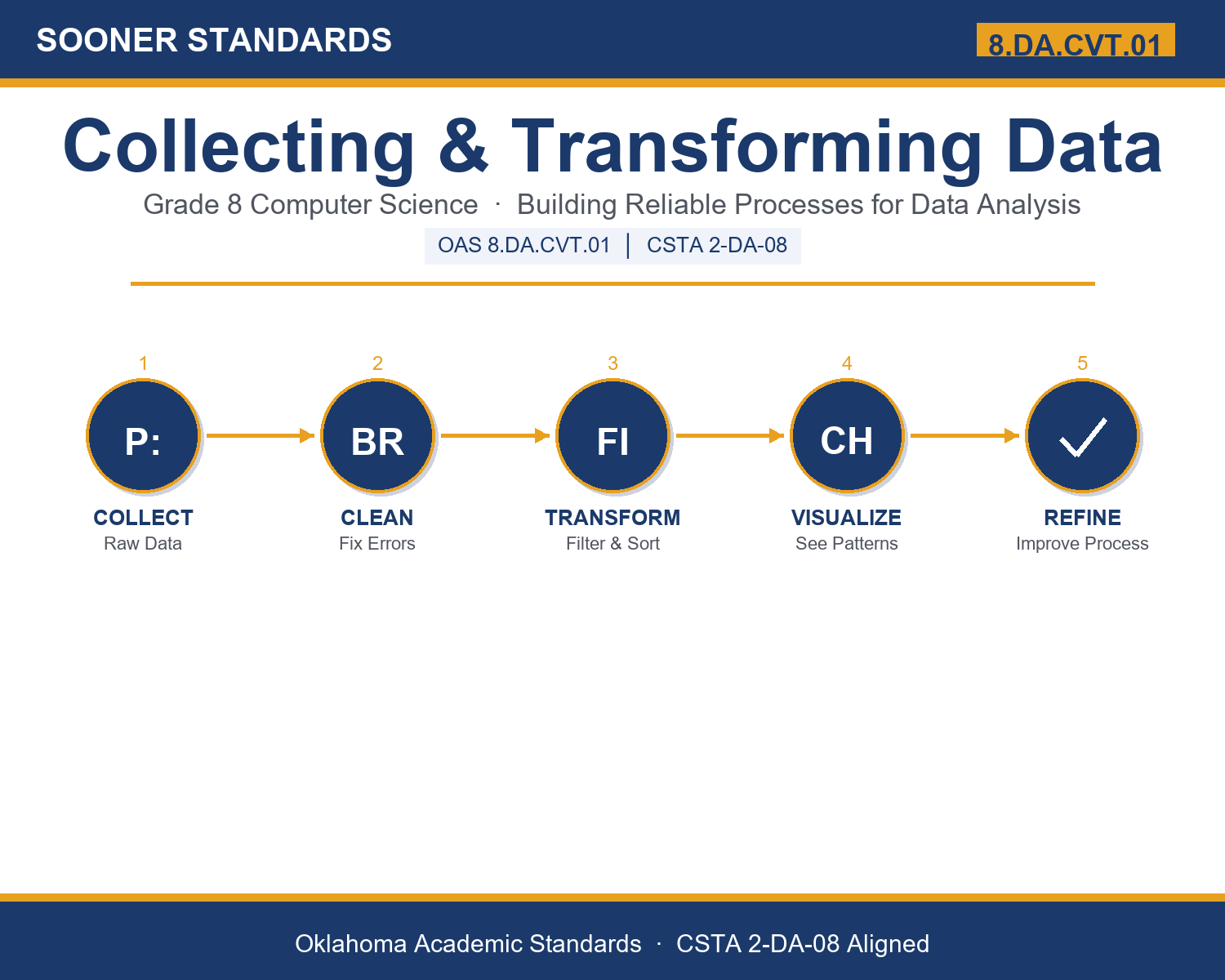
Raw data — from a class survey, a weather station, a fitness tracker, or a social media post — is almost never ready to use as-is. Oklahoma's standard 8.DA.CVT.01 asks eighth graders to build the process that closes that gap: developing, implementing, and refining a process that uses computational tools to collect and transform data so it's more useful and reliable. This post walks through what the standard means, the vocabulary students need, and a few discussion starters you can use tomorrow.
What Does Standard 8.DA.CVT.01 Actually Ask?
Develop, implement, and refine a process that utilizes computational tools to collect and transform data to make it more useful and reliable. — Oklahoma Academic Standards for Computer Science (February 2023)
In plain language: students need to be able to gather real data, clean up the messy parts (errors, wrong formats, irrelevant records), and reshape it into something a person can actually draw conclusions from.
Key Vocabulary Students Will Learn
Data Collection, Data Transformation, Spreadsheet, Data Visualization, Filtering, Sorting, Outlier, Mean, Database, Query, Data Cleaning, Reliability, Trend, Survey, Data Pipeline
These fifteen terms move through the full lifecycle of data — from first collecting it, through cleaning and transforming it, to visualizing what it actually shows.
What's Inside the Lesson
The content reading opens with a relatable observation: data is everywhere — class surveys, weather readings, fitness logs, attendance records, social media likes — but raw data collected from the real world is almost never ready to use as-is. It contains errors, inconsistencies, and irrelevant records; it may be in the wrong format or units; and it's often too large and unstructured for a person to draw conclusions from directly. The reading frames data collection and transformation as the process that turns that mess into something reliable.
Discussion Starters You Can Use Tomorrow
- If you collected survey data from your class, what kinds of errors or inconsistencies might show up in the responses?
- Why might sorting and filtering data change what conclusions you're able to draw from it?
- What's the difference between data that's simply large and data that's actually useful?
Where This Leads
Students who can collect and transform data reliably are building a skill used across nearly every modern field — from science and business to sports analytics and public health — the ability to turn messy real-world information into something trustworthy enough to act on.
See the Unit in Action
Get the Complete 8.DA.CVT.01 Unit
I built a complete, no-prep unit for this standard — Collecting and Transforming Data: Using Computational Tools for Reliable Analysis — across 27 ready-to-print pages:
- Vocabulary reference — all 15 terms with definitions and real-world examples
- Full content reading with embedded comprehension checkpoints
- 10-question assessment (6 multiple choice, 4 true/false) with a complete answer key and explanations
- Group activity — "Design, Collect, Clean, and Visualize"
- Individual activity — "Data Pipeline Analysis and Improvement"
- Crossword and word search built from all 15 vocabulary terms (with answer keys)
- Standards alignment verification page
- Data Collection & Transformation Reference (separate printable)
- Data Pipeline Practice (separate printable)
Get Collecting and Transforming Data on Teachers Pay Teachers →
Every Sooner Standards resource is built directly from the official Oklahoma Academic Standards for Computer Science (February 2023) — standard text verified, never paraphrased from memory.