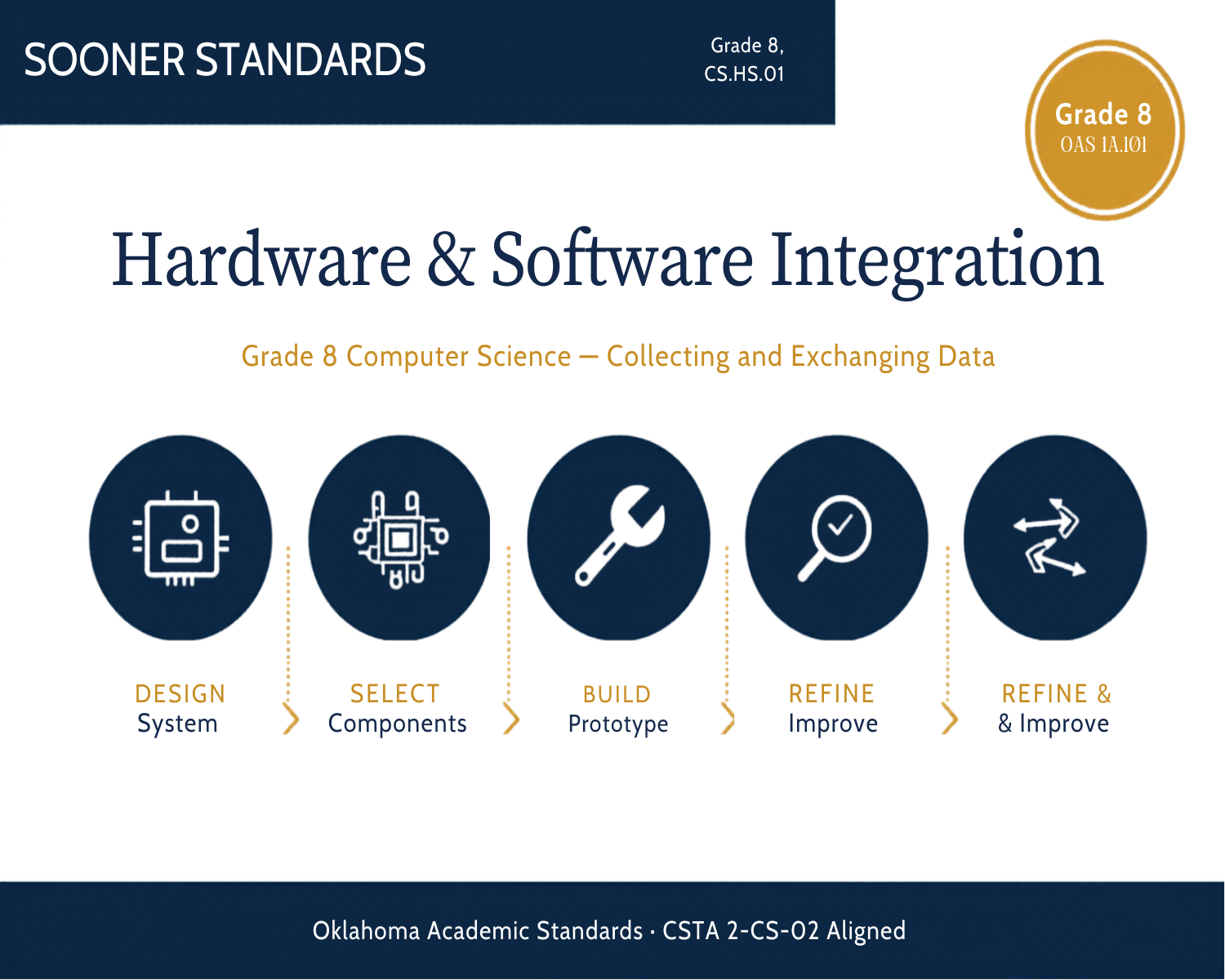
Hardware and Software Integration: Designing Systems That Collect and Exchange Data
Teaching Hardware and Software Integration in Grade 8: Oklahoma Standard 8.CS.HS.01
Every time a phone checks the weather, a smart scale reports a reading, or a security camera streams video, hardware and software are working together to collect and exchange data. Oklahoma's standard 8.CS.HS.01 asks eighth graders to design and refine that kind of system themselves — projects that combine hardware and software components to collect and exchange data. This post walks through what the standard means, the vocabulary students need, and a few discussion starters you can use tomorrow.
What Does Standard 8.CS.HS.01 Actually Ask?
Design and refine projects that combine hardware and software components to collect and exchange data. — Oklahoma Academic Standards for Computer Science (February 2023)
In plain language: students need to understand how the physical parts of a device (sensors, chips, wires) work together with the code that tells those parts what to do — and be able to design and improve a system where the two are integrated.
Key Vocabulary Students Will Learn
Hardware, Software, Sensor, Firmware, Microcontroller, Actuator, Protocol, Dataflow, Latency, Bandwidth, Integration, Debugging, Iteration, Prototype, Exchange
These terms cover both sides of the integration this standard is built around — the physical (hardware, sensor, microcontroller) and the logical (software, dataflow, protocol).
What's Inside the Lesson
The content reading opens with everyday examples students already recognize — checking the weather on a phone, stepping on a smart scale, watching a security camera feed — and uses them to define hardware as the physical components of a system (chips, sensors, wires, circuit boards) and software as the programs and coded instructions that tell those components what to do and when. The reading builds toward the central idea: real systems only work when hardware and software are designed to work together.
Discussion Starters You Can Use Tomorrow
- Think of a smart device you've used — what hardware components does it likely have, and what is the software probably telling those components to do?
- Why might a sensor collecting data be useless without software to interpret that data?
- If you were designing a system that combines hardware and software, what's one thing that could go wrong at the point where they connect?
Where This Leads
Students who can design systems that integrate hardware and software are building the exact skill behind the Internet of Things, wearable technology, and robotics — fields where physical components and code have to work together seamlessly.
See the Unit in Action
Get the Complete 8.CS.HS.01 Unit
I built a complete, no-prep unit for this standard — Hardware and Software Integration: Designing Systems That Collect and Exchange Data — across 26 ready-to-print pages:
- Vocabulary reference — all 15 terms with definitions and real-world examples
- Full content reading with embedded comprehension checkpoints
- 10-question assessment (6 multiple choice, 4 true/false) with a complete answer key and explanations
- Group activity — "Smart System Design Challenge"
- Individual activity — "System Refinement Proposal"
- Crossword and word search built from all 15 vocabulary terms (with answer keys)
- Standards alignment verification page
- System Design Rubric (separate printable)
- System Planning Worksheet (separate printable)
Get Hardware and Software Integration on Teachers Pay Teachers →
Every Sooner Standards resource is built directly from the official Oklahoma Academic Standards for Computer Science (February 2023) — standard text verified, never paraphrased from memory.