Collaborative Refinement: Feedback, Iteration, and User-Centered Design
Teaching Collaborative Refinement in Grade 8: Oklahoma Standard 8.AP.PD.01
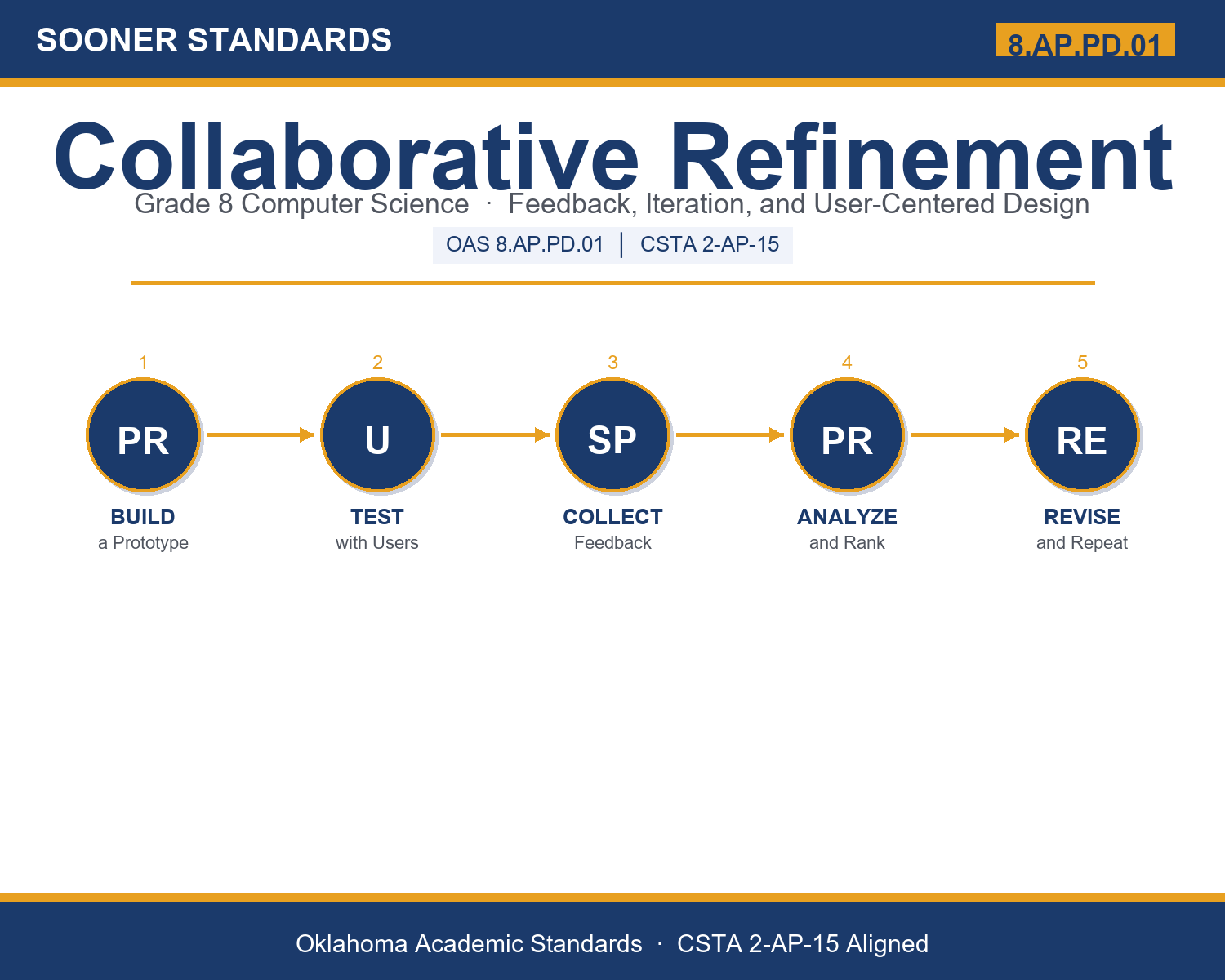
Even experienced programmers rarely get a solution right on the first try. Oklahoma's standard 8.AP.PD.01 asks eighth graders to build that reality into their process from the start: seeking and incorporating feedback from team members and users to refine a solution that actually meets the needs of the people using it. This post walks through what the standard means, the vocabulary students need, and a few discussion starters you can use tomorrow.
What Does Standard 8.AP.PD.01 Actually Ask?
Seek and incorporate feedback from team members and users to refine a solution to a problem that meets the needs of different users. — Oklahoma Academic Standards for Computer Science (February 2023)
In plain language: students need to treat their first version of a program as a starting point, not a finished product — actively gathering feedback from the people who will use it, and using that feedback to make real, targeted improvements.
Key Vocabulary Students Will Learn
Feedback, Iteration, Prototype, Usability, Stakeholder, Revision, Criteria, Evaluation, Collaboration, Refinement, Specification, Constraint, Validation
These are the working words of user-centered design — the vocabulary that shows up any time a team is deciding whether a solution is actually good, not just whether it technically works.
What's Inside the Lesson
The content reading opens with a candid observation: designing a program or any technology solution is rarely a one-shot process, even for the most experienced programmers and engineers. First versions almost always need improvement before they truly meet user needs. Collaborative refinement is presented as the practice that closes that gap — seeking feedback from team members and actual users, then systematically improving the solution based on what they say.
The reading frames this as an acknowledgment, not a weakness: no single developer can anticipate every need or perspective of the people who will eventually use what they build.
Discussion Starters You Can Use Tomorrow
- Why might a program work perfectly for the person who built it, but confuse someone else using it for the first time?
- What's the difference between feedback that's just an opinion and feedback that points to a real, fixable problem?
- If two team members give you conflicting feedback, how would you decide which change to make first?
Where This Leads
Students who can seek out and act on feedback are building the exact skill that separates good developers from great ones — the humility and process to treat "working" as the starting point, not the finish line.
See the Unit in Action
Get the Complete 8.AP.PD.01 Unit
I built a complete, no-prep unit for this standard — Collaborative Refinement: Feedback, Iteration, and User-Centered Design — across 21 ready-to-print pages:
- Vocabulary reference — all 13 terms with definitions and real-world examples
- Full content reading with embedded comprehension checkpoints
- 10-question assessment (6 multiple choice, 4 true/false) with a complete answer key and explanations
- Group activity — "Prototype and Refine Challenge"
- Individual activity — "Feedback Analysis and Revision Planning"
- Crossword and word search built from all 13 vocabulary terms (with answer keys)
- Standards alignment verification page
- Feedback Worksheet (separate printable)
- Process Guide (separate printable)
Get Collaborative Refinement on Teachers Pay Teachers →
Every Sooner Standards resource is built directly from the official Oklahoma Academic Standards for Computer Science (February 2023) — standard text verified, never paraphrased from memory.