Teaching How Much Data? Data and Accurate Conclusions in Grade 5: Oklahoma Standard 5.DA.IM.01
Teaching How Much Data? Data and Accurate Conclusions in Grade 5: Oklahoma Standard 5.DA.IM.01
Teaching data accuracy in grade 5 does not have to be complicated. Picture a scientist repeating an experiment many times before trusting a result. That kind of thinking is exactly what Oklahoma's grade 5 computer science standard 5.DA.IM.01 asks students to practice — and it is very teachable with the right materials. This post walks through what the standard means, the misconceptions students bring to it, and discussion starters you can use tomorrow, whether you teach in a classroom or at your kitchen table.
What Does Standard 5.DA.IM.01 Actually Ask?
Determine how the accuracy of conclusions is influenced by the amount of data collected. — Oklahoma Academic Standards for Computer Science (February 2023)
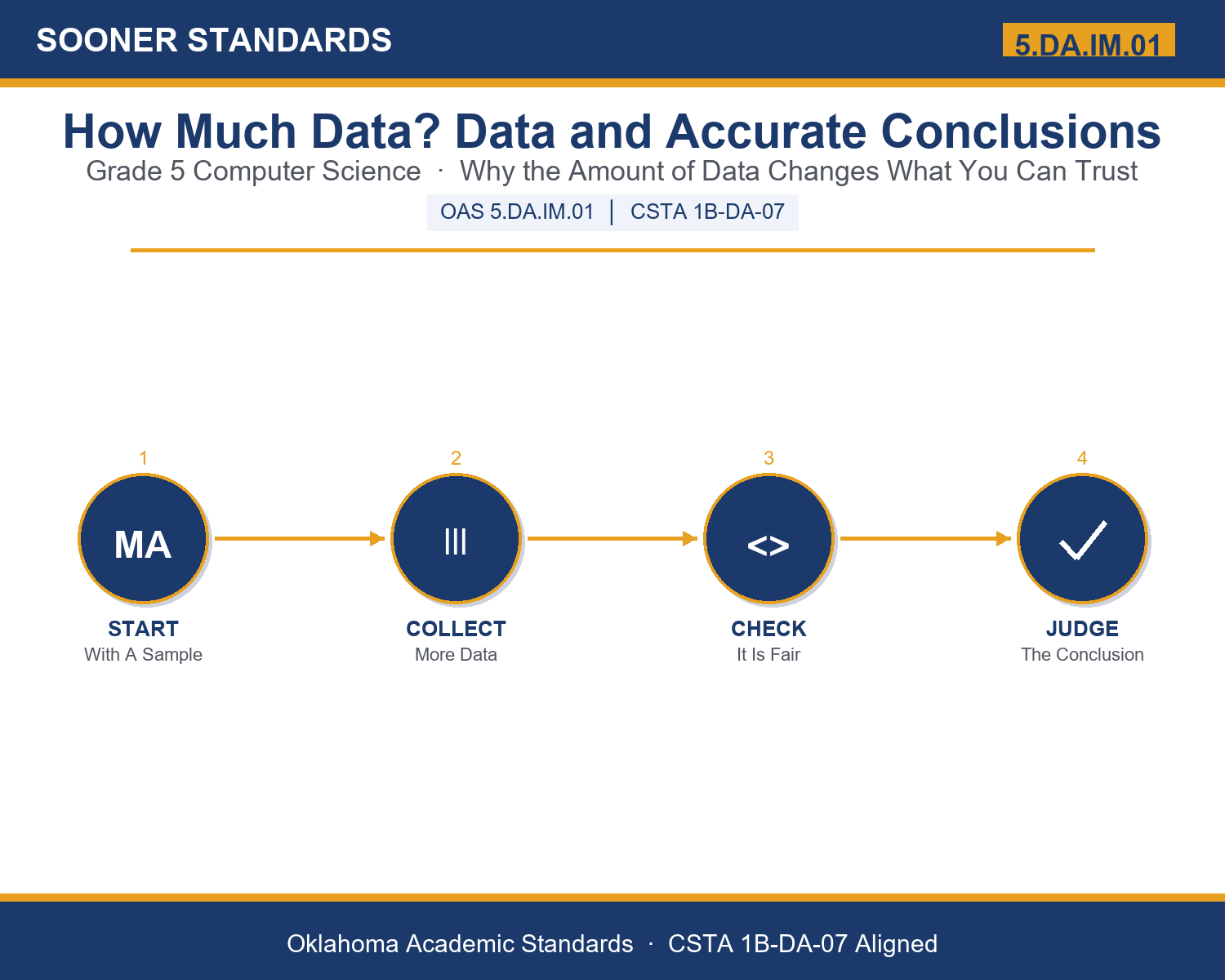
In plain language: Oklahoma's standard asks fifth graders to figure out how the accuracy of a conclusion depends on how much data was collected, learning that small amounts of data can be misleading while more, fair data leads closer to the truth.
In student-friendly terms, the learning target is: "I can determine how the amount of data collected affects the accuracy and reliability of a conclusion."
What Students Should Be Able to Do
- I can explain why a small amount of data can lead to a misleading conclusion.
- I can explain how collecting more trustworthy data makes a conclusion more accurate.
- I can describe how a single outlier affects small and large samples differently.
- I can judge a conclusion by asking whether there was enough data and whether it was fair.
Along the way, students pick up the working vocabulary of the topic: data, sample, survey, test, large, fair, reliable, evidence, pattern, small, average, outlier, trend.
Data Accuracy: Misconceptions to Watch For
These are the wrong turns students reliably take with this standard — knowing them ahead of time is half the lesson plan. Each correction strategy below comes straight from the unit's teacher guide (the paragraph and activity references point into the unit itself).
1. "If something happened a few times in a row, it must be a real pattern."
Use paragraph 3 and a live coin demo. Small numbers bounce around; three heads in a row is common with a fair coin. A real pattern needs a large amount of data to confirm.
2. "More data is the only thing that matters for a good conclusion."
Use paragraph 7. Show the soccer-game survey example. A large but unfair (biased) sample is still weak; data must be both large and fair.
3. "One strange result (an outlier) should change the whole conclusion."
Use paragraph 5. Compare the effect of one tall plant on a sample of 5 versus 100. More data shrinks an outlier's power; investigate outliers, do not let them rule.
4. "A conclusion is true as soon as you find any data that agrees with it."
Use paragraphs 6 and 8. Ask whether more data might change the answer and whether the result repeats. Cherry-picking a little agreeing data is not the same as a reliable conclusion.
Discussion Starters You Can Use Tomorrow
- Have you ever believed something after seeing it happen just once or twice, then found out you were wrong?
- How many people do you think we would need to survey to fairly know our whole school's favorite lunch? Why?
- Why do scientists repeat experiments many times instead of trusting a single result?
Bringing It Home
This topic is a natural one for families. One ten-minute activity to try: Together, flip a coin 5 times and write down the results, then flip it 30 more times. Talk about how the results after 5 flips compared to the results after many flips, and which felt closer to a fair coin. Then look for a claim on TV or a package that uses a number, and ask your child how much data they think is behind it.
Where This Leads
Students who can determine how the amount of data collected affects the accuracy and reliability of a conclusion are building skills used every day in data science, scientific research, public opinion polling, medicine, and weather forecasting.
Part of the Complete Grade 5 Computer Science Curriculum
This lesson covers just one standard. It is part of a complete grade 5 computer science curriculum aligned to every Oklahoma OAS CS standard. See the full listing — every standard, organized by strand — here: Grade 5 Computer Science Curriculum: Every Oklahoma OAS CS Standard.
See the Unit in Action
Get the Complete 5.DA.IM.01 Unit
I built a complete, no-prep unit for this standard — How Much Data? The Amount of Data and the Accuracy of Conclusions — covering 3-4 days of instruction across 39 pages:
- Teacher guide — day-by-day pacing, misconceptions to watch for, discussion questions, differentiation for support / ELL / extension, and a 4-point rubric
- Student learning target page — a kid-friendly "I can" statement with success criteria
- Full content lesson with 3 embedded "Check Your Understanding" checkpoints
- 12-question assessment (6 multiple choice, 4 true/false, 2 short answer) with a complete answer key, explanations, and exemplar responses
- Group activity — "Small Sample vs. Large Sample: Test It!" (25-30 minutes)
- Individual activity — "How Much Data? Trust the Conclusion" (15-20 minutes)
- Crossword and word search built from all 13 vocabulary terms (with answer keys)
- Family connection letter — a plain-language page for parents, with dinner-table questions and a 10-minute home activity
- Certificate of achievement — ready to sign and send home
- Test It! Small Sample vs. Large Sample Recording Sheet (separate printable, 1 page)
- Data & Accuracy Reference Notes (separate printable, 1 page)
- How Much Data? Trust the Conclusion (separate printable, 2 pages)
Get How Much Data? Data and Accurate Conclusions on Teachers Pay Teachers →
Also aligned to CSTA 1B-DA-07: Use data to highlight or propose cause-and-effect relationships, predict outcomes, or communicate an idea.
Every Sooner Standards resource is built directly from the official Oklahoma Academic Standards for Computer Science (February 2023) — standard text verified, never paraphrased from memory.