Unmasking Bias: How AI Systems Interpret Data and the Importance of Algorithmic Fairness
Want a free Oklahoma CS lesson?
—
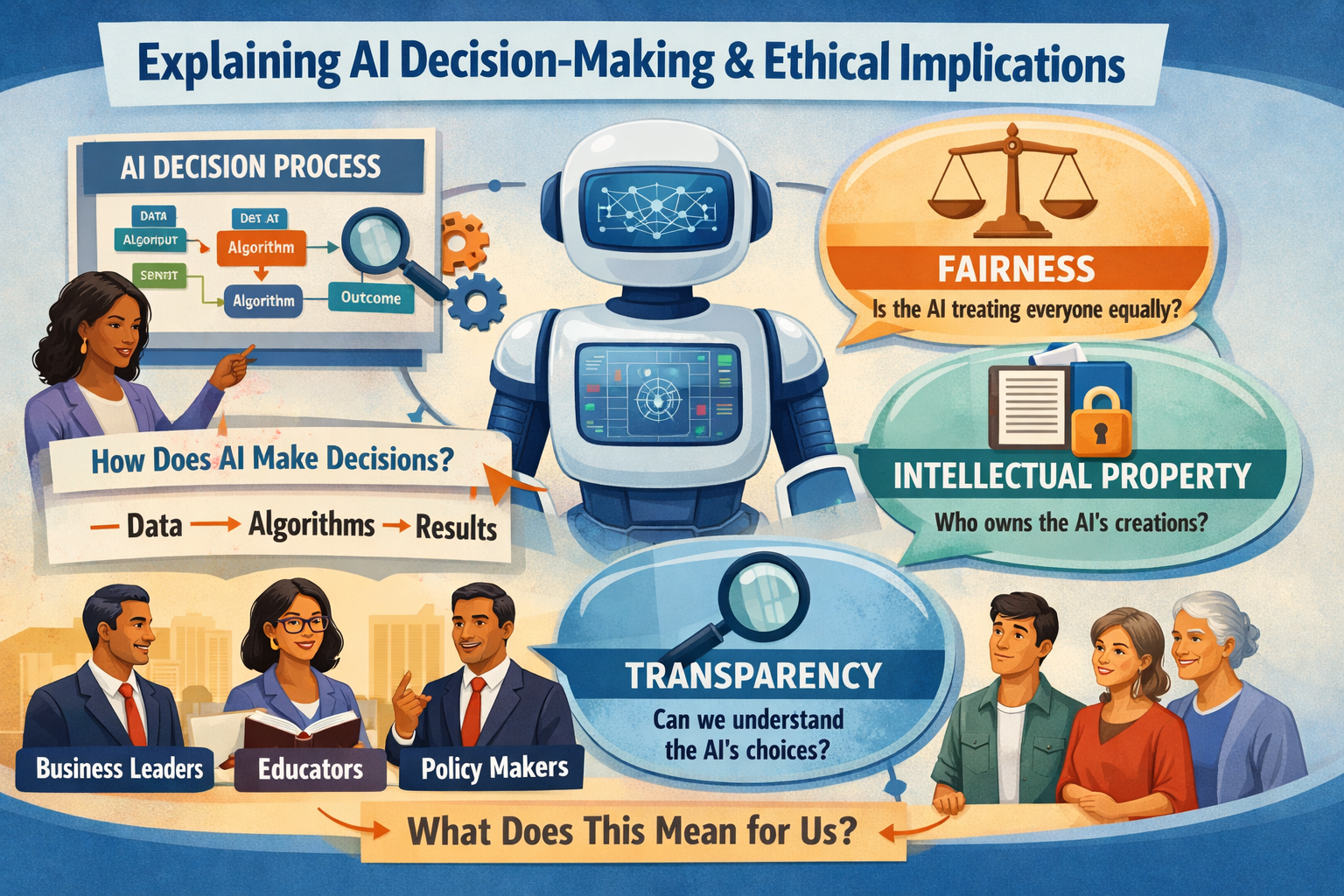
Artificial Intelligence (AI) is rapidly permeating nearly every aspect of modern life, from the recommendations we receive on streaming services to the decisions made about loan applications and even criminal justice sentencing. At its core, AI relies on systems that can represent and reason with data, but this data isn’t always neutral; it’s often imbued with human biases that can be amplified by algorithms. Understanding how AI systems process different data modalities – text, images, audio, and video – is crucial to identifying and mitigating these biases, ensuring fairer outcomes for everyone impacted by these increasingly powerful technologies. The Oklahoma Academic Standard L1.ET.AI.06 specifically asks students to analyze how AI systems represent and reason with these diverse data types, laying the foundation for critical thinking about the implications of AI in our world. This analysis is becoming ever more important as we rely on AI to make decisions that impact our daily lives, requiring a deeper understanding of its strengths and weaknesses.
The way an AI system “sees” text differs significantly from how it “sees” an image or hears audio; each modality requires unique processing techniques. For textual data, AI often utilizes Natural Language Processing (NLP) which breaks down language into smaller components to understand meaning, sentiment, and relationships between words. This can involve techniques like tokenization, stemming, and parsing, allowing the AI to identify patterns and draw inferences from written content. However, even in text analysis, bias can creep in – consider training data predominantly sourced from one demographic or genre; this can lead to an AI that struggles with dialects or nuances outside of its primary dataset. The quality and diversity of the textual data used to train these systems are paramount for accurate representation and reasoning, ensuring it doesn’t perpetuate existing societal biases within language itself.
Images present a different set of challenges for AI, relying heavily on Computer Vision techniques like Convolutional Neural Networks (CNNs). These networks analyze images by identifying patterns in pixels, learning to recognize objects, faces, and scenes. While seemingly objective, image recognition can be surprisingly susceptible to bias; studies have shown that facial recognition systems often perform less accurately on people of color, particularly women, due to a lack of diverse representation in the training data. This isn’t necessarily about the AI being “racist,” but rather reflecting the biases present within the images it was trained on – if an algorithm primarily sees white faces, it will be better at recognizing them. Therefore, careful consideration must be given to the composition and diversity of image datasets used for training these systems, ensuring they accurately represent the world we live in.
Audio data is processed by AI through techniques like speech recognition and audio classification, often utilizing WaveNet or similar architectures. These systems convert sound waves into digital representations that can be analyzed for patterns and meaning. Similar to images, bias can arise from the source of the audio – accents, background noise, and even the speaker’s gender can influence accuracy. For example, early speech recognition software often struggled with female voices compared to male voices, due in part to a training dataset dominated by male speakers. This highlights the importance of diverse audio datasets that capture a wide range of vocal characteristics and acoustic environments, ensuring AI systems can accurately interpret sound regardless of who or where it originates from.
Video data combines the complexities of both images and audio, requiring AI systems to process visual information alongside auditory cues. This often involves combining Computer Vision techniques with speech recognition and Natural Language Processing to understand events unfolding within a video clip. Bias in video analysis can stem from multiple sources – biased image recognition, skewed audio interpretation, or even how the video itself was filmed (lighting, camera angle, subject representation). Consider an AI system trained to identify “professional” settings; if most of its training videos depict white-collar offices, it might struggle to recognize a professional setting in a different context, like a construction site or a farm. The more complex the data modality, the more opportunities for bias to creep into the analysis process.
Fortunately, resources are available to help students and educators delve deeper into these concepts. The High School Computer Science: Algorithmic Bias Detection Unit – L2.ET.AI.06 from Teachers Pay Teachers (Resource) provides a comprehensive exploration of algorithmic bias, offering activities and assessments designed to help students understand how biases are introduced into AI systems and how they can be detected. This unit directly supports the Oklahoma Academic Standard L2.ET.AI.06, building upon the foundational understanding established by L1.ET.AI.06, allowing students to move beyond simply identifying data modalities to actively investigating bias within them. It’s a practical resource for bringing real-world examples of algorithmic bias into the classroom and empowering students to become critical consumers of AI technology.
Ultimately, analyzing how AI systems represent and reason with different data modalities is not just about technical proficiency; it’s about fostering fairness and equity in an increasingly AI-driven world. By understanding the potential sources of bias within each modality – text, images, audio, and video – we can develop strategies to mitigate these biases and ensure that AI benefits all members of society. The ability to critically evaluate AI systems and their outputs is becoming a fundamental skill for students entering the 21st-century workforce, preparing them to navigate a world where algorithms play an ever-increasing role in shaping our lives. This requires ongoing investigation, diverse datasets, and a commitment to building more inclusive and representative AI systems that reflect the richness of human experience.
For a full resource on all Oklahoma Academic Standards involving AI: Resource [ Resource ]
info